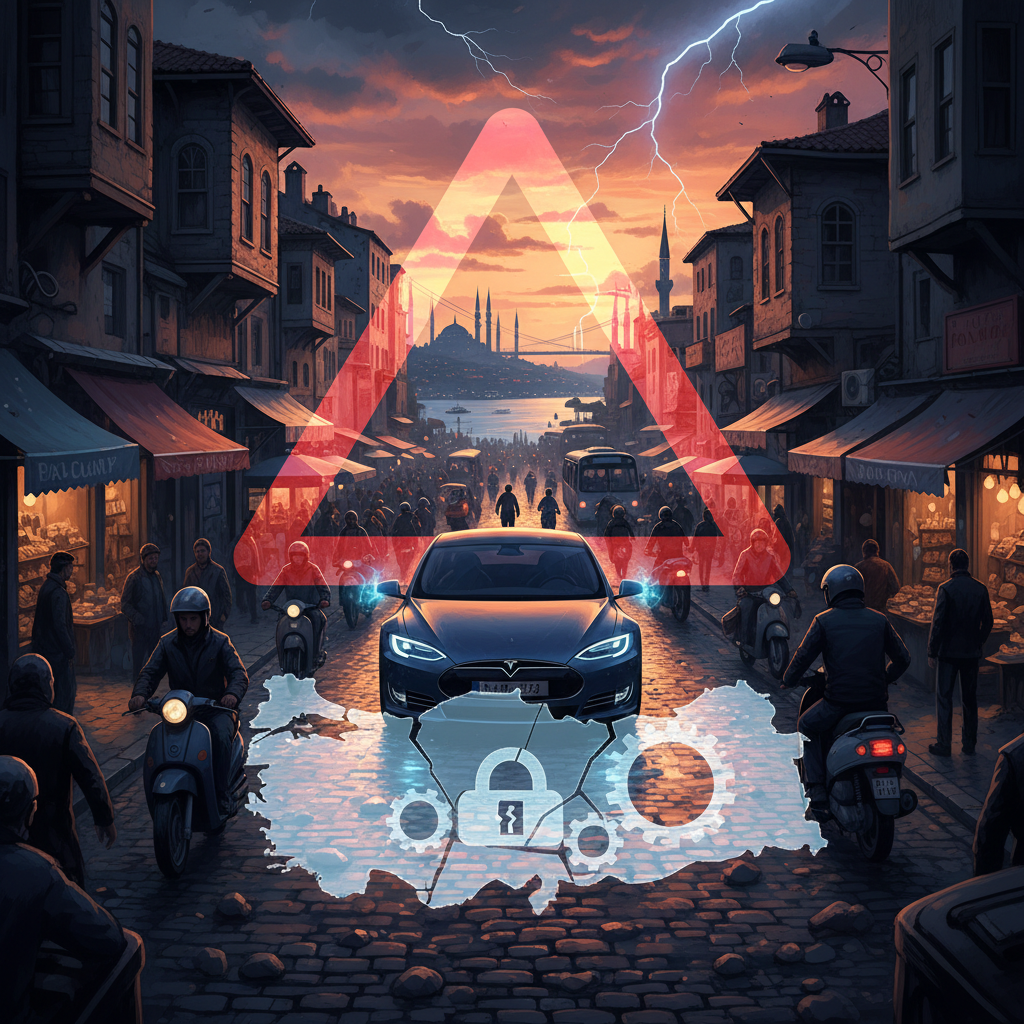
The Bosphorus is a waterway of constant motion, a chaotic ballet of ferries, tankers, and fishing boats, each navigating currents and fellow travelers with an almost intuitive understanding. It is a perfect metaphor, I often think, for the complex dance of innovation and regulation in the age of artificial intelligence. Right now, nowhere is this dance more fraught with peril and promise than in the realm of autonomous vehicles, particularly with Elon Musk's ambitious, and often controversial, Full Self-Driving (FSD) technology from Tesla.
Musk, ever the provocateur, has long championed FSD as the future of transportation, a system that will eliminate accidents, reduce congestion, and revolutionize our daily lives. He speaks of millions of robotaxis, a vision of urban mobility that feels lifted from a science fiction novel. But here, on the ground, in the bustling streets of Istanbul, Ankara, or Izmir, that future feels distant, almost alien. The reality is that FSD, despite its name, is not truly 'full self-driving' in the traditional sense. It is an advanced driver assistance system, one that still requires human supervision, and its deployment has been marked by a deeply unsettling series of incidents and a fierce regulatory tug-of-war.
Let us not mince words: the risk scenario is clear and present. We are talking about machines making life or death decisions on our roads. The promise of fewer accidents is compelling, but the reality of current FSD capabilities has led to documented crashes, some resulting in fatalities. These incidents, often involving the vehicle failing to perceive obstacles, misinterpreting road signs, or making unexpected maneuvers, highlight the chasm between marketing hype and engineering reality. The National Highway Traffic Safety Administration (nhtsa) in the United States has launched multiple investigations into Tesla's FSD system, scrutinizing its safety performance and the company's claims. These investigations are not mere bureaucratic hurdles; they are critical inquiries into the very fabric of public safety.
Technically, Tesla's FSD relies heavily on a vision-only system, using an array of cameras around the vehicle to perceive its surroundings. Unlike some competitors that integrate radar or lidar, Tesla has opted for a camera-centric approach, arguing that the human brain also primarily relies on vision. This approach processes visual data through deep neural networks to identify lanes, other vehicles, pedestrians, traffic lights, and potential hazards. The system then plans a path and executes driving maneuvers. The challenge, and where the system often falters, lies in the sheer complexity and variability of real-world driving environments. Edge cases, those unusual or unpredictable situations, are notoriously difficult for AI models to handle, especially when relying solely on visual input which can be affected by weather, lighting, or unusual objects. A sudden downpour, a poorly marked construction zone, or a child darting out from behind a parked car can present scenarios that even the most advanced vision systems struggle to interpret flawlessly.
Experts are deeply divided on the path forward. On one side, you have the ardent proponents, often within Tesla itself and its most loyal customer base, who argue that the data collected from millions of miles driven by FSD users is rapidly improving the system. They believe that with enough data and iterative updates, FSD will eventually surpass human driving capabilities. "The data loop is critical," stated Andrej Karpathy, a former head of AI at Tesla, in a past interview. "Every mile driven provides valuable training data that makes the system safer." This perspective often emphasizes the long-term statistical benefits, suggesting that even with initial incidents, the overall safety improvement will be significant.
On the other side, a chorus of safety advocates, researchers, and some regulatory bodies express profound skepticism. They point to the 'human in the loop' problem, where drivers become complacent and over-reliant on the system, failing to intervene when necessary. "The current naming of 'Full Self-Driving' is misleading and dangerous," argued Missy Cummings, a professor of computer science at George Mason University and a former Nhtsa safety adviser, in a recent public statement. "It instills a false sense of security and absolves the driver of responsibility, which is simply not the case with current technology." Others, like Dr. Steven Shladover from the University of California, Berkeley, highlight the fundamental limitations of current AI perception in truly understanding context and intent, which are crucial for safe driving. These critics often advocate for a more cautious, phased deployment, with clearer definitions of system capabilities and robust independent testing.
For Turkey, the implications are profound. As a nation that is building the future at the crossroads, we are not just consumers of technology, but increasingly, innovators. Istanbul's tech ambitions are massive and realistic, with a burgeoning ecosystem of startups in AI, defense tech, and mobility. We are developing our own autonomous capabilities, particularly in drone technology and defense systems, where safety and reliability are paramount. The lessons from Tesla's FSD journey, both its successes and its stumbles, are invaluable.
Consider our unique driving conditions. The dynamic, often unpredictable traffic flow, the prevalence of motorcycles and scooters weaving through lanes, the occasional stray animal, and the sheer density of urban areas present a challenge far greater than the structured highways of California. Integrating autonomous vehicles into such an environment requires not just technological prowess, but a deep understanding of local driving culture and infrastructure. Our regulatory framework, while evolving, needs to be robust enough to handle these complexities without stifling innovation. The Turkish Standards Institution (TSE) and the Ministry of Transport and Infrastructure would be at the forefront of defining these standards, ensuring that any autonomous system deployed here meets stringent safety criteria tailored to our specific context.
What, then, should be done? First, there must be absolute clarity in terminology. Companies must cease using terms like 'Full Self-Driving' for systems that are not truly autonomous. Transparency about system limitations and driver responsibilities is non-negotiable. Second, regulators, both internationally and within Turkey, must collaborate to establish clear, enforceable safety standards. This includes independent third-party testing, robust data collection requirements for incidents, and clear protocols for software updates and recalls. The European Union's proposed AI Act, with its risk-based approach, offers a potential blueprint, classifying high-risk AI systems like autonomous vehicles under strict regulations. Turkey, as a European nation, should align with and even contribute to these efforts, ensuring our unique perspective is heard.
Furthermore, investment in local AI research and development for autonomous systems is crucial. We must foster our own expertise, understanding not just how to use these technologies, but how to build, test, and adapt them for our context. This means supporting universities, research centers, and startups focused on areas like robust perception systems for diverse environments, ethical AI decision-making, and human-machine interaction. The Ottoman approach to AI empire-building is not about blindly importing technology, but about mastering it, adapting it, and ultimately, making it our own.
The road ahead for autonomous vehicles is long and winding, much like a drive through the historical streets of Sultanahmet. The promise of a safer, more efficient future is tantalizing, but it must not come at the expense of human lives. As Tesla pushes the boundaries of what is technologically possible, regulators and nations like Turkey must ensure that these innovations are introduced responsibly, with safety and public trust as the ultimate guiding principles. The future of mobility is not just about technology; it is about trust, ethics, and the collective wisdom to navigate uncharted waters. For more insights on the broader regulatory landscape, one might consult Reuters' technology section which frequently covers these developments. For a deeper dive into the technical debates, MIT Technology Review often publishes excellent analyses. The ethical considerations are also paramount, and an internal article on AI ethics documentary [blocked] might offer a complementary perspective on the broader societal impacts of AI.