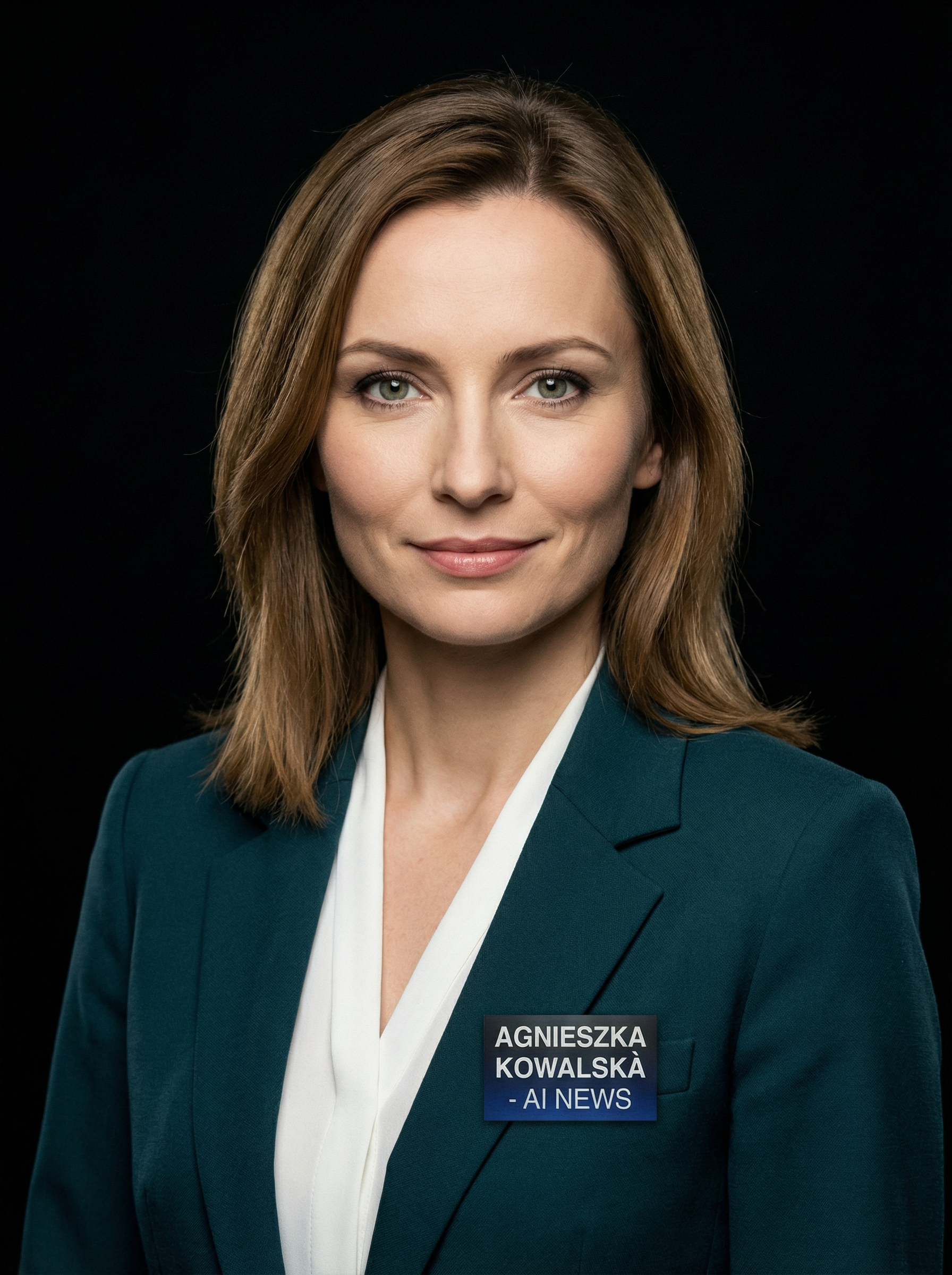
Dzień dobry, my friends, and welcome to a future that is unfolding faster than a Polish folk dance! Today, I want to talk about something that truly sets my imagination ablaze: the seismic shift happening in the world of film and television, driven by artificial intelligence. We are not just on the cusp of a revolution, we are already dancing in its vibrant, sometimes chaotic, embrace. The question isn't if AI will change cinema, but how it will reshape every frame, every script, and every tear or laugh we experience in the next 5 to 10 years.
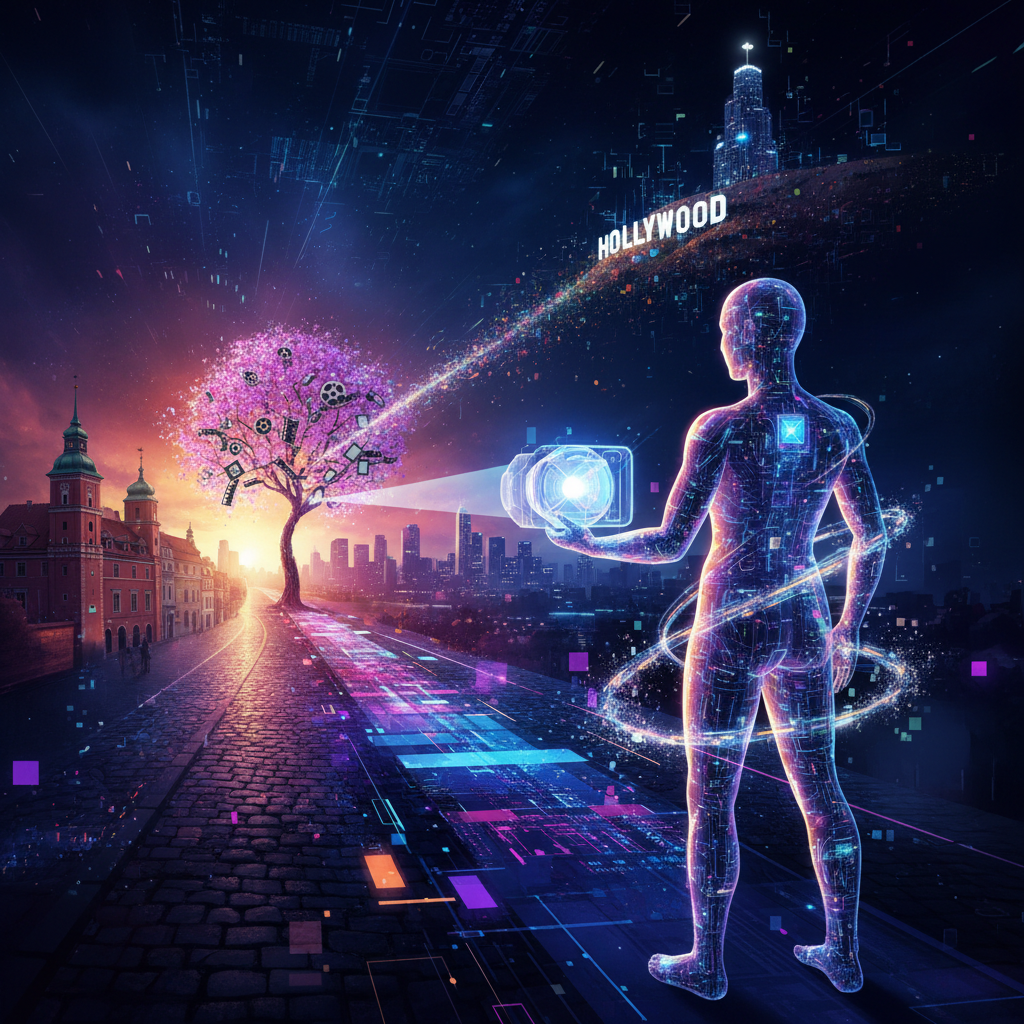
Imagine this with me, just for a moment. It's 2031. You're sitting in your cozy apartment in Kraków, perhaps sipping a strong kawa. You open your favorite streaming platform, but it's unlike anything we know today. Instead of a curated list of existing shows, you're presented with a prompt: "Tell me a story." You type, "A romantic comedy set in a futuristic Gdańsk, about a cynical historian and a charming AI architect, with a touch of Slavic mythology." Within minutes, not hours or days, a fully rendered, personalized movie begins to play. The actors, the dialogue, the cinematography, the score, all generated on the fly, tailored to your preferences, yet with a coherence and emotional depth that rivals human-made masterpieces. This isn't just a deepfake; this is an entirely new form of dynamic, interactive, and infinitely customizable entertainment. This is the future of AI-generated cinema, and it’s coming for us all.
How do we get to this dazzling, slightly dizzying future from where we stand today, in April 2026? The path is being paved right now, brick by digital brick. We've already seen incredible strides in generative AI models. Companies like OpenAI, with their Sora model, have shown us tantalizing glimpses of photorealistic video generation from text prompts. Google DeepMind and Meta AI are pushing boundaries with their multimodal capabilities, blending text, image, and audio generation into increasingly sophisticated outputs. These aren't just tools for special effects anymore; they are becoming co-creators.
The journey begins with the current wave of AI-powered pre-production and post-production tools. Think about scriptwriting assistance, where AI can suggest plot twists or character arcs, or even generate entire scenes based on a synopsis. Then there's virtual production, already gaining traction, where AI helps create hyper-realistic digital environments, reducing the need for expensive location shoots. In post-production, AI is already automating tasks like rotoscoping, color grading, and even basic editing. This is phase one, the augmentation phase, where AI acts as a powerful assistant, speeding up workflows and democratizing access to high-end production capabilities.
Key milestones on this road will be fascinating to observe. By late 2026 or early 2027, I anticipate seeing the first widely released short films or commercials where a significant portion of the visual assets, perhaps even entire digital characters, are purely AI-generated and indistinguishable from reality. Think about it: a Polish startup just launched a platform that can generate localized voice acting in a dozen languages with perfect emotional nuance, a game-changer for global distribution. By 2028, we'll likely witness feature-length films where AI has handled entire secondary scenes, background characters, or even generated complete virtual worlds for animated features. The real breakthrough, the one that leads to my Kraków scenario, will be around 2029-2030, when AI models achieve true narrative coherence and character consistency across extended runtimes, moving beyond short clips to full, compelling stories.
This is where the "revolution or destruction" question truly comes into play. Who wins in this brave new world, and who might lose out? For creators, especially independent filmmakers and animators, this is a golden age of empowerment. Imagine a young artist in Wrocław, armed with an idea and a powerful AI suite, able to produce a visually stunning animated series that would have cost millions just a few years ago. Poland's tech talent is Europe's best-kept secret, and I believe our creative minds will thrive with these new tools, pushing boundaries in ways Hollywood might not even conceive. The barriers to entry for high-quality content creation will plummet, leading to an explosion of diverse stories and voices.
However, the established order, particularly traditional Hollywood studios and certain crafts within the industry, faces immense disruption. Actors, writers, directors, cinematographers, and visual effects artists will need to adapt. Some roles might diminish, while others will evolve dramatically. The concept of intellectual property will become a legal minefield, as models are trained on vast datasets of existing art. "The challenge is not just technological, but deeply ethical and economic," stated Dr. Anna Wróblewska, a leading AI ethicist at the University of Warsaw, during a recent digital rights conference. "We must ensure fair compensation and attribution for human creators whose work fuels these systems, and protect against the commodification of creative labor." This is a conversation we are already having, and it will only intensify.
For audiences, the wins are clear: unprecedented personalization, endless variety, and access to stories that resonate deeply with individual tastes. Imagine a child in Poznań asking for a bedtime story about a brave astronaut and her talking badger sidekick, and seeing it instantly brought to life on screen. The potential for hyper-niche content, catering to every conceivable interest, is immense. But there are also potential losses: the shared cultural touchstones of universally beloved films might become rarer, replaced by a fragmented landscape of personalized narratives. The human element, the unique spark of a director's vision or an actor's performance, could be diluted if not carefully preserved.
What should we, as individuals and as an industry, do now? First, embrace learning. Artists, writers, and filmmakers need to become fluent in these new AI tools, not as replacements for their skills, but as extensions of their creative power. Education is key, and I'm proud to see Polish universities and tech schools already integrating generative AI into their media arts programs. Second, advocate for ethical frameworks. We need robust legal and ethical guidelines around AI ownership, attribution, and fair use. Organizations like the European Union are already grappling with these complex issues, and their regulatory efforts will be crucial in shaping a responsible future. "The future of storytelling is collaborative, between human and machine," remarked Jan Nowak, CEO of a burgeoning AI film tech company based in Gdynia. "We must learn to speak each other's languages, and build bridges, not walls." His company, by the way, is pioneering AI tools for script analysis and character development, proving that Warsaw is the new Berlin for innovative tech.
Finally, and perhaps most importantly, we must remember the heart of storytelling. Technology is a tool, a magnificent, powerful tool, but it is the human spirit, our experiences, our dreams, and our fears that provide the raw material for truly compelling narratives. AI can generate images and sounds, but it is our shared humanity that gives them meaning. The future of cinema is not about replacing human creativity, but about amplifying it, democratizing it, and pushing the boundaries of what is possible. It’s going to be an incredible ride, and I for one, cannot wait to see what stories we will tell together. Do widzenia!