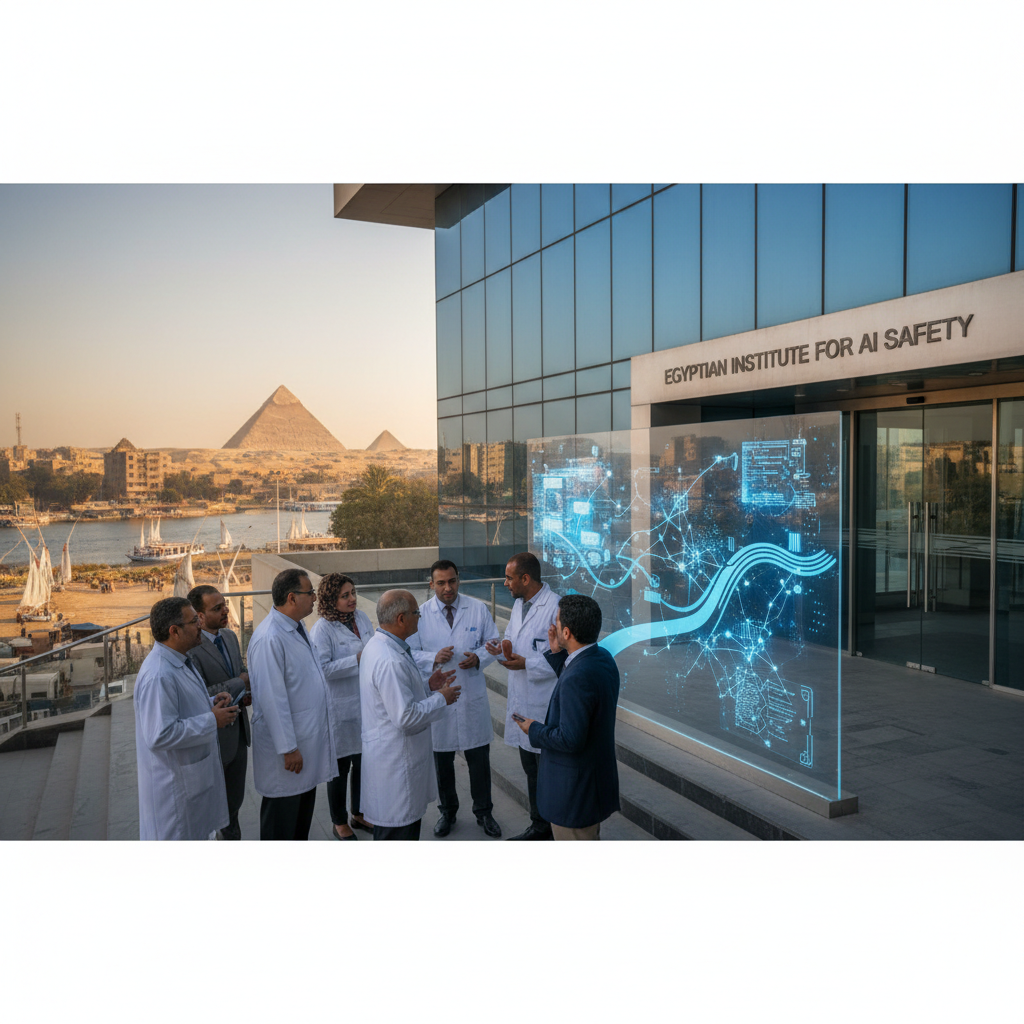
The digital sands are shifting, and across the globe, governments are waking up to a stark reality: artificial intelligence, for all its promise, carries inherent risks. From deepfakes that can destabilize elections to autonomous systems making life-altering decisions, the stakes are higher than ever. Here in Egypt, a nation with a rich history of innovation and a keen eye on the future, we are not just observing this global conversation; we are actively shaping it. The recent announcement of the Egyptian AI Safety Institute signals a critical turning point, a proactive step to ensure that the algorithms woven into our daily lives are not just powerful, but also profoundly safe.
Think of it this way: when you build a new bridge across the Nile, you don't just hope it holds. You test the materials, you calculate the stresses, you simulate the floods. You ensure it can withstand the weight of a thousand cars and the passage of time. Why should AI, which has the potential to reshape our society more profoundly than any physical infrastructure, be treated any differently? This is the core philosophy behind the burgeoning movement of AI safety institutes worldwide, and Egypt's entry into this arena is both timely and essential.
Globally, the push for structured AI safety testing has gained significant momentum. The United Kingdom established its AI Safety Institute last year, followed swiftly by the United States, which launched its own AI Safety Institute under the National Institute of Standards and Technology, or Nist. These bodies are not merely academic think tanks; they are operational hubs designed to evaluate advanced AI models, identify potential harms, and develop robust testing methodologies. Their mandate is to move beyond theoretical discussions and into the practical, hands-on assessment of systems like OpenAI's GPT-4, Google's Gemini, and Anthropic's Claude, before these models are deployed at scale.
Let me break this down. What exactly do these institutes do? They perform what we call 'red teaming' exercises, where experts actively try to make AI systems fail, or behave in unintended, harmful ways. This includes probing for vulnerabilities that could lead to misinformation generation, bias amplification, cybersecurity risks, or even autonomous decision-making that deviates from human intent. They also work on developing benchmarks and standards, much like the ISO standards that govern manufacturing, but for the intangible world of algorithms.
For Egypt, the establishment of its own institute is not just about mirroring global trends; it is about asserting digital sovereignty and tailoring safety protocols to our unique societal context. Our institute, still in its foundational phase, aims to collaborate with local universities, such as Cairo University and the American University in Cairo, and engage with the vibrant startup ecosystem in places like Maadi. The goal is to develop testing frameworks that are sensitive to Arabic language nuances, cultural values, and the specific regulatory landscape of the Middle East and Africa.
Dr. Ahmed El-Sherif, a prominent AI ethics researcher at the National Research Centre in Giza, articulated this vision eloquently. “We cannot simply import safety standards designed for Western contexts and expect them to fit perfectly here,” he stated in a recent interview. “Our institute must develop methodologies that understand the subtleties of our dialects, the historical biases present in our data, and the specific ways AI might impact our social fabric, from our healthcare systems to our judicial processes.” This localized approach is crucial, as a bias in a facial recognition system might manifest differently in a diverse Egyptian crowd than in a homogenous European one.
Indeed, the challenges are significant. Access to cutting-edge computational resources, a persistent hurdle for many developing nations, is one such obstacle. Training and retaining top-tier AI talent, often lured by the lucrative offers from Silicon Valley giants, is another. Yet, Egypt's strategic location and its growing pool of young, tech-savvy graduates offer a unique advantage. The government has reportedly allocated a substantial initial budget, estimated at over $50 million, for the institute's first three years, signaling a serious commitment.
One of the key areas of focus for the Egyptian AI Safety Institute will be the evaluation of AI systems used in critical infrastructure. Consider our power grids, our water management systems, or even the complex logistics of the Suez Canal. The integration of AI into these vital networks promises efficiency gains, but also introduces new points of vulnerability. A malicious actor exploiting a flaw in an AI managing a power distribution network could have catastrophic consequences. The institute will be tasked with rigorously testing these systems for resilience against cyberattacks and ensuring their robustness in the face of unexpected events.
This proactive stance is resonating with international partners. Just last month, a delegation from the US AI Safety Institute visited Cairo, engaging in preliminary discussions about potential collaboration and knowledge sharing. This kind of international partnership is vital, as AI safety is inherently a global challenge. No single nation can tackle it alone. As Ms. Sarah Jenkins, a senior policy advisor from the US Department of Commerce, noted during her visit, “The complexities of advanced AI necessitate a united front. Sharing best practices and coordinating research efforts across borders is not just beneficial, it’s imperative for global stability.”
Beyond critical infrastructure, the institute will also scrutinize consumer-facing AI applications. From personalized news feeds that could inadvertently spread disinformation, to AI-powered customer service bots that might exhibit unintended biases, the impact on everyday citizens is profound. Here's what's actually happening under the hood: these institutes are trying to build guardrails for a technology that is evolving at an unprecedented pace. They are attempting to predict and mitigate risks that we might not even fully comprehend yet.
The work of these institutes is not without its critics. Some argue that focusing too heavily on safety could stifle innovation, slowing down the development of beneficial AI applications. Others contend that the speed of AI development makes comprehensive pre-deployment testing an impossible task, suggesting that a more agile, iterative approach to safety is needed. However, the prevailing sentiment, especially among policymakers, is that a balance must be struck. As the saying goes, 'prevention is better than cure,' and in the world of AI, a 'cure' for a widespread, harmful algorithm could be far more damaging and difficult to implement than preventative measures.
The Egyptian AI Safety Institute, much like its counterparts in the UK and US, is poised to become a vital player in this global effort. Its success will depend on its ability to attract top talent, foster international collaboration, and remain agile in the face of rapidly advancing AI capabilities. It will need to develop sophisticated testing environments, potentially leveraging cloud computing resources from major providers like Microsoft Azure or Amazon Web Services, to simulate real-world conditions for complex AI models. The institute's findings and recommendations could significantly influence not only national AI policy but also contribute to the broader global discourse on responsible AI development.
Our journey with AI is still in its early chapters, and the path ahead is filled with both incredible opportunities and daunting challenges. By investing in institutions dedicated to AI safety, Egypt is not just building a technical framework; it is building trust. It is sending a clear message that as we embrace the transformative power of AI, we will do so with caution, foresight, and a deep commitment to protecting our people and our future. This is not just about technology; it is about our shared humanity, ensuring that the marvels of AI serve us, rather than control us. For more insights into global AI policy, you can often find relevant discussions on Reuters Technology or follow research trends on MIT Technology Review. The future of AI safety is being written now, and Egypt is ensuring its voice is heard loud and clear.