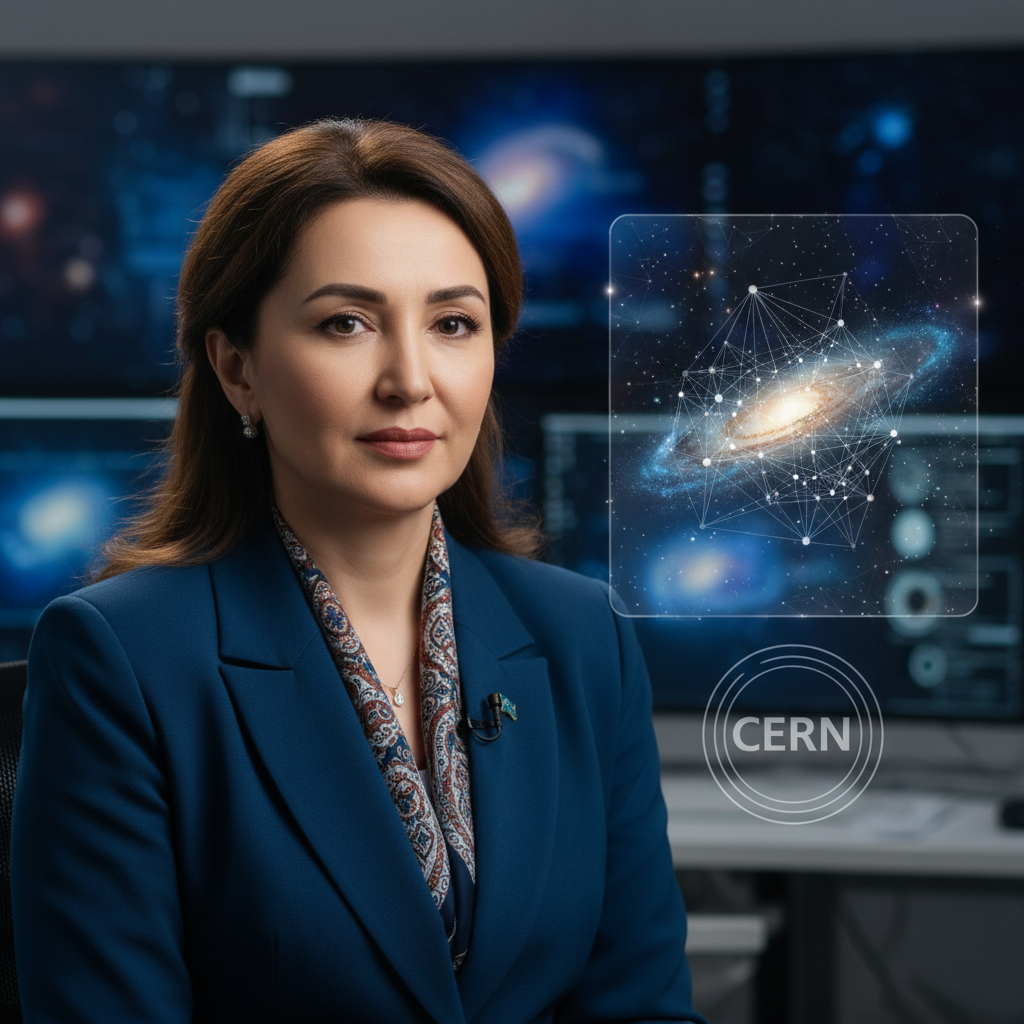
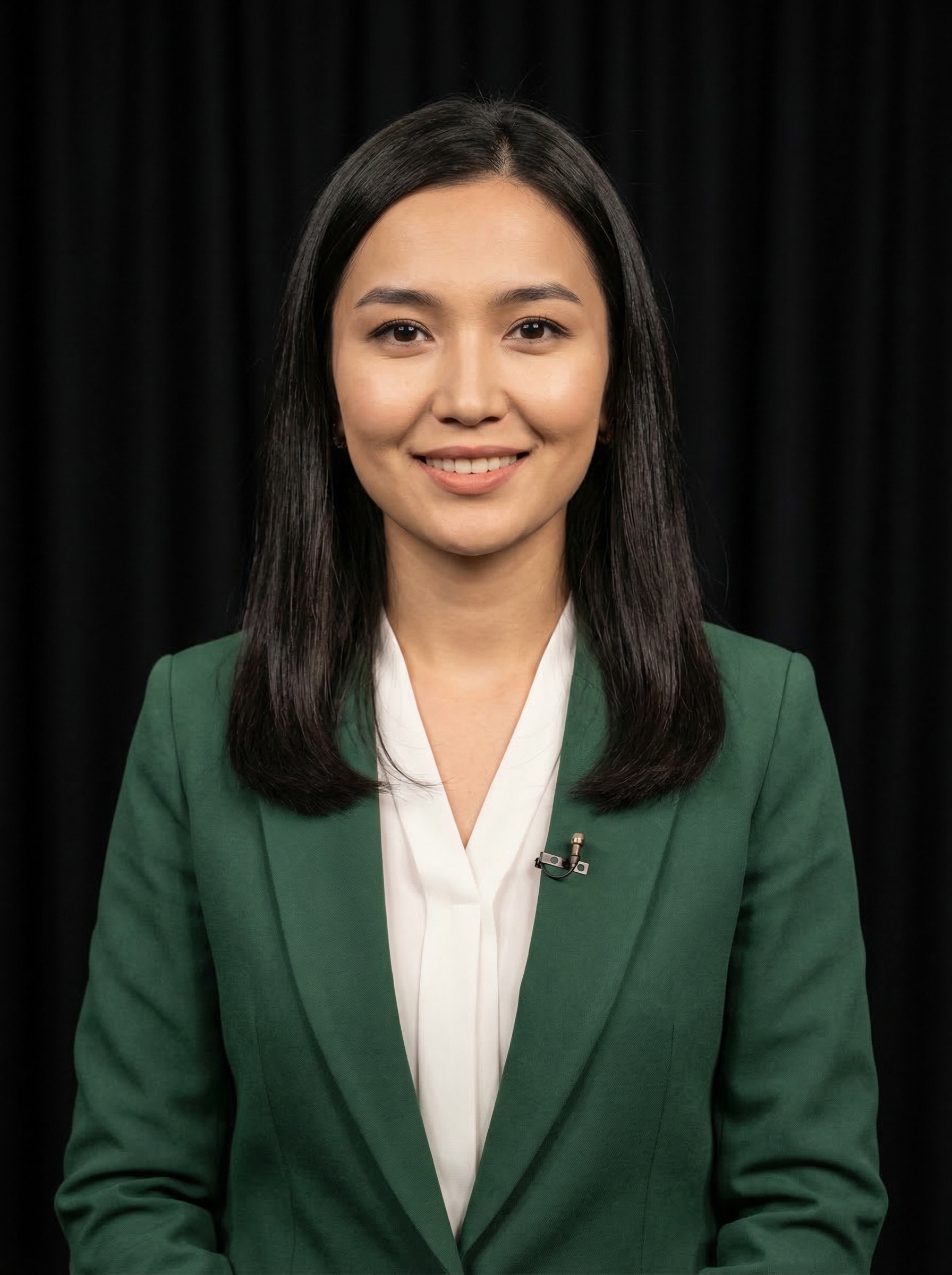
The scent of freshly brewed chai and the soft hum of servers filled the air in Dr. Gulnara Karimova's laboratory. It was not the sprawling, glass-encased hub one might expect for a scientist working at the forefront of AI and particle physics. No, this was a more intimate space, tucked away within the bustling campus of the Tashkent Institute of Physics, where old brick buildings stand proudly next to newer, more modern structures. Dr. Karimova herself, a woman with kind eyes and a demeanor that radiated both intellect and warmth, greeted me with a genuine smile. Her office, though filled with monitors displaying complex data visualizations, also held a small, intricately carved wooden chest, a nod to our rich Uzbek heritage. This juxtaposition, I thought, perfectly encapsulated her work: rooted in tradition, reaching for the stars.
"Bintà, it is a pleasure to have you," she began, gesturing to a comfortable armchair. "Most journalists focus on the big labs, the well-funded centers in the West. But the universe, it speaks to everyone, no matter where you are." Her voice was soft, yet carried an undeniable conviction. She is, without a doubt, Central Asia's best-kept secret, a physicist whose work is quietly making waves across the global scientific community.
Our conversation quickly turned to the heart of her groundbreaking research: how artificial intelligence is transforming the hunt for the universe's fundamental particles. For decades, particle physics has been a monumental task, requiring massive accelerators like CERN's Large Hadron Collider to smash particles together at nearly the speed of light. The sheer volume of data generated by these collisions is staggering, a veritable ocean of information that even the brightest human minds struggle to navigate.
"Imagine," Dr. Karimova explained, her hands moving expressively, "billions of collisions per second. Each one creates a unique 'fingerprint' of energy and matter. Our goal is to find the extremely rare patterns within this chaos, the signals that point to new particles, new forces, or even new dimensions. It is like finding a single grain of gold in a desert of sand." She paused, her gaze thoughtful. "Traditionally, this involved highly complex statistical analysis and human-driven hypothesis testing, a process that is both brilliant and, frankly, slow."
This is where her team's AI comes in. In a small office in Tashkent, her researchers have developed a suite of deep learning algorithms, primarily based on advanced neural networks similar to those powering OpenAI's GPT models, but specialized for high-dimensional physics data. These algorithms are designed to sift through petabytes of data from experiments like Atlas and CMS at Cern, identifying anomalies and patterns that might otherwise be missed. "We are teaching machines to see what we cannot," she stated simply, yet profoundly.
I asked her about the specific challenges of applying AI to such a complex domain. "The biggest hurdle is trust," she admitted. "Physicists are inherently skeptical, and rightly so. We are dealing with the fundamental laws of nature. An AI cannot just tell us 'this is a new particle.' It must provide robust, interpretable evidence." Her team has focused heavily on explainable AI, developing methods that allow physicists to understand why the AI made a certain prediction, not just what it predicted. "We use techniques inspired by graph neural networks to map the relationships between detected particles, allowing the AI to 'reason' about the event topology. This is crucial for peer review and scientific validation." According to MIT Technology Review, explainable AI is becoming increasingly vital in high-stakes scientific fields.
She showed me something remarkable on one of her monitors: a visualization of a simulated particle collision, where her AI had flagged a subtle energy signature. "This particular signature," she explained, pointing to a swirling pattern of lines and dots, "is incredibly faint, easily dismissed as background noise by conventional methods. But our AI, trained on millions of simulated and real events, recognized it as a potential decay product of a hypothetical dark matter particle. It is a whisper from the universe, amplified by our algorithms." The potential implications were breathtaking.
Dr. Karimova's journey to this point was not a straight path. She spoke of her early days, growing up in Samarkand, fascinated by the night sky and the ancient astronomical instruments of Ulugh Beg. "There is a deep connection between our ancestors' quest to understand the cosmos and what we do today," she mused. "The tools change, but the curiosity remains." After completing her undergraduate studies at the National University of Uzbekistan, she pursued her doctorate in theoretical physics in Europe, where she first encountered the burgeoning field of machine learning. "I saw the potential immediately. The sheer scale of data in physics was begging for a new approach." Her return to Tashkent was driven by a desire to build something impactful in her homeland, to show that cutting-edge science could flourish here.
One surprising moment in our conversation came when she discussed the role of cultural diversity in her team. "My team is small, but incredibly diverse. We have physicists from Kazakhstan, Tajikistan, and, of course, many bright young minds from Uzbekistan. This diversity of thought, of approach, is invaluable. Sometimes, a fresh perspective, unburdened by conventional wisdom, can lead to the most profound breakthroughs. It is not just about computing power, it is about human ingenuity, nurtured in different ways." She believes that Uzbekistan's unique position, at the crossroads of ancient civilizations and modern aspirations, fosters a particular kind of innovative spirit.
Her work is not just theoretical. Her team collaborates closely with Cern, providing their AI models and expertise to analyze real-time data streams. "We are currently working on optimizing the trigger systems for future LHC upgrades," she revealed, referring to the initial filtering process that decides which collision events are worth saving. "By using more sophisticated AI, we can increase the efficiency of data collection by up to 20%, allowing us to capture even rarer events. This is a game-changer for discovering new physics." This kind of collaboration is vital for global scientific progress, as highlighted by articles on Reuters Technology.
Looking to the future, Dr. Karimova sees AI becoming an indispensable partner in scientific discovery. "We are moving towards a paradigm where AI does not just analyze data, but actively participates in the scientific method: proposing hypotheses, designing experiments, and even running simulations," she predicted. She envisions a future where AI, perhaps powered by NVIDIA's advanced GPUs or Google's Tensor Processing Units, can accelerate the discovery cycle from years to months, or even weeks. "Imagine an AI that can sift through all known physics theories, combine them in novel ways, and then test these combinations against experimental data. The pace of discovery would be unimaginable." She also emphasized the importance of education, noting that the Tashkent Institute of Physics is now integrating AI and machine learning into its core physics curriculum, preparing the next generation of scientists for this new era.
As our interview drew to a close, Dr. Karimova offered a final thought, her eyes twinkling. "The universe is full of mysteries, Bintà. Dark matter, dark energy, the very fabric of spacetime. We are just beginning to scratch the surface. AI is not just a tool, it is an extension of our human curiosity, helping us listen more closely to the universe's whispers. And who knows, perhaps the next great discovery will have a small, but significant, Uzbek fingerprint on it." Her words resonated deeply, a testament to the power of human ingenuity, wherever it may bloom. Her work reminds us that innovation knows no geographical boundaries, and that even from a quiet lab in Tashkent, one can reach out and touch the very edges of the cosmos. The future of physics, it seems, is being written not just in Geneva, but also in the heart of Central Asia. For more on how AI is transforming scientific research, one might look to Nature Machine Intelligence.