
The global economic landscape, perpetually in flux, now finds itself grappling with an intensified era of trade wars and protectionist policies. Tariffs, once a blunt instrument of last resort, have become a common feature in international commerce, forcing nations and corporations to rethink their supply chain strategies. It is within this turbulent environment that a research team at the University of Waterloo, a hub of Canadian innovation, has unveiled a development that promises to fundamentally alter how we perceive and manage these economic shifts. Their work, detailed in a recent paper titled 'QuantumTrade AI: A Game-Theoretic Approach to Resilient Supply Chain Optimization Under Geopolitical Volatility', introduces an AI framework designed to predict and adapt to trade barriers with unprecedented agility.
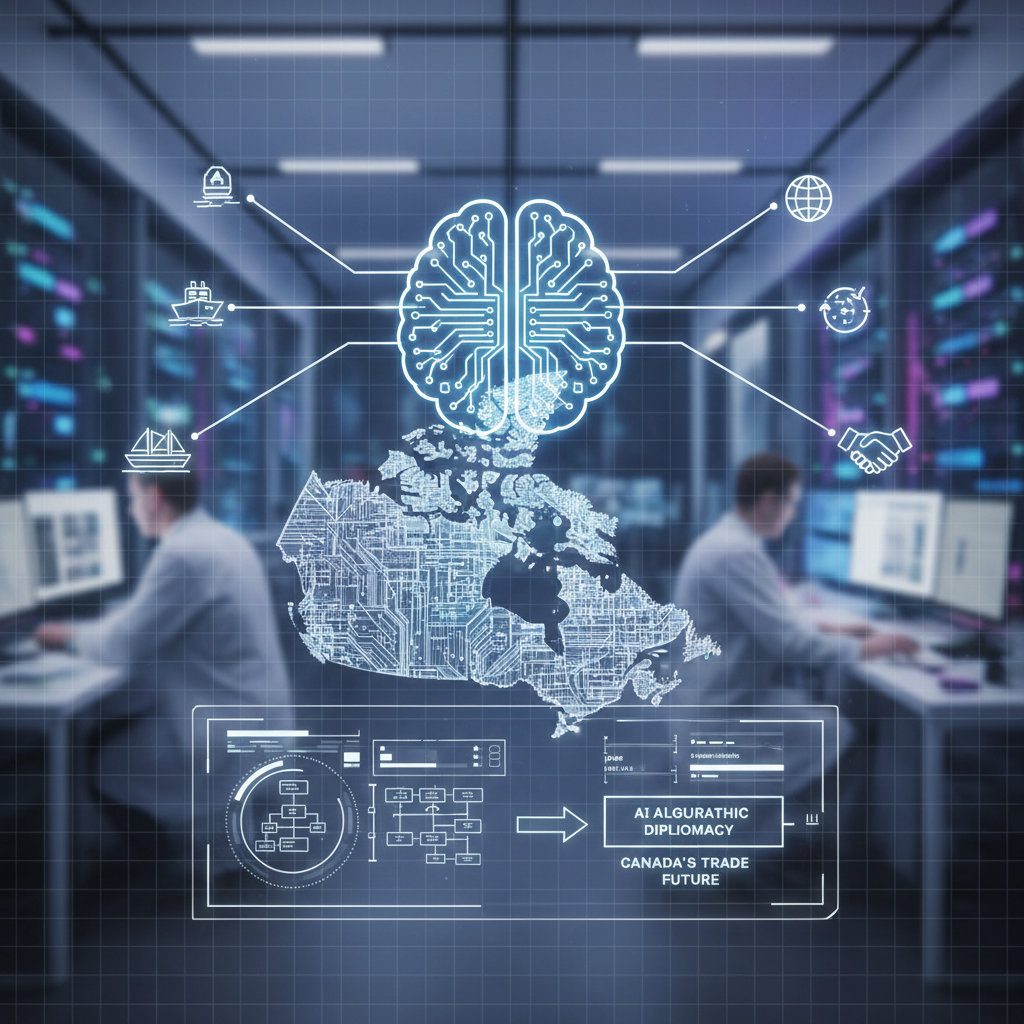
At its core, the breakthrough lies in an advanced form of reinforcement learning combined with quantum-inspired optimization techniques. Unlike traditional supply chain management systems that rely on historical data and static models, QuantumTrade AI dynamically learns from real-time geopolitical events, tariff announcements, and trade agreement shifts. It then simulates millions of potential supply chain configurations, evaluating their resilience and cost-effectiveness under various protectionist scenarios. The system's ability to process and correlate vast, disparate datasets, from satellite imagery of shipping lanes to parliamentary debates on trade legislation, allows it to identify optimal sourcing, manufacturing, and distribution routes, often in ways human analysts might overlook. This is not merely predictive analytics; it is proactive, adaptive strategy generation.
Why does this matter, especially for a trade-dependent nation like Canada? Our economy, deeply intertwined with global markets, particularly that of our southern neighbour, is acutely vulnerable to disruptions. The Canadian approach deserves more scrutiny when considering how we manage these risks. For years, Canadian businesses have navigated tariffs on steel, aluminum, and agricultural products, often absorbing costs or scrambling to find alternative markets. QuantumTrade AI offers a potential antidote to this reactive stance, transforming uncertainty into a calculable risk.
Dr. Anya Sharma, lead researcher at the Waterloo AI Institute and principal author of the paper, emphasized the paradigm shift. “We are moving beyond simply reacting to tariffs,” she explained in a recent virtual press briefing. “Our system allows companies, and potentially governments, to anticipate the ripple effects of a trade dispute before it fully materializes. It can model the impact of a 25 percent tariff on a specific component, not just on the immediate cost, but on the entire production cycle, labor allocation, and even consumer demand in affected markets.” Her team's simulations, detailed in a pre-print available on arXiv, suggest that companies utilizing such an AI could reduce tariff-related losses by up to 18 percent over a five-year period, a significant figure for industries operating on thin margins.
The technical details, while complex, are grounded in principles accessible to those familiar with modern AI. The system employs a multi-agent reinforcement learning architecture, where each 'agent' represents a node in the supply chain, a factory, a port, a raw material supplier. These agents learn to cooperate and compete, optimizing for global efficiency while minimizing exposure to geopolitical risk. The 'quantum-inspired' aspect refers to the use of algorithms that leverage principles of quantum mechanics, such as superposition and entanglement, to explore a vast solution space more efficiently than classical computers. This allows the AI to consider exponentially more variables and scenarios, leading to more robust and innovative solutions. Imagine a chess grandmaster who can not only see every possible move but also every possible counter-move across multiple boards simultaneously; that is the computational advantage at play here.
The research, a collaborative effort between the University of Waterloo, the National Research Council of Canada, and a consortium of Canadian logistics firms, represents a significant homegrown contribution to global AI. Dr. Liam O'Connell, a trade policy analyst with Global Affairs Canada, noted the potential. “This kind of advanced analytical capability could be invaluable for Canadian policymakers,” he stated, “providing data-driven insights to inform our trade negotiations and identify strategic vulnerabilities before they become crises. It allows us to move beyond anecdotal evidence and into a realm of predictive, data-backed diplomacy.”
However, as with all powerful technologies, a healthy dose of skepticism is warranted. Let's separate the marketing from the reality. While the simulations are compelling, real-world deployment presents formidable challenges. The accuracy of the AI's predictions hinges on the quality and timeliness of its input data, and geopolitical events are notoriously unpredictable. Furthermore, the ethical implications of an AI dictating national trade strategy or corporate sourcing decisions demand careful consideration. Who is accountable when an algorithm makes a suboptimal or even harmful recommendation? These are not trivial questions.
Moreover, the adoption of such a sophisticated system requires substantial investment in infrastructure, data governance, and specialized talent. Many small and medium-sized enterprises (SMEs) in Canada, the backbone of our economy, may find themselves unable to access or implement such advanced tools, potentially exacerbating existing inequalities. As Professor Evelyn Chen, an expert in AI ethics at the University of Toronto, pointed out, “The promise of efficiency must be balanced against the risk of creating a two-tiered system, where only the largest players can afford algorithmic advantage. We must ensure that the benefits of such innovations are broadly distributed, not concentrated.”
The implications extend beyond mere cost savings. In a world increasingly defined by economic blocs and strategic rivalries, QuantumTrade AI could empower nations to build more resilient, self-sufficient supply chains, reducing dependence on potentially volatile regions. For Canada, this could mean a renewed focus on domestic production and near-shoring within North America, bolstering our manufacturing sector and creating new jobs. The data suggests a different conclusion than simply continuing with business as usual; it points to a need for strategic re-evaluation.
The next steps for Dr. Sharma's team involve refining the AI's ability to handle qualitative data, such as diplomatic rhetoric and public sentiment, which often precede policy shifts. They are also exploring partnerships with major Canadian corporations, including those in the automotive and aerospace sectors, to pilot the technology in real-world scenarios. The goal is not to replace human decision-makers but to augment their capabilities, providing an unparalleled informational advantage in the complex arena of global trade. The future of Canadian commerce, it seems, may well be written in algorithms, but the human element of oversight and ethical consideration remains paramount. For more insights into how AI is shaping global business, see Bloomberg Technology. This evolution demands our continuous vigilance and informed engagement, ensuring that these powerful tools serve the broader public interest, not just corporate bottom lines.