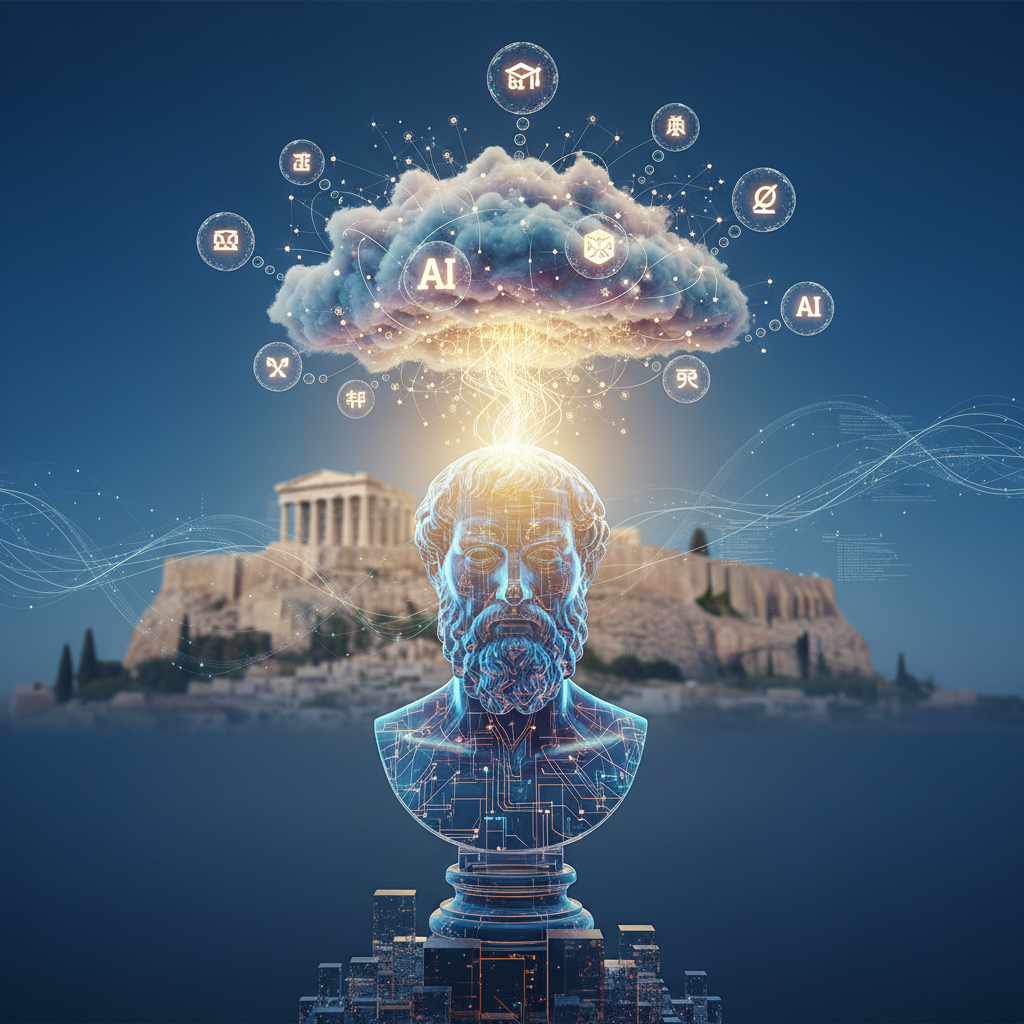

The world, as we know it, is being reshaped by algorithms. From the bustling markets of Athens to the quiet fishing villages of Crete, the digital currents flow, carrying with them the promises and perils of artificial intelligence. For too long, we in the West, particularly in Europe, have looked predominantly towards Silicon Valley as the sole arbiter of this future. We have admired OpenAI's GPT, Google's Gemini, and Anthropic's Claude, often overlooking the formidable intellectual and technological might brewing elsewhere. But the tides are turning, and China, with Baidu's Ernie Bot leading the charge, is not just catching up, it is charting its own course, one that demands our attention and understanding.
I think in decades, not quarters, and what I see on the horizon is not just a technological shift, but a geopolitical and philosophical one. The Mediterranean approach to AI is fundamentally different, emphasizing human-centricity and ethical governance, but we must also understand the philosophies driving other major players. Baidu's Ernie Bot, or Enhanced Representation through Knowledge Integration, is more than just a chatbot; it is China's answer to the large language model revolution, a testament to their ambition to build a self-sufficient, technologically advanced society. It is a complex system, a digital oracle that aims to understand, generate, and interact with the world in ways that mirror human cognition, albeit through a distinctly Chinese lens.
The Big Picture: A Digital Silk Road of Thought
What exactly does Ernie Bot do? At its core, it is a multimodal large language model, meaning it can process and generate not only text, but also images, audio, and even video. Imagine a digital polymath, capable of writing poetry, composing music, designing logos, or even generating a short film, all from a simple text prompt. Its purpose is broad: to enhance search engines, power intelligent assistants, automate content creation, and provide sophisticated conversational AI for businesses and individuals across China and beyond. It is an infrastructure, a foundational model upon which countless applications can be built, much like the ancient aqueducts that brought life-giving water to our cities.
But its significance extends beyond mere functionality. Ernie Bot represents a strategic pillar in China's drive for technological sovereignty. While Western models often prioritize general applicability and open-ended creativity, Ernie Bot is deeply integrated with Chinese cultural nuances, ethical frameworks, and regulatory requirements. It is a reflection of a different societal contract with technology, one that emphasizes collective benefit and stability, sometimes at the expense of individual liberty, a stark contrast to the individualistic ethos often lauded in the West. As Professor Ling Wei, a leading AI ethicist at Tsinghua University, recently stated, "Ernie Bot is not just a technological marvel, it is a cultural artifact. It embodies Chinese values in its very architecture, from data curation to ethical guardrails." This is a crucial distinction that many in Europe, myself included, are only beginning to fully appreciate.
The Building Blocks: Pillars of Knowledge and Perception
To understand how Ernie Bot works, we must break it down into its fundamental components, much like dissecting a classical Greek sculpture to understand its form and balance. These are the key elements:
- Massive Data Corpus: This is the bedrock. Ernie Bot is trained on an enormous dataset of text, code, images, audio, and video, predominantly in Chinese. This includes books, articles, web pages, social media, scientific papers, and proprietary Baidu data. The sheer scale, reportedly in the petabytes, is staggering, providing the model with a vast understanding of the world.
- Transformer Architecture: This is the brain's blueprint. Like most modern large language models, Ernie Bot relies on the transformer architecture. This neural network design is incredibly efficient at processing sequential data, allowing the model to understand context and relationships between words, sentences, and even across different modalities. It is what enables the model to 'pay attention' to different parts of the input when generating an output.
- Knowledge Graph Integration: This is where Ernie truly differentiates itself. Baidu has long been a pioneer in knowledge graphs, structured databases of real-world entities and their relationships. Ernie Bot is not just learning patterns from raw text; it actively incorporates Baidu's massive knowledge graph, known as Ernie (Enhanced Representation through kNowledge IntEgration), during its training. This allows it to ground its understanding in factual knowledge, reducing hallucinations and improving reasoning capabilities. Think of it as having access to a vast, interconnected encyclopedia during its learning process, rather than just reading millions of disconnected books.
- Multimodal Encoders and Decoders: These are the senses and the voice. For images, audio, and video, specialized neural networks (encoders) convert these raw inputs into a numerical format that the transformer can understand. Similarly, decoders translate the model's internal representations back into human-readable text, or generate new images, sounds, or videos. This is the magic that allows Ernie to 'see' and 'hear' and 'create' in different forms.
- Reinforcement Learning with Human Feedback (rlhf): This is the refinement process. After initial training, human annotators provide feedback on Ernie Bot's outputs, ranking responses for helpfulness, harmlessness, and accuracy. This feedback is then used to fine-tune the model, aligning its behavior more closely with human preferences and ethical guidelines. It is a continuous sculpting process, shaping the raw intelligence into something more refined and useful.
Step by Step: From Prompt to Pantheon
Let us walk through a typical interaction with Ernie Bot, from the moment you type a query to the moment it delivers its response:
Step 1: The User's Query (Input) You, the user, type a prompt, perhaps in Chinese: "请为我写一首关于希腊夏天的诗,并配一张爱琴海日落的图片" (Please write me a poem about Greek summer, and generate an image of an Aegean sunset).
Step 2: Input Processing and Tokenization The system first takes your text query and breaks it down into smaller units called 'tokens' (words, sub-words, punctuation). If you included an image or audio, those would also be processed by their respective encoders into numerical representations.
Step 3: Contextual Understanding (Encoder Stage) The tokenized input is fed into the transformer's encoder layers. Here, the model uses its vast training to understand the meaning and context of your request. It identifies keywords like "Greek summer," "poem," "Aegean sunset," and the intent to generate both text and an image. Critically, its integrated knowledge graph helps it understand what an "Aegean sunset" typically entails, drawing on factual information about the region's geography and aesthetics.
Step 4: Knowledge Integration and Reasoning This is where Baidu's unique strength shines. The model queries its internal knowledge graph for relevant information about Greek summer, poetry styles, and visual characteristics of Aegean sunsets. This helps it formulate a more informed and coherent response, rather than just statistically predicting the next word. It is like a scholar consulting their library before writing.
Step 5: Response Generation (Decoder Stage) The transformer's decoder layers then begin to generate the response, token by token, based on the encoded input and integrated knowledge. For the poem, it predicts the most probable sequence of words that fit the theme and poetic structure. Simultaneously, for the image, it uses latent diffusion models or similar generative AI techniques, guided by the textual prompt and its understanding of "Aegean sunset," to construct the image pixel by pixel.
Step 6: Output Presentation Finally, the generated poem and image are presented to you, the user, often within a conversational interface or an application powered by Ernie Bot. The entire process, from query to response, typically takes mere seconds.
A Worked Example: Reimagining Our Ancient Past
Let us imagine a Greek historian, Dr. Eleni Petrova from the Aristotle University of Thessaloniki, using Ernie Bot. She inputs: "Generate a detailed historical account of the Peloponnesian War from the perspective of an Athenian foot soldier, including their daily struggles and philosophical musings, and create a realistic 3D render of a trireme in battle, circa 410 BC."
Ernie Bot would first tokenize the request. Its transformer encoder would grasp the complex historical context, the need for a first-person narrative, and the specific visual element. The knowledge graph would be crucial here, pulling in details about Athenian military structure, daily life, philosophical schools of the era, and the design of a trireme. It would then generate a compelling narrative, perhaps describing the soldier's fear, their loyalty to Athens, and their reflections on justice and power, echoing Thucydides, but in a personal voice. Concurrently, its generative image models, informed by the historical data, would construct a highly accurate and dynamic 3D model of a trireme engaged in combat, complete with detailed rigging and crew. The result is not just information retrieval, but creative synthesis, a truly powerful tool for education and historical exploration. This is why Greece has something Silicon Valley doesn't: a deep, living history that AI can help us explore anew.
Why It Sometimes Fails: Echoes in the Cave
Even the most advanced AI, like Ernie Bot, is not infallible. Its failures are often illuminating:
- Hallucinations: Despite knowledge graph integration, Ernie Bot can still 'hallucinate,' generating factually incorrect but confidently stated information. This often happens when the model encounters novel or ambiguous queries, or when its training data has gaps or biases. It is like a scholar confidently asserting a falsehood because their library was incomplete.
- Cultural Bias: Trained predominantly on Chinese data, Ernie Bot may exhibit cultural biases or struggle with nuances of non-Chinese cultures. While it can process English, its understanding of Western idioms, historical perspectives, or ethical dilemmas might be less sophisticated than models trained more broadly. This is a critical point for European users.
- Lack of Real-World Understanding: While it can process vast amounts of data, Ernie Bot does not truly 'understand' the world in the human sense. It lacks common sense reasoning, emotional intelligence, and genuine consciousness. Its responses are statistical predictions, not true insights. It is a master mimic, not a true sage.
- Computational Cost: Running and training such a massive model requires immense computational resources, primarily powerful GPUs from companies like NVIDIA. This makes it expensive to operate and limits its deployment in resource-constrained environments. The energy footprint alone is a significant concern, one that we in Europe, with our focus on sustainability, cannot ignore.
Where This is Heading: Beyond the Great Firewall
The trajectory for Ernie Bot, and Chinese AI in general, is clear: continued refinement, broader application, and increasing global reach. Baidu is investing heavily in making Ernie Bot more efficient, more accurate, and more capable across an even wider array of tasks. We will see improvements in its reasoning abilities, its multimodal generation quality, and its integration into everyday devices and services.
I believe we will see Ernie Bot not just challenging, but fundamentally altering the landscape of global AI dominance. It is not about one model being 'better' than another, but about the emergence of distinct AI ecosystems, each reflecting the values and priorities of its creators. The competition between Baidu, OpenAI, Google, and others is not just a race for technological supremacy, but a contest of visions for humanity's digital future. For us in Greece, in Europe, this means we must not be passive observers. We must engage, understand, and build our own robust, ethically grounded AI capabilities. Athens was the birthplace of democracy, now it is reimagining AI governance, and understanding systems like Ernie Bot is a critical first step in that journey. The future is not singular; it is a tapestry woven from many threads, and China's Ernie Bot is undeniably one of the strongest. We must watch its weave, for it will shape the world our children inherit. You can read more about the broader implications of this global AI race on Wired or MIT Technology Review. The stakes are higher than ever before. We must be prepared. {{youtube:WXuK6gekU1Y}}