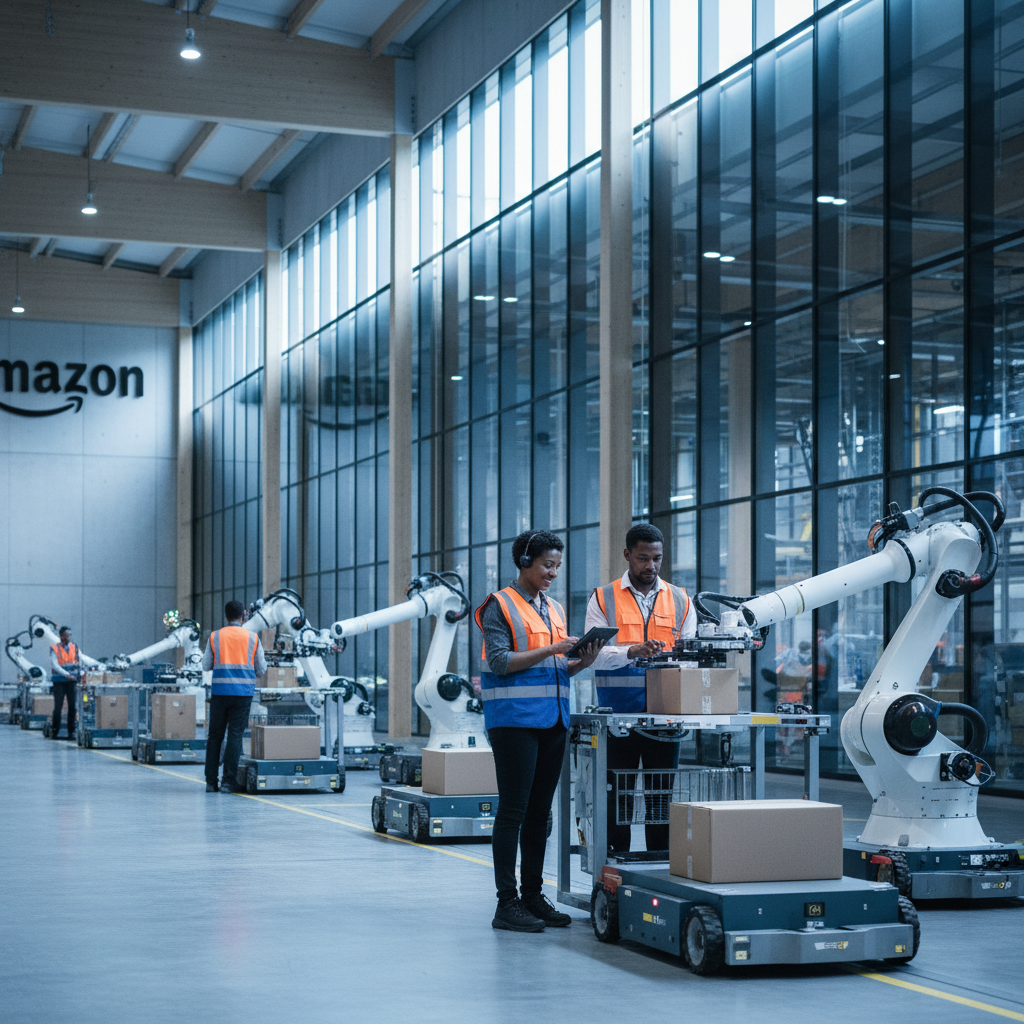

The promise of fully automated logistics, a vision once confined to science fiction, is rapidly materializing within Amazon's sprawling global network. Under the leadership of CEO Andy Jassy, the company continues to invest heavily in artificial intelligence and robotics, fundamentally reshaping how goods are stored, sorted, and shipped. From a Swedish perspective, where efficiency and worker welfare often go hand in hand, this technological acceleration warrants a meticulous examination. The question is not merely if these systems work, but how they work, and at what cost, both economic and societal.
The Technical Challenge: Orchestrating a Symphony of Goods
The fundamental problem Amazon addresses is one of immense scale and complexity: efficiently moving billions of items through a global supply chain, from supplier to customer, often within hours. Traditional warehousing relies on human labor for picking, packing, and sorting, a process prone to error, fatigue, and physical strain. The technical challenge involves replacing or augmenting these human tasks with intelligent machines that can operate autonomously, coordinate seamlessly, and adapt to dynamic inventory and demand fluctuations. This necessitates not just robots, but an intelligent layer, an AI brain, to manage the entire ecosystem. The sheer volume of data generated, from sensor readings to order patterns, demands sophisticated analytical capabilities.
Architecture Overview: A Layered Intelligence
Amazon's AI-powered logistics architecture is a complex, multi-layered system designed for scalability and resilience. At its core, it comprises several interconnected components:
- Robotic Fleet Management System (rfms): This is the central nervous system for thousands of autonomous mobile robots (AMRs) like Kiva robots (now Amazon Robotics drives), robotic arms, and specialized sorting machines. It manages task assignment, path planning, collision avoidance, and battery management.
- Warehouse Management System (WMS) with AI Optimization: The WMS integrates with the Rfms and acts as the brain for inventory placement, order fulfillment, and workflow optimization. AI models within the WMS predict demand, optimize storage locations based on velocity and co-occurrence, and dynamically adjust picking routes.
- Sensor Networks and Computer Vision: Extensive sensor arrays, including LiDAR, cameras, and Rfid, provide real-time data on robot locations, inventory levels, and package states. Computer vision systems are deployed for quality control, package identification, and anomaly detection.
- Data Lake and Analytics Platform: A massive data infrastructure ingests, stores, and processes petabytes of operational data. This platform supports both real-time decision-making and offline model training and refinement.
- Edge Computing Infrastructure: To minimize latency for critical robotic operations, significant computational power is pushed to the edge, directly within the warehouses, allowing for rapid decision-making without constant cloud communication.
This architecture is not monolithic; it is a distributed system, often running on Amazon Web Services (AWS) infrastructure, leveraging services like AWS IoT, AWS SageMaker, and various database solutions. The integration of these components creates a cohesive, albeit incredibly intricate, operational environment.
Key Algorithms and Approaches: The Brain Behind the Brawn
The intelligence driving Amazon's logistics revolution stems from a combination of classical operations research and modern machine learning techniques.
- Reinforcement Learning (RL) for Robot Navigation and Task Allocation: AMRs learn optimal paths and task sequences through trial and error, guided by reward functions that prioritize efficiency, speed, and energy consumption. For instance, an RL agent might learn to navigate a crowded warehouse floor, avoiding dynamic obstacles, to retrieve an item in the shortest possible time. Pseudocode might involve defining states (robot location, inventory status), actions (move forward, turn, pick up), and rewards (negative for collisions, positive for task completion).
 # Conceptual RL for AMR path planning
 def train_amr_agent(environment, episodes):
 agent = QLearningAgent(state_space, action_space, learning_rate, discount_factor)
 for episode in range(episodes):
 state = environment.reset()
 done = False
 while not done:
 action = agent.choose_action(state)
 next_state, reward, done = environment.step(action)
 agent.learn(state, action, reward, next_state)
 state = next_state
 return agent
 # Conceptual RL for AMR path planning
 def train_amr_agent(environment, episodes):
 agent = QLearningAgent(state_space, action_space, learning_rate, discount_factor)
 for episode in range(episodes):
 state = environment.reset()
 done = False
 while not done:
 action = agent.choose_action(state)
 next_state, reward, done = environment.step(action)
 agent.learn(state, action, reward, next_state)
 state = next_state
 return agent
-
Predictive Analytics for Inventory Management: Machine learning models, often based on time series analysis (e.g., Arima, Prophet) or deep learning (e.g., LSTMs), forecast demand for millions of products. These predictions inform inventory stocking levels and placement strategies. For example, popular items might be stored closer to packing stations, reducing robot travel time.
-
Computer Vision for Quality Control and Item Identification: Convolutional Neural Networks (CNNs) are employed to identify products, detect damage, and verify package contents. This reduces manual inspection and improves accuracy. A CNN model trained on vast datasets of product images can quickly classify items as they pass through conveyor belts.
-
Multi-Agent Pathfinding (mapf): This is crucial for coordinating hundreds or thousands of robots in a shared space, ensuring they do not collide and collectively optimize flow. Algorithms like Conflict-Based Search (CBS) or its variants are used to find collision-free paths for multiple agents simultaneously. MIT Technology Review has highlighted the complexity of such multi-agent systems in modern robotics.
Implementation Considerations: The Practicalities of Scale
Deploying such a system at Amazon's scale involves significant practical challenges. Data governance, model interpretability, and system robustness are paramount. Ensuring data quality for training AI models is a continuous effort. The trade-off between model complexity and inference speed is critical, especially for real-time robotic control. Furthermore, maintaining a diverse fleet of robots from various manufacturers and integrating them into a unified system requires robust API design and middleware. The cost of hardware, from robots to sensors, also necessitates a clear return on investment analysis.
Benchmarks and Comparisons: Measuring the Leap
Amazon's internal metrics reportedly show significant improvements in throughput, accuracy, and operational cost reduction compared to traditional, human-centric warehouses. While precise figures are proprietary, industry estimates suggest that automated fulfillment centers can process orders 2-3 times faster and with significantly fewer errors. Compared to competitors who may still rely on more manual processes or less integrated robotic solutions, Amazon's approach offers a distinct competitive advantage in speed and cost efficiency. However, the initial capital expenditure for such advanced systems is substantial, a barrier for smaller players.
Code-Level Insights: Tools of the Trade
For developers and data scientists working on similar challenges, the ecosystem of tools is rich. Python is a dominant language, with libraries like TensorFlow and PyTorch for machine learning, OpenCV for computer vision, and ROS (Robot Operating System) for robotic control. Cloud platforms like AWS provide managed services for data storage (S3), compute (EC2), machine learning (SageMaker), and IoT device management. The emphasis is on microservices architectures, allowing independent teams to develop and deploy components without disrupting the entire system.
Real-World Use Cases: Beyond the Hype
- Fulfillment Centers (FCs): The most visible application, where Kiva robots move shelves to human pickers or directly to robotic arms for item retrieval. This