
AI's Griot: Preserving Wolof Oral Traditions with Digital Narratives
Senegal is exploring how Artificial Intelligence can safeguard and revitalize its rich Wolof oral traditions, from 'tassu' to 'leeb', facing the challenges of digital integration while upholding cultural authenticity. This initiative aims to bridge generations and preserve heritage.
Click play to listen to this article read aloud using text-to-speech.
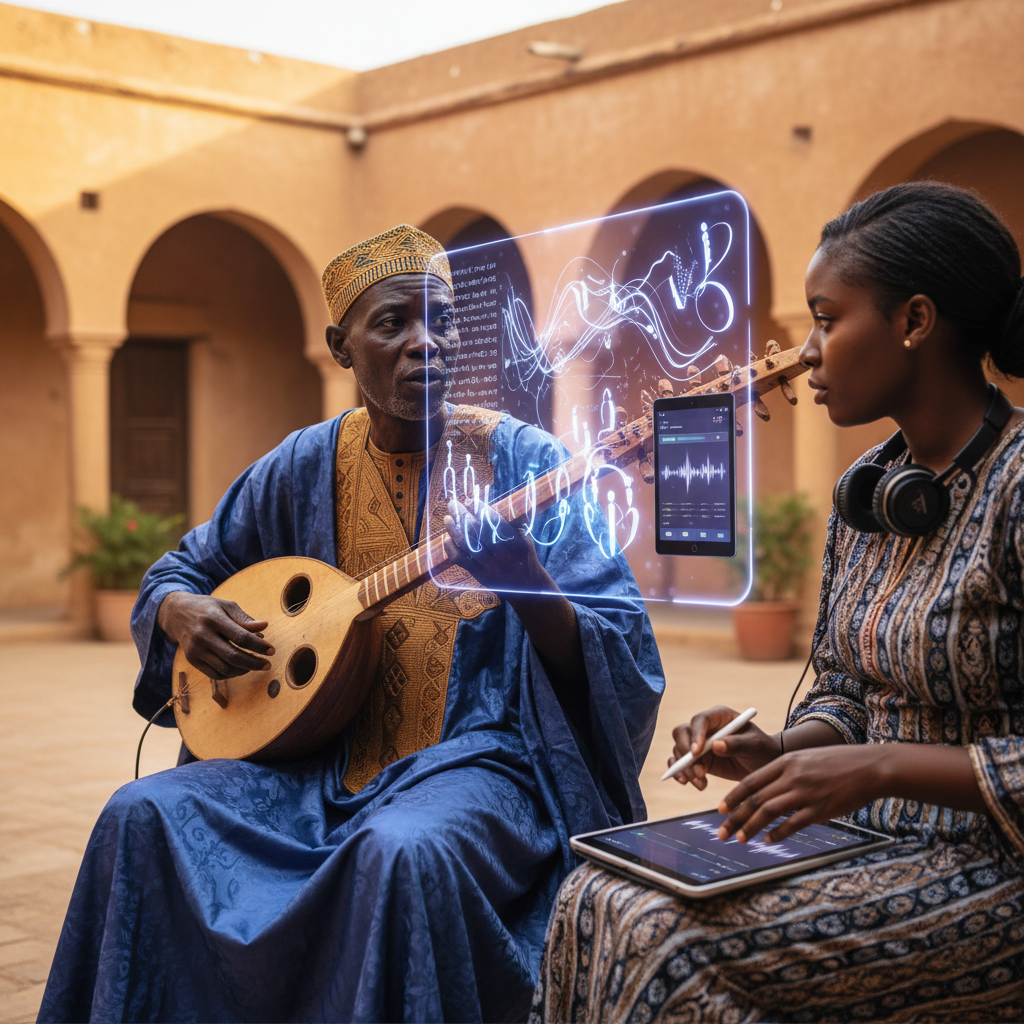
DAKAR, SENEGAL – In the bustling heart of Dakar, where the echoes of ancient griots still resonate through modern streets, a quiet revolution is brewing. It’s a digital one, aiming to harness the power of Artificial Intelligence to preserve and propagate Senegal’s invaluable Wolof oral traditions. This isn't just about technology; it's about safeguarding our very 'jikké', our cultural soul.
The initiative, spearheaded by the Ministry of Culture and Communication in collaboration with the Cheikh Anta Diop University (UCAD) and local tech incubators like JokkoLabs, seeks to create AI models capable of understanding, generating, and even performing Wolof oral narratives. Imagine an AI 'griot' telling a 'leeb' (folktale) with the nuance of a human storyteller, or an algorithm archiving thousands of 'tassu' (praise poems) and making them accessible to a global audience.
"Our oral traditions are the bedrock of our identity, the 'ndoxum daara' (water from the Quranic school) that nourishes our understanding of the world," explains Dr. Fatou Diop, a leading ethno-linguist at UCAD and a key figure in the project. "But they are fragile. Modern life, globalization, and even the decline of traditional griots threaten their continuity. AI offers a powerful tool, a 'jàngale' (teaching) mechanism that can transcend geographical and generational barriers."
The project is currently in its pilot phase, focusing on digitizing vast archives of recorded oral performances and developing natural language processing (NLP) models specifically trained on Wolof. This is no small feat, given the language's complex tonal variations and rich idiomatic expressions. "It's a challenge akin to teaching a computer the rhythm of a sabar drum," quips Ousmane Ndiaye, CEO of 'Ndongo Tech', a local startup contributing to the platform's development. "But we are committed to ensuring the AI doesn't just mimic, but truly respects the 'kàddu' (word) and its cultural weight."
Concerns, naturally, arise. Some cultural purists worry about the potential for AI to dilute the authenticity of these traditions, fearing a loss of the human touch, the 'ngor' (dignity) and 'teranga' (hospitality) inherent in a live performance. However, proponents argue that AI is not meant to replace human griots, but to augment their reach and preserve their legacy. "It's a 'njàngat' (lesson) for the future," states Minister of Culture, Moustapha Sarr. "We are not creating artificial griots; we are creating digital custodians, ensuring that our children and grandchildren can connect with the wisdom of their ancestors, no matter where they are in the world. This is about cultural resilience, about using 'xamal' (knowledge) to protect our heritage."
As Senegal looks towards 2026 and beyond, this innovative blend of ancient wisdom and cutting-edge technology promises to redefine cultural preservation, ensuring that the vibrant narratives of the Wolof people continue to inspire and educate for generations to come, much like a timeless 'xalam' melody.
Related Articles

AI's Cultural Crossroads: Czech Language and Identity in the Digital Age
 Vladimìr Novàk
Morocco's AI Health Revolution: Berber Communities on the Forefront of Digital Wellness
 Tariqù Benaì
Ghana's 'Adinkra AI' Initiative: Bridging Tradition and Technology for Digital Inclusion
 Akosùa Mensàh
Mali's Digital Future: AI for Agriculture and Local Languages
 Mouhamadouù Bâ