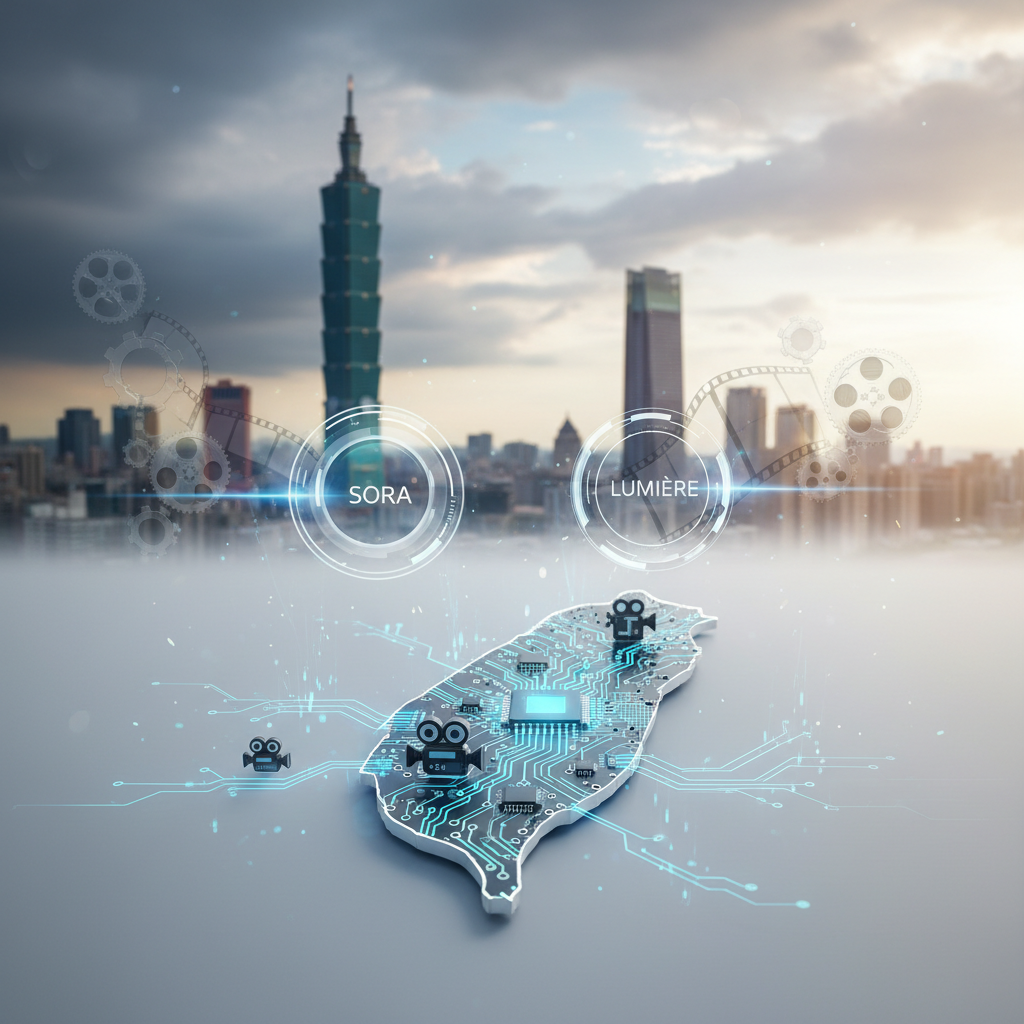

The flickering images on our screens, once the sole domain of human ingenuity and immense capital, now face a profound transformation. Generative AI models, particularly in the realm of video synthesis, are moving from academic curiosities to tools of disruptive potential. Recent demonstrations from OpenAI's Sora and Google's Lumiere have ignited fervent debate: are we witnessing Hollywood's next revolution, or its impending destruction? For Taiwan, a critical node in the global technology supply chain and an increasingly important player in content creation, the implications are particularly salient. Let's separate fact from narrative and delve into the technical architecture that underpins this seismic shift.
The technical challenge of generating coherent, high-fidelity video is formidable. Unlike static images, video requires temporal consistency, object persistence across frames, and complex motion dynamics, all while maintaining visual realism. Early attempts often struggled with 'flicker' artifacts, inconsistent character appearances, and a general lack of physical plausibility. The problem, at its core, is one of modeling high-dimensional data with both spatial and temporal dependencies. Traditional methods relied on frame-by-frame generation or interpolation, which invariably broke down over longer sequences.
Modern generative video models, such as Sora and Lumiere, largely leverage variations of diffusion models. The architecture typically involves a U-Net like backbone, similar to those used in image generation, but extended with temporal attention mechanisms and 3D convolutional layers. The process begins with a noisy latent representation, which is iteratively refined by a neural network. This network learns to reverse a diffusion process, gradually denoisifying the input to produce a coherent video sequence. The key advancement lies in how these models learn to understand and generate motion, object interactions, and scene dynamics over extended durations.
Consider a simplified architectural overview. At its highest level, the system comprises three primary components: a text-to-video encoder, a spatial-temporal U-Net denoiser, and a video decoder. The text-to-video encoder takes a natural language prompt, perhaps 'A bustling night market in Taipei, with steam rising from food stalls and people walking by,' and translates it into a rich, semantic latent representation. This representation guides the diffusion process. The spatial-temporal U-Net denoiser is the computational heart, processing the noisy video latent and progressively removing noise while ensuring both spatial realism within each frame and temporal consistency across frames. This is where the 3D convolutions and attention mechanisms are crucial, allowing the model to 'see' not just pixels, but pixel changes over time. Finally, the video decoder upsamples the refined latent representation into a high-resolution video output.
Key algorithms and approaches involve sophisticated attention mechanisms. For instance, models might employ a combination of self-attention within individual frames (spatial attention) and cross-frame attention across a sequence of frames (temporal attention). This allows the model to maintain object identity and motion trajectories. Some models also incorporate a 'factorized' approach, where spatial and temporal components are learned somewhat independently before being combined, reducing computational complexity. Pseudocode for the core diffusion step might look conceptually like this:
Implementation considerations are paramount. These models are incredibly resource-intensive. Training requires vast datasets of video and corresponding text descriptions, often curated from public sources. Inference, while less demanding than training, still necessitates powerful hardware, typically multiple NVIDIA A100 or H100 GPUs. Optimizations like mixed-precision training, efficient attention mechanisms, and model parallelism are critical for practical deployment. The sheer scale of data and computation means that only well-resourced entities like Google, Meta, and OpenAI can currently push the boundaries of this technology. Taiwan's semiconductor industry, particularly Tsmc, plays an indispensable role here, fabricating the advanced chips that power these AI behemoths. Without TSMC's cutting-edge processes, the computational horsepower required for such models would be far less accessible.
When we consider benchmarks and comparisons, the qualitative leap is undeniable. Compared to earlier generative adversarial networks (GANs) or recurrent neural network (RNN) based approaches, diffusion models exhibit superior fidelity, temporal coherence, and controllability via text prompts. While GANs struggled with mode collapse and generating diverse outputs, diffusion models offer a more stable training process and richer sample diversity. The 'quality' of AI-generated video is often assessed by human evaluators, but metrics like Fréchet Inception Distance (FID) adapted for video, or perceptual similarity metrics, offer quantitative comparisons. The data tells a more nuanced story; while the visual quality is high, the narrative coherence and artistic intent still require significant human oversight.
Code-level insights reveal reliance on frameworks like PyTorch or TensorFlow, with extensive use of libraries such as diffusers for diffusion model implementations, transformers for text encoding, and torchvision for video processing utilities. Specific patterns involve multi-scale architectures, where the U-Net processes features at various resolutions, and the careful orchestration of attention layers to capture both local and global dependencies in space and time. For instance, the use of axial attention or sparse attention patterns can help manage the quadratic complexity of full attention over long video sequences.
Real-world use cases are beginning to emerge, albeit cautiously. Production deployments are not yet replacing entire film crews, but rather augmenting them. One practical application is rapid prototyping and visualization for pre-production. Directors can generate multiple versions of a scene based on a script, quickly iterating on camera angles, lighting, and character blocking without the expense of physical sets or actors. Another use case is automated content generation for niche markets, such as short social media clips, stock footage, or personalized advertisements. Imagine a small Taiwanese animation studio using AI to generate background plates, freeing up animators to focus on character performance. Companies like RunwayML and Pika Labs are already offering tools that democratize access to these capabilities, allowing smaller studios and independent creators to experiment.
However, there are significant gotchas and pitfalls. Copyright remains a massive legal and ethical quagmire. If models are trained on existing copyrighted works, who owns the output? This is a question currently being debated in courts globally, and Taiwan's legal framework will need to adapt swiftly. Bias in training data can also lead to problematic outputs, perpetuating stereotypes or misrepresenting certain demographics. Furthermore, the 'uncanny valley' effect is still prevalent; while AI can generate photorealistic scenes, subtle imperfections in human motion or expression can make the output feel unsettlingly artificial. The creative control aspect is also crucial; while AI can generate, it cannot yet truly 'create' with the intentionality and emotional depth of a human artist. Taiwan's position is more complex than headlines suggest, as it grapples with both the opportunities for its tech sector and the potential disruption to its burgeoning creative industries.
As Wei-Chéng Liu, I observe these developments with a critical eye. The promise of AI-generated cinema is immense, offering unprecedented efficiency and accessibility. Yet, the path to a truly revolutionary impact is fraught with technical, ethical, and legal challenges. The semiconductor industry here in Taiwan will continue to provide the foundational hardware, but the software, the data, and the societal implications demand careful consideration and robust policy. We must ask not just what AI can do, but what it should do, and how we ensure it serves human creativity rather than subsuming it.
For those seeking to delve deeper, excellent resources include research papers on diffusion models applied to video generation, such as those from Google Research and OpenAI. The arXiv pre-print server is an invaluable source for the latest academic contributions. For industry perspectives and practical applications, platforms like TechCrunch often feature interviews with startups pushing the boundaries. Understanding the underlying mathematics of stochastic differential equations and variational inference is also beneficial, as is hands-on experimentation with open-source implementations of diffusion models.