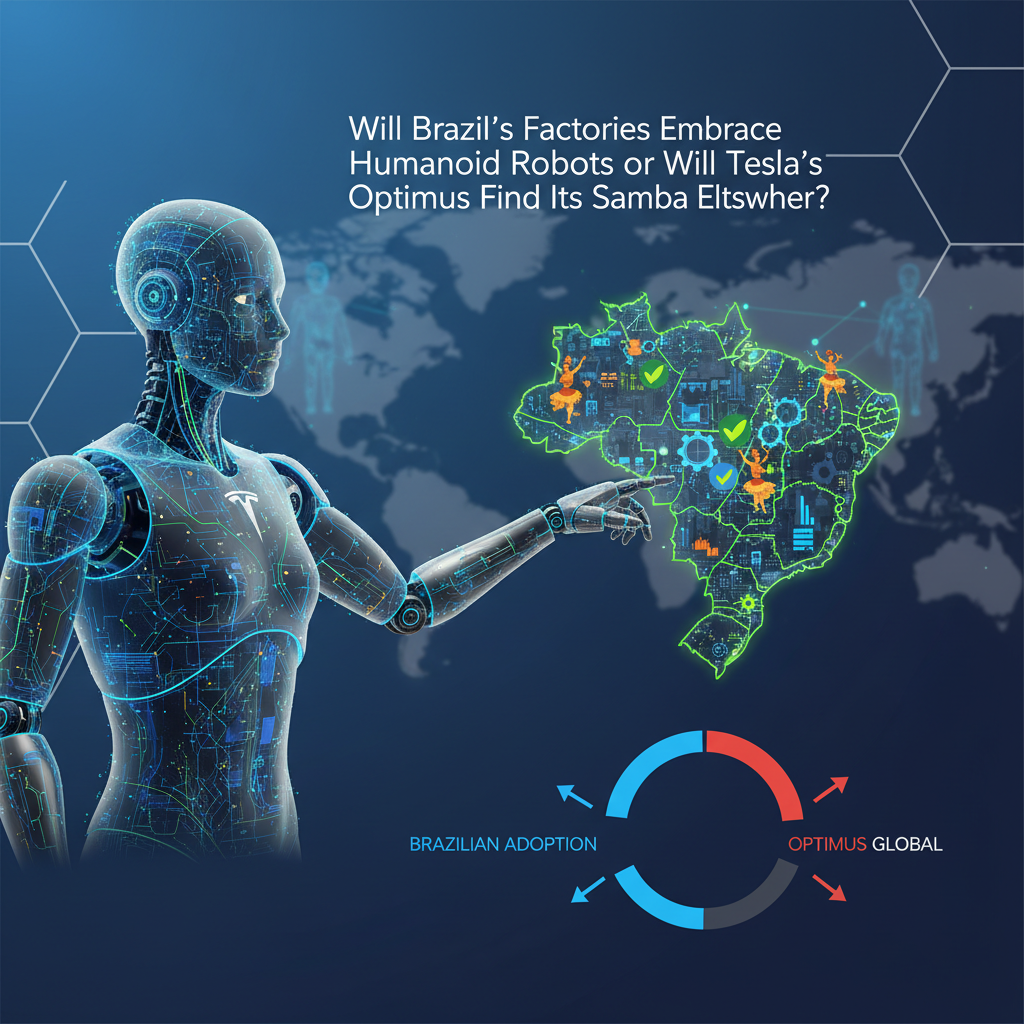

Is it just me, or does it feel like we are living in a science fiction movie that someone forgot to give a proper script to? One minute we are talking about AI chatbots, the next we have metal people walking around, ready to flip burgers or pack boxes. The buzz around humanoid robots entering the workforce, from sprawling factories to bustling retail stores and even our favorite neighborhood restaurants, is deafening. But here in Brazil, where the rhythm of innovation often dances to its own beat, I have to ask: is this a genuine industrial revolution knocking on our door, or just another Silicon Valley spectacle that will take decades to truly trickle down to our shores?
For centuries, the idea of automatons mimicking human form has captivated us. From the intricate mechanical dolls of the 18th century to the industrial robots that transformed automotive assembly lines in the mid-20th century, humanity has always sought to offload repetitive or dangerous tasks to machines. The difference today is not just in capability, but in form. These are not just articulated arms bolted to a floor, these are bipedal, often human-sized machines designed to navigate environments built for people. They are meant to pick up tools, open doors, and interact with objects in ways that traditional industrial robots simply cannot. It is a fundamental shift in how we envision automation.
Historically, Brazil has been a fascinating case study in industrial adoption. We have seen rapid modernization in sectors like agriculture, where agritech AI is transforming yields, and in finance, where our fintech scene is truly world-class. But heavy manufacturing, while significant, has often lagged behind global leaders in adopting cutting-edge automation. The cost, the complexity, and the sheer scale of investment required have always been formidable barriers. However, the current wave of humanoid robotics is different. Companies like Boston Dynamics with their Atlas, and more recently, Tesla with Optimus and Figure AI with their Figure 01, are pushing the boundaries of what is possible, and crucially, what is economically viable. They are not just building robots, they are building platforms.
Consider Tesla's Optimus, which Elon Musk has repeatedly stated will eventually cost less than a car. If that promise holds, we are talking about a game-changer. Imagine a future where a factory can deploy a fleet of general-purpose humanoids for tasks ranging from material handling to quality inspection, without needing to redesign the entire facility. According to Reuters, the market for humanoid robots is projected to grow significantly in the coming decade, driven by advancements in AI, sensor technology, and battery life. We are seeing early deployments, like Figure AI partnering with BMW to integrate their Figure 01 humanoids into manufacturing facilities in the US, handling tasks that previously required human dexterity.
But the question for us, for Brazil, is not just about the technology itself, but its integration into our unique economic and social fabric. Will these robots truly address our labor challenges, or will they exacerbate existing inequalities? I spoke with Dr. Ana Paula Dutra, a leading expert in industrial automation at the University of São Paulo. She told me, “The potential for humanoids in Brazil is immense, particularly in sectors facing labor shortages for strenuous or hazardous jobs, or those requiring high precision. However, we must be strategic. It is not just about importing robots, it is about developing the local expertise to integrate, maintain, and innovate with them. We need to focus on education and reskilling our workforce, not just replacing them.” Her point is well taken. We cannot just be consumers of this technology; we must be creators and adaptors.
Another perspective comes from João Mendes, CEO of a prominent Brazilian logistics startup that recently integrated advanced sorting robots. He shared, “The initial investment is always a hurdle, especially with our interest rates, but the long-term efficiency gains are undeniable. For humanoids, the flexibility is the real draw. If a robot can do multiple jobs, that changes the calculus completely. We are closely watching companies like Agility Robotics and their Digit robot, designed for warehouse logistics, because that is a direct fit for our operations. The global supply chain demands efficiency, and Brazil needs to be competitive.” Mendes highlights the pragmatic business case, focusing on the return on investment and adaptability.
My take? This is not a fad. This is the new normal, slowly but surely. The technological advancements in AI, particularly in areas like reinforcement learning and computer vision, are making these robots increasingly capable and autonomous. NVIDIA, for instance, is not just selling GPUs, they are building the foundational AI platforms that power these next-generation robots. Their Isaac platform is designed to accelerate robotics development, providing the simulation tools and AI models necessary for robots to learn and adapt to complex, real-world environments. This kind of infrastructure support is what makes the current wave different from previous attempts.
However, the path for Brazil will be complex. We are a nation of immense potential, but also one with significant social challenges. The fear of job displacement is real, and it needs to be addressed head-on. We need robust public discourse and proactive policy-making to ensure that the benefits of this robotic revolution are shared broadly. We cannot afford a future where only a select few prosper while the majority are left behind.
This is Brazil's decade, I truly believe that. We have the talent, the ambition, and the sheer scale to become a major player in the global AI and robotics landscape. But it requires foresight, investment in education, and a willingness to embrace change, not just as a consumer, but as an innovator. We have seen how our financial sector adapted to digital transformation with PIX, our instant payment system, becoming a global benchmark. We can do the same with robotics. The sleeping giant of AI is waking up, and it needs to decide if it will lead the dance with humanoids or merely watch from the sidelines.
The integration of humanoids into our workforce will not be a simple flip of a switch. It will be a gradual, iterative process, filled with trials, errors, and continuous adaptation. But the trajectory is clear. From the assembly lines of São Bernardo do Campo to the retail aisles of Rio de Janeiro, these machines are coming. The question is not if, but how, Brazil will welcome them and, more importantly, how we will shape their role to build a more prosperous and equitable future for all. The global race is on, and the samba of innovation waits for no one. For more insights into how AI is shaping industries globally, check out MIT Technology Review. You can also follow the latest in AI and robotics developments on TechCrunch.
Speaking of our own backyard, if you want to understand how Brazil's AI is already making waves in other sectors, you might be interested in this article: From Guarulhos to the Globe: How Brazil's AI is Charting a New Course for Aviation [blocked].