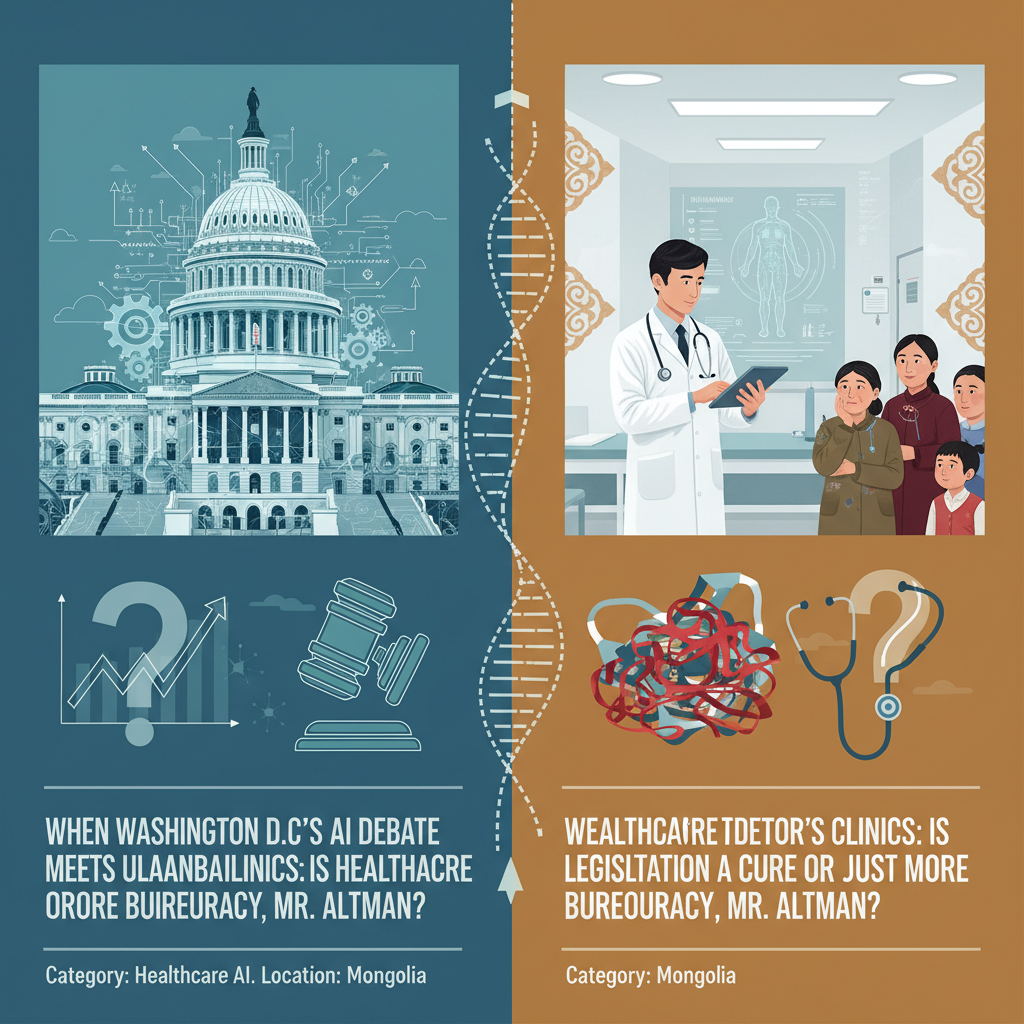

Is the US Congress truly charting a course for responsible AI in healthcare, or are we witnessing another cycle of grand pronouncements diluted by powerful lobbying? This is the question that echoes from the marble halls of Washington D.C. all the way to the ger districts of Ulaanbaatar. From where I sit, in a country where healthcare access can mean a day's journey across the steppe, the talk of AI legislation often feels distant, yet its implications are profoundly real.
For years, the promise of artificial intelligence in healthcare has been immense. We've heard about AI diagnosing diseases earlier, personalizing treatments, and even streamlining hospital operations. Here in Mongolia, where specialists are scarce in rural areas, AI powered diagnostics could be a game changer, bringing expert-level analysis to places that have never had it. But the rapid advancement of models like OpenAI's GPT-4 and Anthropic's Claude 3 in medical contexts has also brought a surge of ethical and safety concerns. Who is liable when an AI misdiagnoses? How do we ensure fairness in algorithms trained on potentially biased datasets? These are not abstract philosophical debates; they are questions of life and death.
The historical context of technology regulation in the US offers a mixed bag of lessons. Think back to the early days of the internet. A hands-off approach initially fostered explosive growth, but it also led to significant challenges in privacy, misinformation, and market dominance that policymakers are still struggling to address decades later. With AI, there's a palpable sense that lawmakers want to avoid repeating those mistakes. The current legislative push is not a sudden epiphany; it's the culmination of years of warnings from academics, ethicists, and even some industry insiders. Dr. Anya Sharma, a senior policy analyst at the Center for AI and Public Policy, noted, "The sheer speed of AI development, coupled with its pervasive impact on critical sectors like healthcare, has forced Congress's hand. They can no longer afford to wait and see, but the challenge is designing legislation that is both effective and future-proof." Her comments, made during a recent virtual panel, highlighted the tightrope walk policymakers face.
Fast forward to today, April 2026. The US Congress is deep in debate over several comprehensive AI bills. The proposed AI in Healthcare Act, for instance, aims to establish a federal oversight body, mandate algorithmic transparency, and set standards for data privacy and security. Early drafts included provisions for independent audits of AI models used in clinical settings, and even a 'kill switch' mechanism for systems deemed unsafe. However, the legislative process is rarely so straightforward. Data from the Congressional Research Service indicates that over 150 AI-related bills have been introduced since 2023, but only a handful have made it past committee stages. The primary sticking point? Industry lobbying.
Major tech players like Google, Microsoft, and NVIDIA, alongside pharmaceutical and healthcare giants, have significantly ramped up their lobbying efforts. Public records show that spending on AI lobbying by these companies collectively surged by over 40% in 2025, reaching an estimated $120 million. Their arguments often center on the fear of stifling innovation, advocating for a more industry-led, self-regulatory approach. "Overly prescriptive regulation could inadvertently slow down the very advancements that promise to revolutionize patient care," stated Dr. Elias Vance, Chief Medical AI Officer at MedTech Innovations, in a recent industry white paper. "We need frameworks that encourage responsible development, not ones that create unnecessary barriers to entry for life-saving technologies." This perspective, while understandable from a business standpoint, often overlooks the power imbalances inherent in technology adoption, especially in vulnerable populations.
Here in Mongolia, we watch these debates with keen interest. Our healthcare system, while robust in its resilience, faces unique challenges. Vast distances separate communities, and specialized medical expertise is concentrated in urban centers like Ulaanbaatar. Mongolia's challenges are unique and so are its solutions, and AI offers a glimmer of hope. Imagine an AI diagnostic tool, trained on diverse global and local datasets, helping a rural doctor in Khovd province identify a rare condition. Or an AI assistant streamlining administrative tasks, freeing up nurses to focus on patient care. But for this to be a reality, the AI must be reliable, transparent, and ethically sound. We cannot afford to import technologies that carry the biases or regulatory loopholes of their origin countries.
Ms. Enkhjargal Batbold, head of the Mongolian Ministry of Health's Digital Transformation Department, emphasized this point in a recent discussion. "For us, practical innovation means technology that works, reliably, in our specific context. We cannot simply adopt systems designed for densely populated, resource-rich environments without careful consideration. Any US legislation, while focused on their own market, will inevitably set precedents that influence global standards and the products offered to us." Her words underscore a critical truth: the ripple effects of US policy are felt far beyond its borders, particularly in a globalized tech landscape.
Consider the data. A recent report by the World Health Organization suggested that AI could reduce diagnostic errors by up to 30% in low-resource settings, provided the models are properly validated and regulated. However, an analysis by MIT Technology Review highlighted that less than 5% of AI models currently deployed in healthcare have undergone independent, rigorous ethical audits. This gap is precisely what Congress is trying to address, but the path is fraught with compromises.
One of the most contentious points in the US debate is the role of federal agencies. Some proposals advocate for the FDA to expand its oversight significantly, treating AI algorithms as medical devices. Others suggest a new, dedicated AI agency, or a multi-agency task force. This bureaucratic wrangling, while necessary, consumes valuable time. Meanwhile, AI capabilities continue to advance at a breakneck pace. Sam Altman, CEO of OpenAI, has publicly called for a balanced approach, advocating for international cooperation on AI safety while warning against overregulation that could cede leadership to other nations. His company has been a significant voice in the US legislative discussions, often pushing for flexible, principles-based regulation rather than rigid rules. You can often find their perspectives on their official blog, like OpenAI's Blog.
My verdict? The current legislative push in the US Congress is not a fad, but it is far from a complete solution. It represents a necessary, albeit belated, acknowledgement of AI's profound societal impact. The sheer volume of legislative proposals and the intensity of industry lobbying suggest that this is indeed the new normal: a continuous, complex negotiation between innovation, ethics, and economic interests. However, the danger lies in the compromises made. If the final legislation is too watered down, too focused on appeasing powerful corporations, it risks becoming a regulatory facade rather than a genuine safeguard. The ultimate outcome will likely be a patchwork of regulations, some effective, some less so, creating a complex compliance landscape for companies and a varied safety net for patients.
From our vantage point, where the steppe meets the server farm, we need clear, actionable, and globally resonant standards. We need AI that serves humanity, not just corporate bottom lines. The US legislative debate is a crucial step, but it is just one step on a very long journey. The real test will be whether these laws can foster truly beneficial and equitable AI, not just for the well-connected in Silicon Valley, but for everyone, including the herder's child in the remotest corner of Mongolia who might one day rely on an AI for their health. For more insights on global AI policy, you might find articles on Reuters Technology section useful. The conversation is far from over, and its outcome will shape the future of healthcare for generations. We must demand practical, enforceable solutions, not just well-intentioned rhetoric.