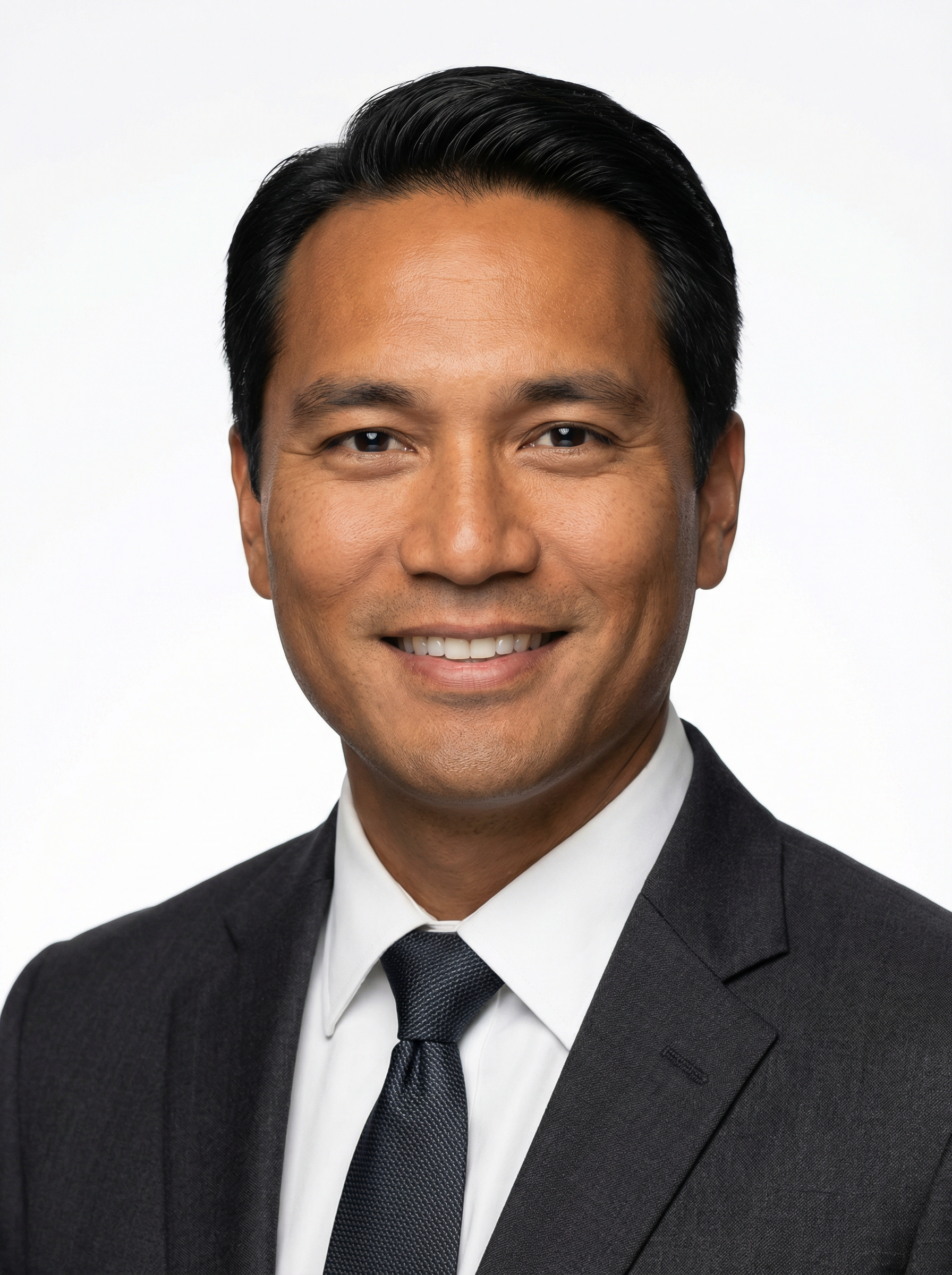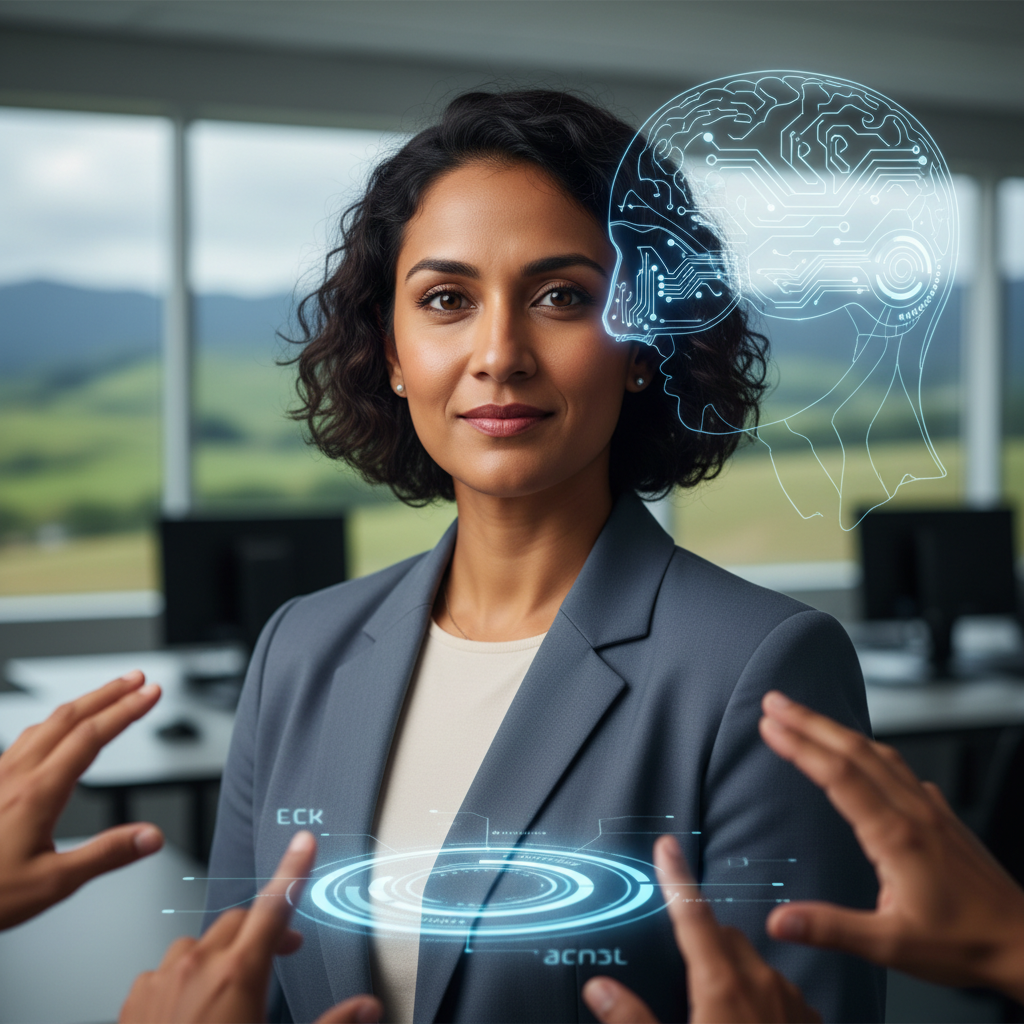
The air in Dr. Anya Sharma's lab at the University of Auckland hums with a quiet energy, a stark contrast to the bustling city just beyond its walls. It is a space where the future of human potential is being meticulously, thoughtfully, and ethically crafted. As I walked in, the scent of antiseptic mingled with something subtly metallic, the smell of cutting-edge research, perhaps. Dr. Sharma, a woman whose calm demeanor belies the revolutionary nature of her work, greeted me with a warm smile. She is a leading figure in the burgeoning field of brain-computer interfaces (BCIs) and her team is pushing the boundaries of what AI can do to restore lost human functions.
“Come in, Arohà,” she said, gesturing towards a sleek, minimalist meeting area overlooking the Waitematā Harbour. “It is good to finally connect.”
I had heard whispers about Dr. Sharma’s work for months, particularly her team's advancements in using sophisticated AI algorithms, often drawing inspiration from Google DeepMind's foundational research, to interpret neural signals with unprecedented accuracy. Their focus is not just on technological prowess, but on ensuring these life-changing innovations reach those who need them most. In Te Reo Māori, we have a word for this, manaakitanga, which speaks to hospitality, kindness, and generosity, but also to the care and protection of people. It is a concept that feels deeply embedded in Dr. Sharma’s approach.
“Our goal here is simple, yet profoundly complex,” Dr. Sharma began, her gaze fixed on the distant Rangitoto Island. “We are building bridges between the human mind and the digital world, not for enhancement, but for restoration. Imagine giving a voice back to someone silenced by locked-in syndrome, or sight to someone who has only known darkness, or the ability to walk again.”
Her lab, a collaborative effort with funding from both the New Zealand government and private entities like NVIDIA, has recently achieved a significant milestone. They successfully demonstrated an AI-powered BCI that allowed a participant with severe motor neuron disease to control a robotic arm with thought alone, achieving a 92% accuracy rate in object manipulation during trials. This is a leap forward from previous iterations, which often struggled with signal noise and latency. “The AI, a custom-trained neural network akin to advanced versions of OpenAI’s GPT models but specialized for neural decoding, learns the unique ‘language’ of an individual’s brain,” she explained. “It translates intention into action, bypassing damaged neural pathways.”
I asked her about the journey that led her to this point. Dr. Sharma, originally from a small town in Waikato, spoke of a childhood fascination with biology and a deep-seated desire to help people. “I saw the profound impact of neurological conditions on families, including my own,” she shared. “The helplessness can be overwhelming. I knew technology had to offer more.” After completing her doctorate in computational neuroscience, she spent time at leading institutions overseas, including a stint at MIT, but felt a strong pull to return home. “Aotearoa’s approach to AI is rooted in indigenous wisdom, a holistic view of well-being that prioritizes community and ethical development,” she stated. “That resonated deeply with me. I believe technology must serve the people, not the other way around.”
One of the most surprising moments of our conversation came when she detailed the challenges of data diversity. “Most BCI research data sets are heavily skewed towards Western populations,” she revealed. “This creates inherent biases in the AI models. If an algorithm is trained predominantly on data from one demographic, its performance may degrade significantly when applied to others. For Māori and Pasifika communities, this is a critical concern, as neurological conditions can manifest differently, and cultural interpretations of health and well-being are distinct.” Her team is actively collaborating with Māori health providers and community leaders to build culturally sensitive and representative datasets, ensuring their AI models are truly universal in their application.
“We are not just collecting data, we are building relationships based on trust and mutual respect,” said Dr. Hemi Pōtiki, a Senior Māori Health Advisor working with Dr. Sharma's team. “It is about ensuring that this incredible technology is developed with our communities, not just for them. Data sovereignty is paramount here.” This emphasis on partnership and ethical data governance sets a powerful precedent for global AI development, a lesson many larger tech companies could learn from. For more on the ethical considerations of AI, particularly in health, MIT Technology Review often publishes insightful pieces.
Our discussion then shifted to the economic implications. While the potential for improved quality of life is immeasurable, the cost of these advanced BCIs remains a significant barrier. “A single, sophisticated BCI implant and its accompanying AI processing unit can currently cost upwards of NZD $500,000,” Dr. Sharma admitted. “That is simply out of reach for most. We are working tirelessly to drive down these costs through miniaturization, improved manufacturing processes, and open-source AI frameworks. Our aim is to make this technology as accessible as a smartphone, not a luxury item.” She cited ongoing discussions with the New Zealand Ministry of Health and ACC (Accident Compensation Corporation) to explore pathways for subsidized access, recognizing the societal benefit of restoring independence and dignity.
I asked her about the role of global tech giants. “Companies like Meta and Neuralink are pouring billions into BCI research, often with a focus on augmentation rather than just restoration,” I noted. “How does your approach differ?”
Dr. Sharma paused, choosing her words carefully. “Their investments are certainly accelerating the core science, and we learn from their advancements, particularly in areas like signal processing and miniaturization. However, our fundamental philosophy diverges. While they might explore connecting healthy brains to the metaverse, our immediate priority is alleviating suffering. We are driven by a humanitarian imperative, not a commercial one, although sustainable funding is always a consideration. We want to ensure that the benefits of this technology are distributed equitably, not just to those who can afford it or those who fit a narrow definition of 'normal.'”
She believes that the true measure of AI’s success in this domain will not be in how many new capabilities it unlocks for the already able-bodied, but in how many people it helps reclaim what was lost. “The stories we hear from our trial participants, the sheer joy in their eyes when they move a cursor with their thoughts, or utter a word through a synthetic voice, that is our true metric of progress,” she said, a hint of emotion in her voice. “It is about restoring whanaungatanga, connection, to their families and communities.”
Looking ahead, Dr. Sharma envisions a future where BCIs are not just medical devices but integrated tools that empower individuals. Her team is also exploring non-invasive BCI applications, using AI to enhance rehabilitation therapies for stroke survivors and individuals with spinal cord injuries, without the need for surgery. “The potential for AI to personalize these therapies, adapting in real-time to a patient’s progress, is immense,” she enthused. “We are just scratching the surface of what is possible.” For more on the broader applications of AI in healthcare, you can explore Reuters' technology section.
As our interview concluded, Dr. Sharma escorted me out, the hum of the lab fading behind us. Her work is not just about wires and algorithms; it is about hope, dignity, and the profound belief that everyone deserves a chance to live a full life. Her vision, deeply rooted in the values of Aotearoa, offers a powerful counter-narrative to the often-unfettered pursuit of technological advancement. It is a reminder that true innovation must always be guided by compassion and a commitment to equity. Her work is a beacon, showing us that the most advanced AI can, and should, serve humanity’s deepest needs. It is a future I, for one, am eager to witness unfold. While this article focuses on BCIs, the broader ethical considerations around AI are always relevant, and you can find more discussions on AI ethics and societal impact [blocked] in other AI News reports.