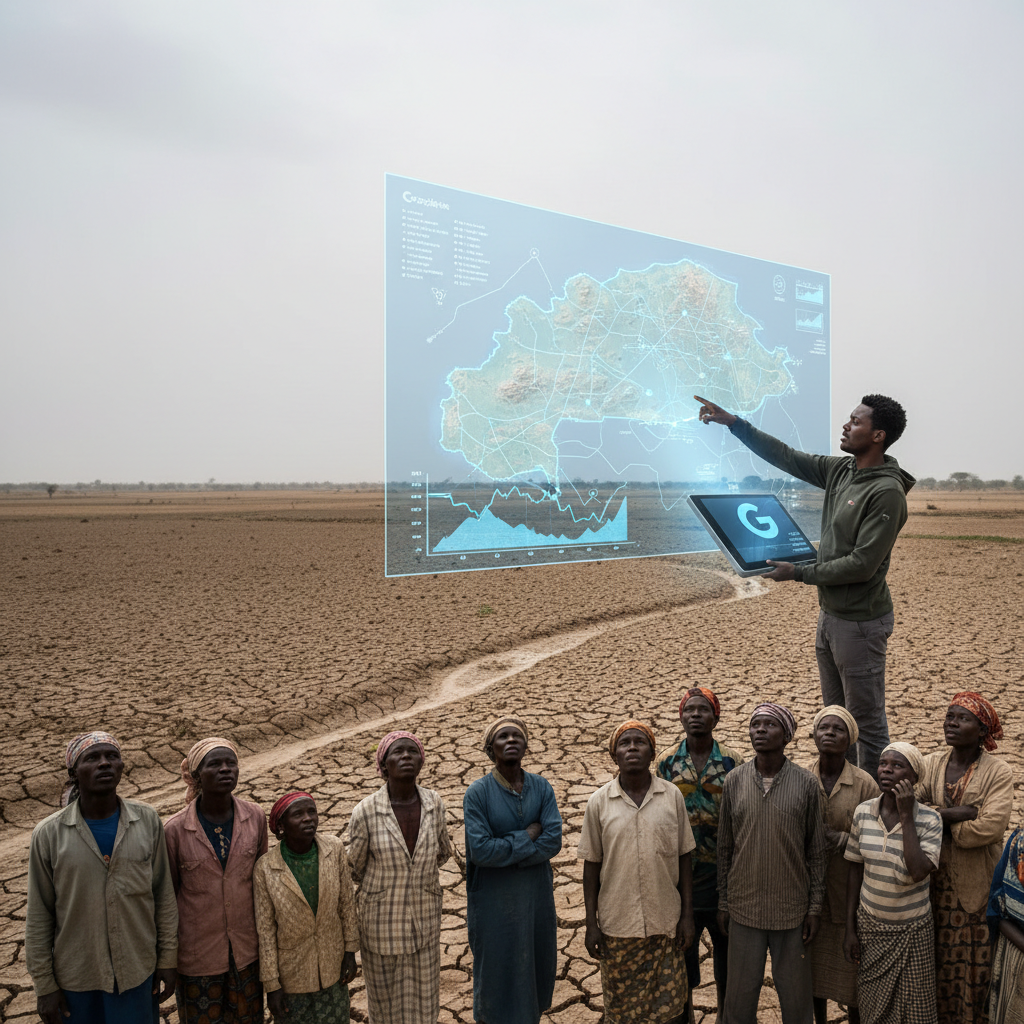

Here in Burkina Faso, the rhythm of life, especially in our villages, has always been tied to the sky. The planting, the harvest, the very survival of our families, it all hinges on the rains. But the rains, as we know too well, have become unpredictable. One year, a deluge washes away homes; the next, a relentless sun bakes the earth into dust. This isn't just bad luck, it is climate change, and its effects are felt most acutely by those who have contributed least to it.
For too long, predicting these shifts felt like reading tea leaves. But now, there is a new tool in the fight, one that promises to bring clarity to the chaos: AI-powered climate modeling. Forget the hype, this is what matters for people whose lives depend on knowing what the weather will do next.
What is AI-Powered Climate Modeling?
At its core, AI-powered climate modeling is about using artificial intelligence, particularly machine learning, to analyze vast amounts of environmental data and predict future climate patterns with greater accuracy and speed than traditional methods. Think of it like this: traditional climate models are like a highly skilled artisan building a complex sculpture piece by piece, meticulously calculating every angle. AI models, on the other hand, are like a powerful computer that has studied millions of sculptures, learned the underlying patterns, and can now rapidly generate new, incredibly detailed ones, often spotting connections the human eye might miss.
These models ingest everything from satellite imagery, ocean temperatures, atmospheric pressure, wind patterns, and historical weather records to even geological data. They then identify complex, non-linear relationships within this data, which are often too intricate for human scientists or conventional statistical models to fully grasp. The goal is not just to forecast tomorrow's weather, but to project climate trends weeks, months, or even years into the future, with a focus on extreme events like droughts, floods, heatwaves, and severe storms.
Why Should You Care, Especially Here in Burkina Faso?
For us, the answer is simple: survival and prosperity. When the rains fail, our farmers lose their crops, leading to food insecurity and economic hardship. When floods come, homes are destroyed, diseases spread, and infrastructure is damaged. The reality on the ground is that accurate predictions mean we can prepare. It means farmers can choose drought-resistant crops, or plant at optimal times. It means aid organizations can pre-position resources before a famine hits. It means our government can plan for water management, build resilient infrastructure, and protect our people.
Consider the Sahel, a region particularly vulnerable to climate shocks. A 2023 report by the United Nations Office for the Coordination of Humanitarian Affairs (ocha) indicated that over 30 million people in the Sahel region were projected to face food insecurity. This is not some abstract number; these are our neighbors, our families. Better climate predictions could literally save lives and livelihoods.
How Did It Develop?
The journey to AI-powered climate modeling began with the foundational work in meteorology and climate science, which has been evolving for centuries. Early climate models, developed in the mid-20th century, relied on complex physics equations run on supercomputers. These were groundbreaking, but computationally intensive and often limited in resolution and speed. The advent of machine learning in the late 20th and early 21st centuries, coupled with the explosion of data from satellites, sensors, and global observation networks, provided a new pathway.
Researchers started experimenting with neural networks to identify patterns in climate data. Companies like Google, with its DeepMind AI division, and institutions like the European Centre for Medium-Range Weather Forecasts (ecmwf) began dedicating significant resources to this field. The breakthroughs in deep learning, particularly in areas like computer vision and natural language processing, showed that AI could handle incredibly complex, high-dimensional data, a perfect fit for the intricacies of climate science.
How Does It Work in Simple Terms?
Imagine you are teaching a child to recognize different types of clouds. You show them thousands of pictures: cumulus, stratus, cirrus. You point out the fluffy ones, the flat gray ones, the wispy ones. Over time, the child learns to identify them on their own, even new ones they haven't seen before. That is a bit like how AI learns. Instead of clouds, it is learning patterns in atmospheric pressure, ocean currents, and temperature anomalies.
Specifically, these models often use what are called neural networks. These are layers of interconnected