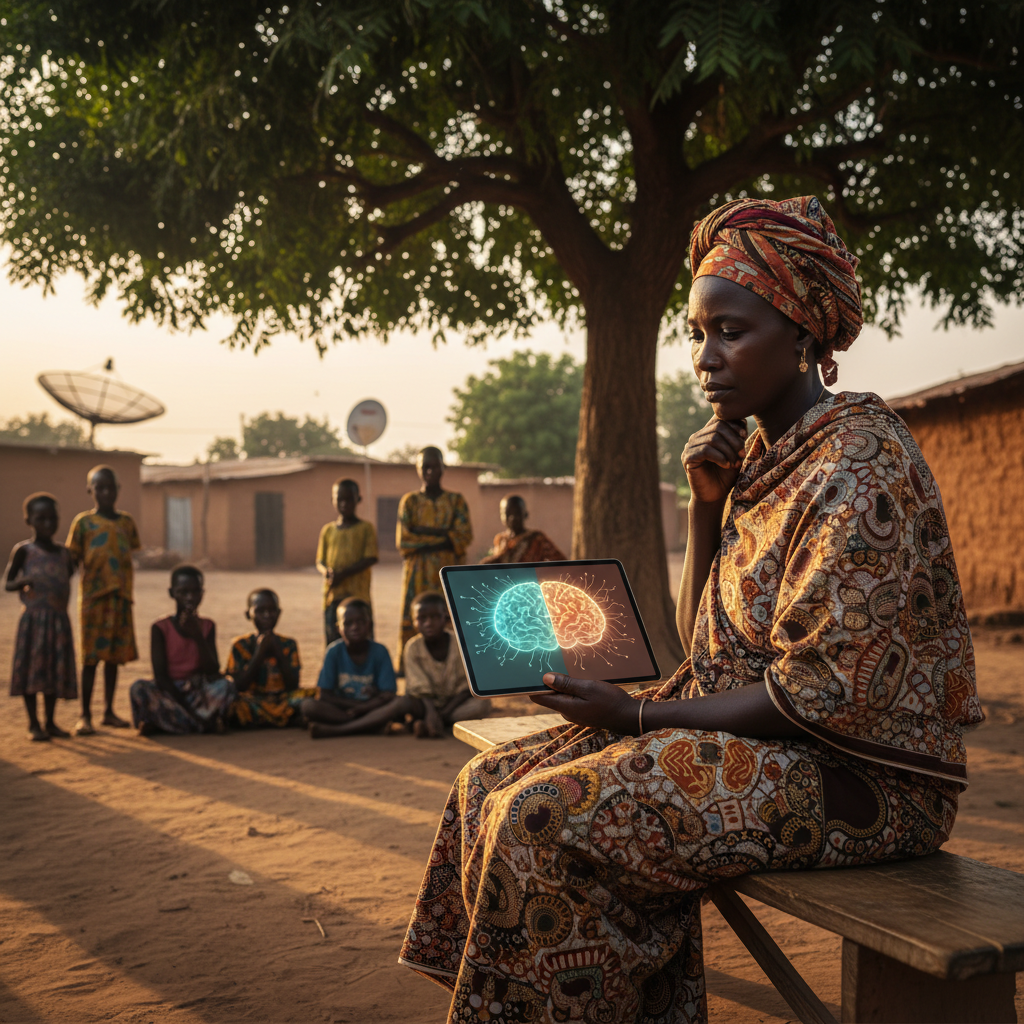
The sun beats down on the dusty streets of Ouagadougou, much as it always has. Life here moves with a rhythm dictated by necessity, by community, and by the challenges that are a daily reality for many. Yet, even in this familiar landscape, the whispers of a new kind of technology are growing louder: artificial intelligence, now claiming it can mend the mind.
Globally, the conversation around AI and mental health is booming. Companies like Woebot Health and Wysa are making headlines with their therapy chatbots, promising accessible, affordable mental health support. Then there are the addiction algorithms, designed to predict relapse or personalize recovery plans. And, of course, the broader concept of digital wellness, where AI nudges us towards healthier screen habits. It all sounds very impressive on paper, a solution to a global crisis of mental wellbeing. But here, in Burkina Faso, where access to basic healthcare is still a struggle for many, the picture is far more complex.
"We hear about these AI solutions from Europe and America, and they sound like magic," says Dr. Aïcha Sawadogo, a clinical psychologist who runs a small, overburdened clinic in the capital. "But magic often comes with a hidden cost, or simply does not translate to our reality. Our patients need to feel understood, to see a human face, to know that their struggles are recognized within their cultural context. Can an algorithm truly do that? I have my doubts." Dr. Sawadogo's skepticism is not unique; it echoes a sentiment I've encountered often when discussing these high-tech promises.
The reality on the ground is that mental health services are critically underfunded and understaffed across much of Africa. In Burkina Faso, the ratio of mental health professionals to the population is staggeringly low, far below the global average. The World Health Organization estimates that in low-income countries, there is often less than one mental health professional per 100,000 people. This scarcity creates a massive vacuum, one that proponents argue AI could help fill.
Consider the potential: a young person in a remote village, struggling with anxiety, could theoretically access a chatbot on a basic smartphone, receiving immediate, anonymous support. This is the dream sold by the tech giants. OpenAI's GPT models, Meta's Llama, and Anthropic's Claude are all being explored for their potential in conversational AI for therapeutic purposes. The idea is that these large language models, trained on vast datasets of human conversation, can mimic empathetic dialogue and provide cognitive behavioral therapy (CBT) techniques.
However, the data sets these models are trained on are overwhelmingly Western. They reflect Western cultural norms, linguistic nuances, and psychological frameworks. "The way we express distress, the role of family, community, and spiritual beliefs in our mental landscape, these are deeply rooted in our culture," explains Professor Karim Traoré, a sociologist at the University of Ouagadougou. "An AI trained on English language data from Silicon Valley cannot possibly grasp the subtleties of a Mossi or Fulani person's experience. It's like trying to understand the taste of tô by reading a recipe for pizza. It just doesn't work." This cultural disconnect is a significant barrier, one that is often overlooked in the rush to deploy solutions globally.
Furthermore, the issue of data privacy and security is paramount. In a region where digital literacy can be low and trust in institutions sometimes fragile, the idea of sharing intimate mental health struggles with a faceless algorithm, whose data is stored on servers thousands of kilometers away, raises serious concerns. Who owns this data? How is it protected? Could it be used for other purposes? These are not abstract questions; they are fundamental to adoption and trust.
Here's what actually happened in a pilot program I tracked in a small town near Koudougou. A non-governmental organization, working with a European tech firm, introduced a mental wellness app featuring a chatbot. The initial uptake was modest. After three months, only about 15% of the target users continued engaging with it regularly. The feedback was telling: users felt the chatbot was repetitive, its advice generic, and it often failed to understand their specific socio-economic pressures, such as food insecurity or familial obligations, which profoundly impact mental well-being here.
"It told me to 'practice mindfulness' when I was worried about how to feed my children," one woman told me, shaking her head. "Mindfulness is good, I am sure, but it does not put food on the table. It did not understand my real problem." This anecdote highlights the chasm between theoretical solutions and practical needs. Forget the hype; this is what matters: does it address the actual lived experience of the people it is meant to serve?
Addiction algorithms present another complex picture. In many parts of Burkina Faso, substance abuse, particularly alcohol and cannabis, is a growing concern, often linked to economic hardship and social dislocation. Algorithms designed to predict relapse or tailor interventions could theoretically be powerful tools. However, these systems rely heavily on consistent data input, often from wearable devices or frequent self-reporting. Such infrastructure is simply not widely available or culturally appropriate in many rural settings.
"We need to build trust first, then perhaps integrate technology," says Madame Fatoumata Diallo, a community health worker in Bobo-Dioulasso. "If someone is struggling with addiction, they need a safe space, a human connection, not just a digital prompt. The algorithm might tell us when someone is at risk, but it does not tell us why or how to truly help them in a way that respects their dignity and their community ties." Her words underscore the importance of human-centered design and implementation.
Even the concept of digital wellness, often framed around managing screen time and digital detoxes, feels somewhat detached when internet access itself is still a luxury for many. While smartphone penetration is increasing, consistent, affordable data is not a given. The digital divide is not just about access; it is about relevance and utility.
This is not to say that AI has no role. Far from it. I believe AI can be a powerful augment to human care, not a replacement. Imagine AI tools that could help overburdened mental health professionals with administrative tasks, allowing them more time with patients. Or AI that could analyze anonymized local health data to identify patterns and predict outbreaks of certain mental health issues in specific communities, informing targeted public health campaigns. This is where the data-driven approach truly shines, supporting existing systems rather than attempting to reinvent them from scratch.
For instance, an AI system that helps analyze local dialect in transcribed therapy sessions, providing insights to clinicians, could be invaluable. Or an AI that helps translate culturally sensitive mental health resources into local languages, making them more accessible. These are practical applications that respect the existing human infrastructure and cultural context.
Companies like Google and Microsoft, with their vast resources, could invest in developing culturally localized AI models, working directly with African psychologists, linguists, and community leaders. This would involve training models on diverse datasets, including local languages, cultural narratives, and specific socio-economic indicators. It means moving beyond a one-size-fits-all approach and embracing the rich diversity of human experience. MIT Technology Review has often highlighted the need for localized AI solutions, and this is precisely the kind of investment needed here.
There is also a pressing need for ethical guidelines and regulatory frameworks tailored to the African context. We cannot simply import regulations from the EU or the US. Our governments, like the Ministry of Health in Burkina Faso, must engage with experts to develop policies that protect citizens, ensure data sovereignty, and promote responsible AI development that serves our unique needs. This is a conversation that needs to happen now, before the technology outpaces our ability to govern it.
Ultimately, the promise of AI for mental health in Burkina Faso, and indeed across Africa, is not in replacing the human touch, but in intelligently augmenting it. It is about empowering our existing healthcare workers, making their jobs more efficient, and extending their reach, while always prioritizing the deeply human need for empathy, understanding, and culturally relevant care. Anything less is just another tech solution looking for a problem it doesn't quite understand. The path forward requires collaboration, cultural sensitivity, and a healthy dose of skepticism about claims that sound too good to be true. For more insights on the broader ethical implications of AI, readers might find this article on NVIDIA's Liability Shield [blocked] relevant, as accountability is a critical component of any new technology rollout.
We must ask ourselves: are these AI tools truly built for us, or are we being asked to adapt ourselves to them? The answer will determine whether AI becomes a genuine ally in our mental health journey or just another well-intentioned, but ultimately ineffective, digital echo.