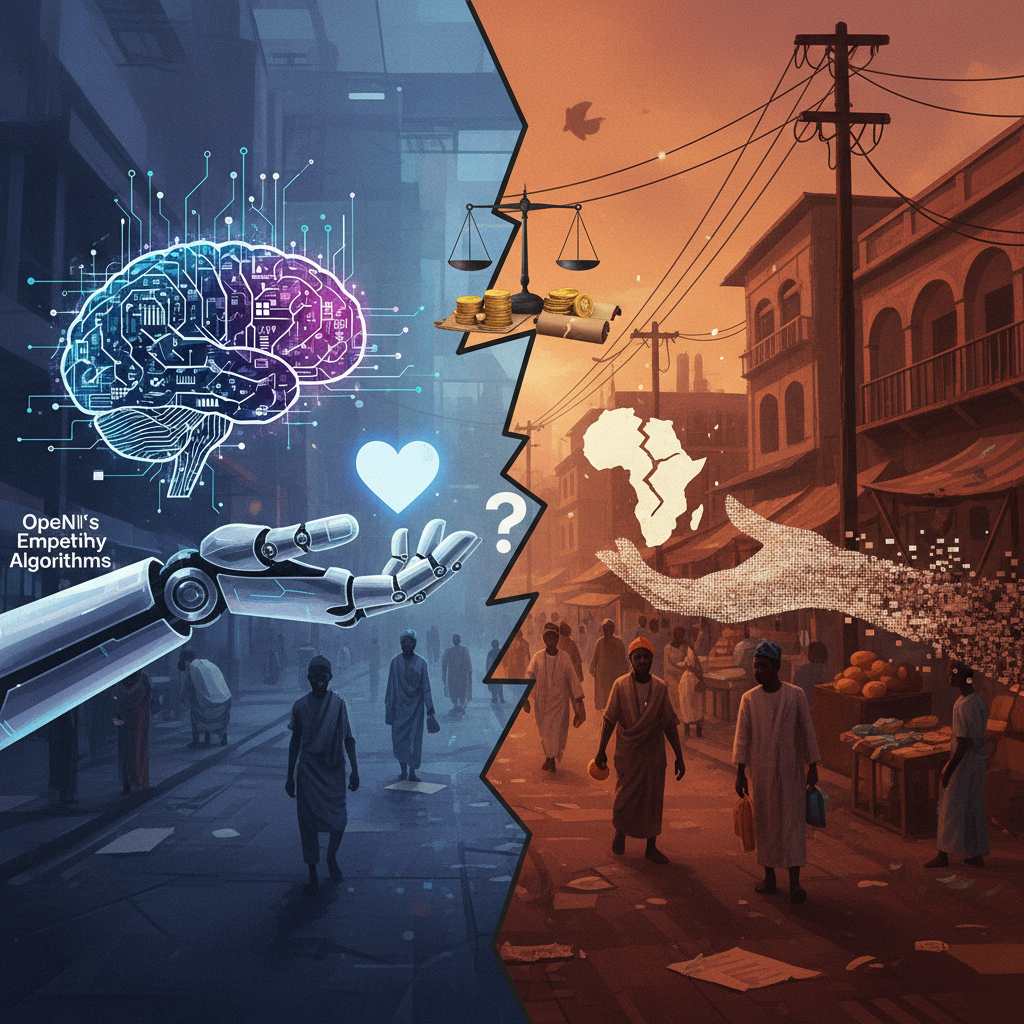

The global tech giants, with their shiny new AI toys, have decided that mental health is the next frontier. From OpenAI's ever-more-human-like GPT models to Meta's ambitious ventures into the metaverse, the narrative is clear: AI will democratize therapy, cure addiction, and usher in an era of digital wellness. Everyone's celebrating, but I have questions. My friends, family, and neighbors in Lagos, and indeed across Africa, are not just data points for Silicon Valley's latest experiment. Our mental landscapes are shaped by unique histories, communal bonds, and socio-economic realities that a chatbot, however sophisticated, simply cannot grasp.
Let's talk about what nobody wants to discuss: the inherent biases and cultural insensitivities baked into these algorithms. These AI models are trained on vast datasets, predominantly from Western contexts. They learn language patterns, emotional cues, and psychological frameworks that are often foreign to our experiences. When a Nigerian, perhaps struggling with the pressures of extended family obligations, economic hardship, or even the lingering trauma of colonial legacies, turns to an AI therapist, what kind of understanding can they truly expect? Can an algorithm, however well-designed, comprehend the nuances of 'African time' or the deep spiritual beliefs that often intertwine with our mental well-being? I think not. It is like asking a fish to understand a bird's song; the medium of communication is simply not aligned.
Dr. Olufunmilayo Oladipo, a prominent Nigerian psychiatrist and advocate for culturally sensitive mental healthcare, once remarked, "Mental health is not a one-size-fits-all concept. Our approach must be rooted in our local realities, our languages, and our belief systems. Importing solutions without adaptation is a disservice to our people." Her words echo a profound truth that seems to be lost in the AI gold rush. These AI therapy apps, often developed by companies like Woebot Health or Wysa, promise scalable solutions. They offer 24/7 availability, anonymity, and affordability, which on the surface, sound like a godsend in regions with severe shortages of mental health professionals. Nigeria, for instance, has a woefully inadequate ratio of psychiatrists to the population, estimated to be around one psychiatrist for every 800,000 people. The need is undeniable, but is a culturally blind AI the answer, or a band-aid that risks further alienating those it seeks to help?
Consider the concept of addiction algorithms. These AI systems are designed to identify behavioral patterns indicative of addiction, from gambling to social media overuse. They then intervene with personalized messages or recommendations. While the intention might be noble, the implementation raises serious concerns. Who owns the data collected by these algorithms? How is it stored, and who has access to it? In a continent where data privacy laws are often nascent or poorly enforced, this is not a trivial question. The idea that our most vulnerable moments, our struggles with mental health and addiction, could become fodder for data mining by foreign corporations is, frankly, alarming. It smells of a new form of digital colonialism, where our emotional vulnerabilities are harvested for profit and algorithmic refinement, without true reciprocity or control.
Unpopular opinion: the push for AI in mental health, particularly in developing nations, often overlooks the foundational issues. We need more trained human professionals, better funding for local mental health initiatives, and robust public health infrastructure. An AI chatbot cannot replace a community elder offering counsel, a pastor providing spiritual guidance, or a trained therapist who understands the intricate family dynamics of a Yoruba household. These are the pillars of mental wellness in many African societies, not algorithms designed in Silicon Valley boardrooms. The human element, the empathy, the shared cultural understanding, these are irreplaceable.
Some might argue that these tools are merely supplementary, a first line of defense, or a stop-gap measure until more human resources become available. They might point to studies showing positive outcomes for certain AI-driven interventions in Western populations. They might say, "Something is better than nothing, Nkirukà. Are you suggesting we do nothing while people suffer?" My response is this: the 'something' must be appropriate, ethical, and empowering, not just convenient for the developers. We must demand that these AI systems are rigorously tested for cultural relevance and bias in our contexts, not just in the West. We must insist on transparency in their data collection and usage policies. And we must prioritize local innovation, fostering African-led AI solutions that are built from the ground up to understand and serve our diverse communities.
Dr. Fei-Fei Li, a leading AI researcher and co-director of Stanford's Human-Centered AI Institute, has often spoken about the need for AI to be built with human values at its core. "We need to ensure that AI serves humanity, not the other way around," she stated in a recent interview. This sentiment is particularly critical when AI delves into the sensitive realm of mental health. If these systems are not built with a deep understanding of diverse human experiences, they risk causing more harm than good. They could inadvertently perpetuate stereotypes, misdiagnose conditions, or even offer advice that is culturally inappropriate or harmful.
Furthermore, the concept of "digital wellness" itself, often promoted by tech companies, can be a double-edged sword. While it encourages mindful tech use, it also subtly reinforces the idea that technology is the primary arbiter of our well-being. We are told to use apps to track our mood, meditate, or manage stress. This can create a dependency on digital tools, potentially exacerbating the very issues of screen addiction or social isolation that some of these apps claim to solve. True wellness, in my view, is holistic. It involves strong social connections, purpose-driven work, access to nature, and a sense of belonging. These are things an app cannot fully provide, no matter how clever its algorithms.
The conversation around AI and mental health needs to shift from uncritical optimism to critical engagement. We need to ask tough questions about power, data ownership, and cultural sovereignty. We cannot allow our most intimate human experiences to be commodified and algorithmically managed without our full understanding and consent. The promise of AI in mental health is immense, but its potential for harm, particularly in vulnerable communities, is equally significant. We must proceed with caution, with our eyes wide open, and with our voices raised. Otherwise, we risk trading one form of suffering for another, more insidious, and digitally mediated kind. For more on the ethical considerations of AI, you can explore resources like MIT Technology Review. The future of our minds, and indeed our societies, depends on it. For a broader perspective on AI's impact on global economies, consider reading articles on Reuters Technology. We must not let the digital age become another chapter of exploitation. We must demand better, and build better, for ourselves.