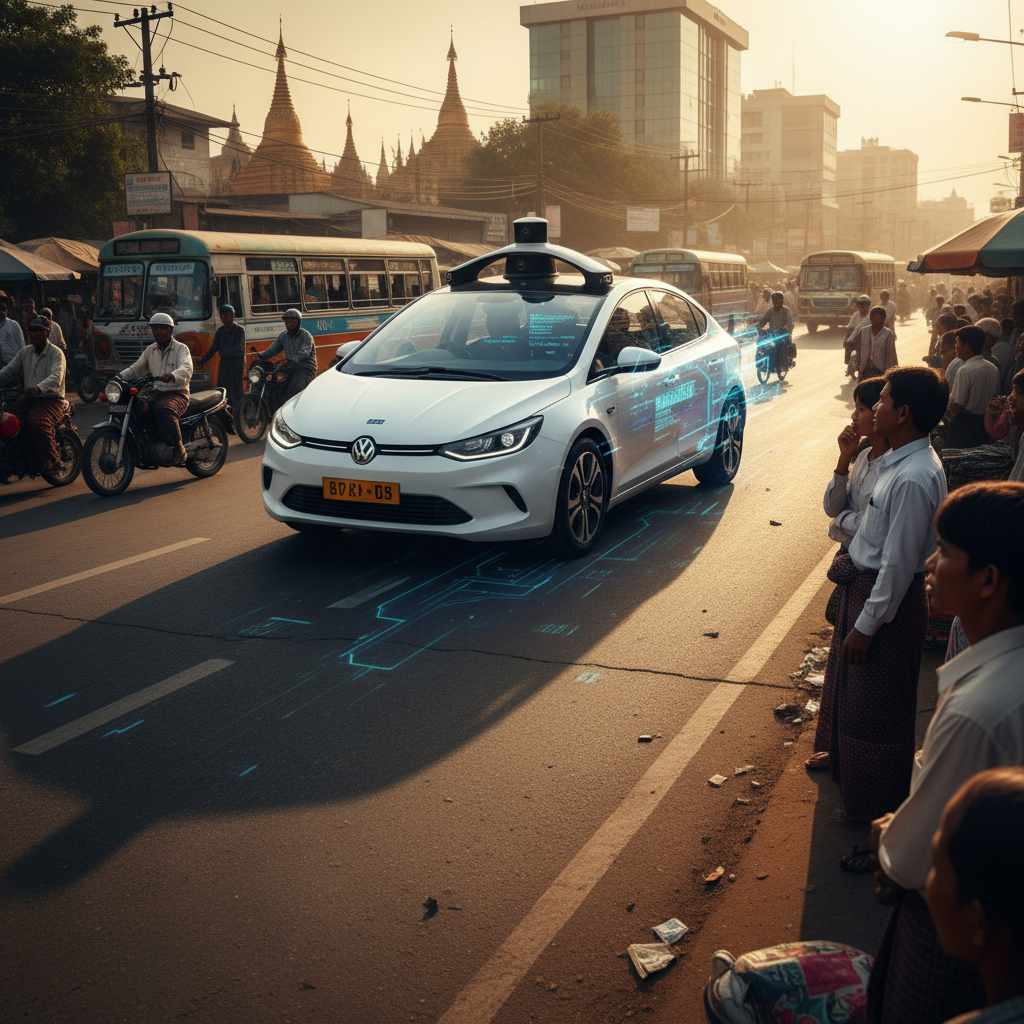

The news arrived quietly, almost a whisper amidst the daily clamor of global headlines: Google's Waymo, the autonomous driving giant, is set to expand its robotaxi services to more cities across the world. For many in the global North, this is just another step towards a sci-fi future, a new app to hail a driverless ride. But from my vantage point here in Myanmar, where the rumble of generators often drowns out the hum of progress, I hear a different story, one laced with both distant hope and immediate concern.
Why does a taxi service, even an autonomous one, matter so much? Because it is not just about getting from point A to point B. It is about infrastructure, jobs, data, and who gets to participate in the future. It is about whether the benefits of cutting-edge technology will ever reach beyond the privileged few, or if we in places like Myanmar will perpetually be left to watch from the sidelines, struggling with basic connectivity while the world speeds ahead.
Why Most People Are Ignoring It
For many, Waymo's expansion is simply a matter of technological advancement, a natural progression. They see it as a luxury service for tech-savvy urbanites in places like San Francisco or Phoenix, perhaps soon London or Tokyo. The headlines focus on the number of vehicles, the safety records, the regulatory hurdles in wealthy nations. The conversation is largely confined to the technicalities of Lidar and AI algorithms, or the convenience of not having to tip a human driver. There is little thought given to the billions of people for whom a reliable, affordable taxi service, let alone an autonomous one, remains a distant dream. The attention gap is vast, a chasm between those who debate the ethics of AI-driven convenience and those who simply yearn for basic mobility.
How It Affects You
Even if you live far from the gleaming cities where Waymo operates, this expansion affects you. Think about the global economy, the supply chains, the very fabric of how goods and services move. Autonomous vehicles promise increased efficiency, reduced labor costs, and potentially lower prices for consumer goods. This could mean cheaper imports, but also a reshuffling of global labor markets. What happens to the millions of drivers worldwide, from the truck drivers in America to the trishaw operators in Mandalay, when their livelihoods are threatened by machines? The ripple effects are inevitable, reaching into every corner of the world, including our own. If the cost of transport drops significantly in major markets, it can shift manufacturing and distribution patterns, inadvertently impacting local economies that rely on traditional logistics.
Moreover, the data collected by these autonomous fleets is immense. Every street, every pedestrian, every traffic pattern is mapped and analyzed. This data, often owned by multinational corporations, becomes a powerful asset. Who controls this data? How is it used? What are the privacy implications for citizens, particularly in countries with less robust data protection laws? These are not abstract questions, but critical concerns for anyone living in an increasingly data-driven world. Reuters often highlights the geopolitical implications of such data monopolies.
The Bigger Picture
Here in Myanmar, the stakes are different. We are not just talking about convenience; this is about survival, not convenience. Our roads are often unpaved, our infrastructure fragile, and our political landscape volatile. The idea of a Waymo vehicle navigating the chaos of Yangon traffic, dodging street vendors and potholes, feels almost absurd. Yet, the underlying technology, the AI that powers Waymo, holds immense potential for humanitarian aid, logistics in conflict zones, and even public transport in underserved areas. Imagine autonomous vehicles delivering medical supplies to remote villages cut off by conflict, or providing essential transport where human drivers face extreme danger. Technology can be a lifeline, but only if it is designed and deployed with equity at its core.
However, the current trajectory suggests a widening gap. While wealthy nations debate the nuances of self-driving cars, many developing countries are still grappling with internet shutdowns, lack of electricity, and basic digital literacy. The digital divide is not just about internet access; it is about access to the very tools that define modern progress. If the world's leading AI innovations are only tailored for the wealthiest markets, what hope do we have of catching up, or even benefiting from them?
What Experts Are Saying
“The rapid deployment of autonomous vehicle technology in developed markets presents a dual challenge for emerging economies,” explains Dr. Aye Aye Thant, a transport economist at the Yangon Institute of Technology. “On one hand, it showcases what is possible, potentially inspiring local innovation. On the other, it risks creating a technological apartheid, where advanced solutions are inaccessible, and traditional industries are undermined without viable alternatives.” She stresses the need for proactive policy-making, not reactive scrambling.
U Hla Myint, a former government official involved in urban planning, shares a more cynical view. “We cannot even maintain our existing roads reliably, let alone build the kind of smart infrastructure these vehicles require. The focus should be on foundational development, not chasing futuristic dreams that are decades away for us. Unless these companies are willing to invest in our basic infrastructure, their expansion means little beyond a distant spectacle.” He believes the conversation needs to be grounded in reality.
“The real innovation for us might not be fully autonomous vehicles, but rather AI-assisted public transport systems that optimize existing routes and reduce congestion,” suggests Daw Khin Marlar, a data privacy advocate based in Mandalay. “The data implications alone are staggering. Imagine a foreign entity mapping every street and movement in our cities. This has profound national security and privacy implications that we are simply not equipped to handle yet.” She urges caution and robust regulatory frameworks.
From a global perspective, Dr. Lena Petrova, a senior researcher at the MIT Technology Review, notes, “The expansion of Waymo and similar services is a bellwether for the future of urban mobility and logistics. Its impact on labor markets, urban planning, and energy consumption will be significant. The question is whether these advancements will be inclusive, or if they will exacerbate existing inequalities between nations and within societies.” She highlights the critical need for international cooperation on ethical AI deployment.
What You Can Do About It
For us, the path forward is complex but clear. First, we must advocate for policies that prioritize digital literacy and infrastructure development. This means pushing for reliable internet access, stable electricity, and investment in education that equips our youth for the jobs of tomorrow, not just today. Second, we need to demand transparency and accountability from global tech companies. If their technologies are to operate in our world, even indirectly, they must adhere to ethical standards that respect our sovereignty and privacy. Supporting local tech initiatives that address our specific challenges, rather than simply importing solutions, is also crucial. We need to foster an environment where our own innovators can thrive, building solutions tailored to our unique context, like those discussed in this article about AI in Africa [blocked].
Finally, we must participate in the global conversation. Our voices, our experiences, and our unique challenges must be heard in the forums where the future of AI and autonomous technology is being shaped. We cannot afford to be passive observers. We must actively engage, question, and demand a seat at the table. Wired often covers these global dialogues, and we need to be part of them.
The Bottom Line
In five years, the world will look very different. Autonomous vehicles, whether fully driverless or highly assisted, will be a more common sight in many parts of the globe. The economic and social shifts they bring will be profound. For Myanmar, and for many nations like ours, the challenge is not just to adapt, but to shape this future. Will we be passive recipients of technology designed elsewhere, grappling with its unintended consequences, or will we find ways to harness its potential for our own development, ensuring that this powerful technology serves our people, not just profits? The answer depends on the choices we make today, the policies we enact, and the voices we choose to amplify. The future of mobility is not just about cars; it is about human dignity, opportunity, and whether progress truly means progress for all.