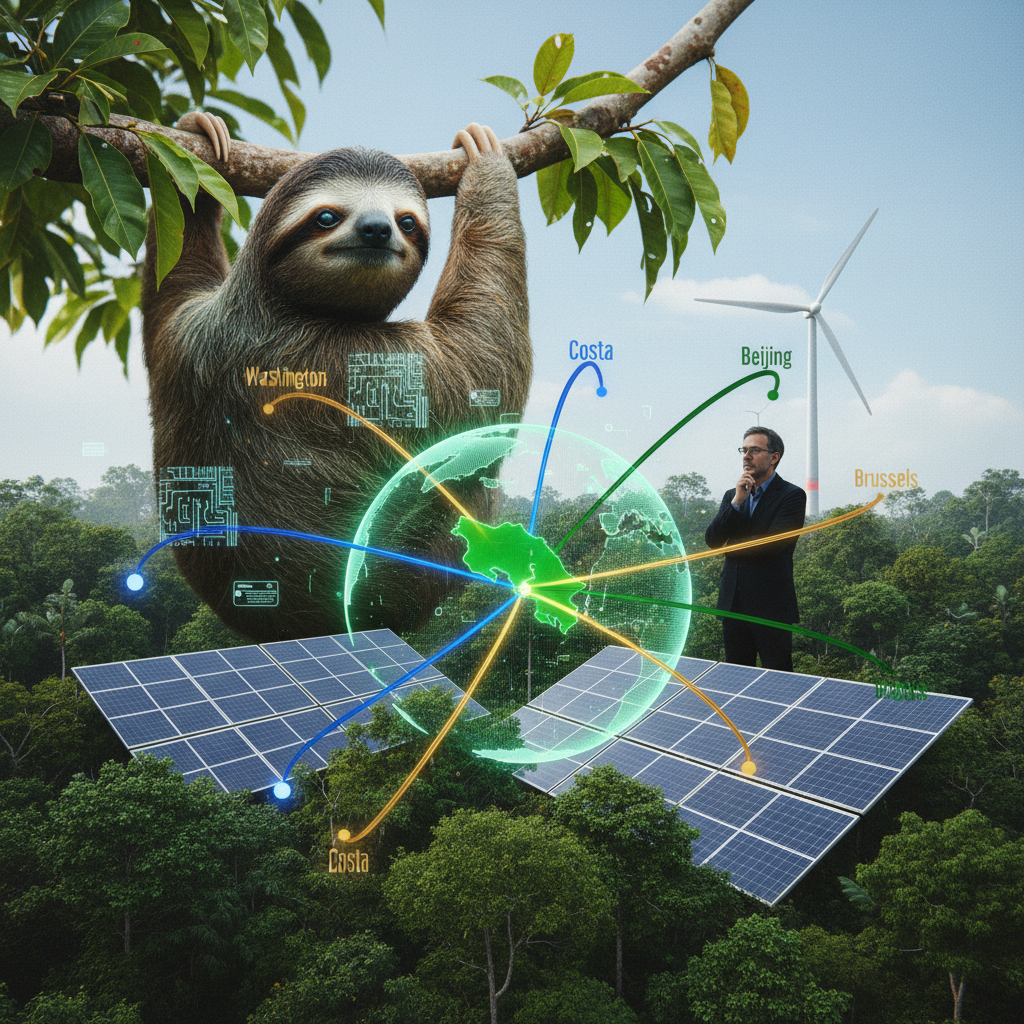
The world is watching, and frankly, it is a bit of a spectacle. Three global titans, the European Union, the United States, and China, are each carving out their own vision for how artificial intelligence should be governed. From my vantage point here in Costa Rica, where the rhythm of life is often dictated by the rainforest and the ocean, this distant legislative dance feels both critically important and, at times, a little out of touch with the practical realities on the ground. Yet, we cannot afford to ignore it, especially when our nation is striving to lead in green tech and AI. The question is, how do these regulatory behemoths affect a small, innovative country like ours, one that prioritizes sustainability above all else?
Let us start with the European Union, the first out of the gate with its comprehensive AI Act. This legislation, which officially began its phased implementation in recent months, is a landmark. It categorizes AI systems by risk, from minimal to unacceptable, and imposes strict requirements on high-risk applications. Think of medical devices, critical infrastructure, or even certain hiring algorithms. The EU’s approach is about consumer protection and fundamental rights, a top-down regulatory framework designed to instill trust and accountability. Dr. Elena Petrova, a senior policy analyst at the European Centre for Digital Rights, told me last week, “The EU AI Act is a declaration that technology must serve humanity, not the other way around. It is a bold, albeit complex, framework that will undoubtedly influence global standards.” Indeed, its extraterritorial reach means any company, including those developing AI in our region, that wants to operate in the EU market must comply. This is a significant hurdle for smaller startups, even those with brilliant sustainable AI solutions, as compliance costs can be substantial.
Then we turn to the United States, which has opted for a more agile, sector-specific approach, largely driven by executive orders and agency guidance rather than a single, overarching law. President Biden’s Executive Order on the Safe, Secure, and Trustworthy Development and Use of Artificial Intelligence, issued in late 2023, set the tone. It emphasizes safety, security, privacy, and promoting innovation, tasking various federal agencies like the National Institute of Standards and Technology (nist) and the Department of Commerce to develop standards and best practices. It is a lighter touch, designed to foster innovation without stifling it with heavy regulation. Sam Altman, CEO of OpenAI, has often voiced his preference for this kind of flexible framework, advocating for a balance between oversight and progress. Speaking at a recent tech summit, he reportedly stated, “We need guardrails, yes, but they must be dynamic enough to evolve with the technology. Overly prescriptive laws risk freezing innovation at a moment when we need it most.” This approach, while less burdensome for developers in the short term, also creates a patchwork of rules that can be confusing to navigate.
Across the Pacific, China presents a third, distinct model. Their regulatory landscape for AI is characterized by a blend of state control, ethical guidelines, and a strong focus on data governance and national security. China has already implemented regulations on generative AI, deepfakes, and algorithmic recommendations, emphasizing content moderation and ensuring AI aligns with socialist core values. Their approach is swift, comprehensive, and often involves direct government intervention in technology development. For instance, the Cyberspace Administration of China (CAC) has been proactive in issuing directives that shape how AI models are trained and deployed. This centralized control allows for rapid deployment of policies but raises significant concerns about surveillance and censorship from a Western perspective. “China’s model is about harnessing AI for national strategic goals, with regulation serving as a tool for control and direction,” explained Dr. Li Wei, a researcher specializing in Chinese tech policy, in a recent interview with Reuters. This creates a very different operating environment for AI companies, one where state priorities often supersede individual freedoms.
So, where does this leave Costa Rica, a nation known for its commitment to environmental protection and its pura vida approach to AI? We are not a global superpower, nor do we have the vast resources of Silicon Valley or Beijing. Yet, we have a unique perspective and a growing ecosystem of sustainable tech startups. Our challenge is to navigate this fragmented global regulatory environment while continuing to foster our own brand of practical innovation. For instance, a Costa Rican startup developing an AI model to monitor deforestation, using satellite imagery and machine learning, might find itself caught between these differing standards. If their model is used by European NGOs, it must comply with the EU AI Act. If they seek investment from US venture capitalists, they need to understand the evolving American landscape. If they collaborate with Chinese researchers, they enter a different regulatory sphere altogether.
“For us, the key is agility and foresight,” says Sofia Vargas, CEO of EcoSense AI, a San José based company using AI to optimize water usage in agriculture. “We are a small team, but our impact can be global. We cannot afford to be blindsided by regulations from Brussels or Washington. We need to build our AI ethically from the ground up, anticipating future requirements, and looking for common ground.” Her company, for example, is already implementing privacy-by-design principles, not just because it is good practice, but because it aligns with the spirit of the EU’s GDPR and the US’s emerging privacy standards. This proactive stance is essential for any small nation operating in the global AI arena.
Data from the World Economic Forum indicates that global AI investment reached over 150 billion US dollars in 2025, a 30% increase from the previous year, with a significant portion flowing into areas like ethical AI and explainable AI. This shows that the market itself is responding to the demand for more responsible AI, regardless of specific regulations. However, the lack of a unified global standard creates friction. A recent study published by MIT Technology Review highlighted that 65% of AI companies operating internationally report increased compliance costs due to differing national regulations, with 20% considering scaling back global operations as a result.
This is where Costa Rica proves you don't need Silicon Valley to think big. Our nation, with its deep-seated environmental consciousness, could become a living laboratory for sustainable and ethical AI development. We could champion a model that is not just about compliance, but about integrating AI with our national values of ecological balance and social well-being. Imagine an AI ethics framework developed from a tico perspective, one that prioritizes biodiversity, community, and equitable access. It would be less about market dominance and more about harmonious coexistence.
Indeed, the Ministry of Science, Innovation, Technology, and Telecommunications (micitt) has been actively engaging with local stakeholders to develop a national AI strategy. “Our focus is on responsible innovation that benefits our people and our planet,” stated Minister Carlos Alvarado, during a recent press conference at the University of Costa Rica. “We are studying these global models, but our solution will be uniquely Costa Rican. We aim for practical innovation that serves our specific needs, like protecting our rainforests or improving public health, without compromising our values.” This is the kind of practical wisdom that often gets lost in the grand debates of global powers.
The global AI regulation showdown is far from over. It is a complex, evolving narrative with profound implications for the future of technology and society. For Costa Rica, it is not just about choosing a side, but about understanding the currents and charting our own course. We must continue to innovate, to build sustainable AI solutions, and perhaps, to show the world that a different, more harmonious path is possible. After all, the most powerful technology is the one that serves life, not just profit or power. Our small nation, with its rich natural heritage, has a lot to teach about that balance. Perhaps the world should listen. For more on how AI is impacting global tech, you can always check out TechCrunch's AI section.