The skies above Conakry have always told a story, a narrative of life and sometimes, of profound loss. For generations, our farmers and fishermen have read the clouds, felt the shifting winds, and understood the rhythm of the seasons. This ancestral knowledge, honed over centuries, has been our primary defense against the capricious nature of West Africa's climate. Now, a new oracle has emerged, one powered by algorithms and vast datasets: Artificial Intelligence.
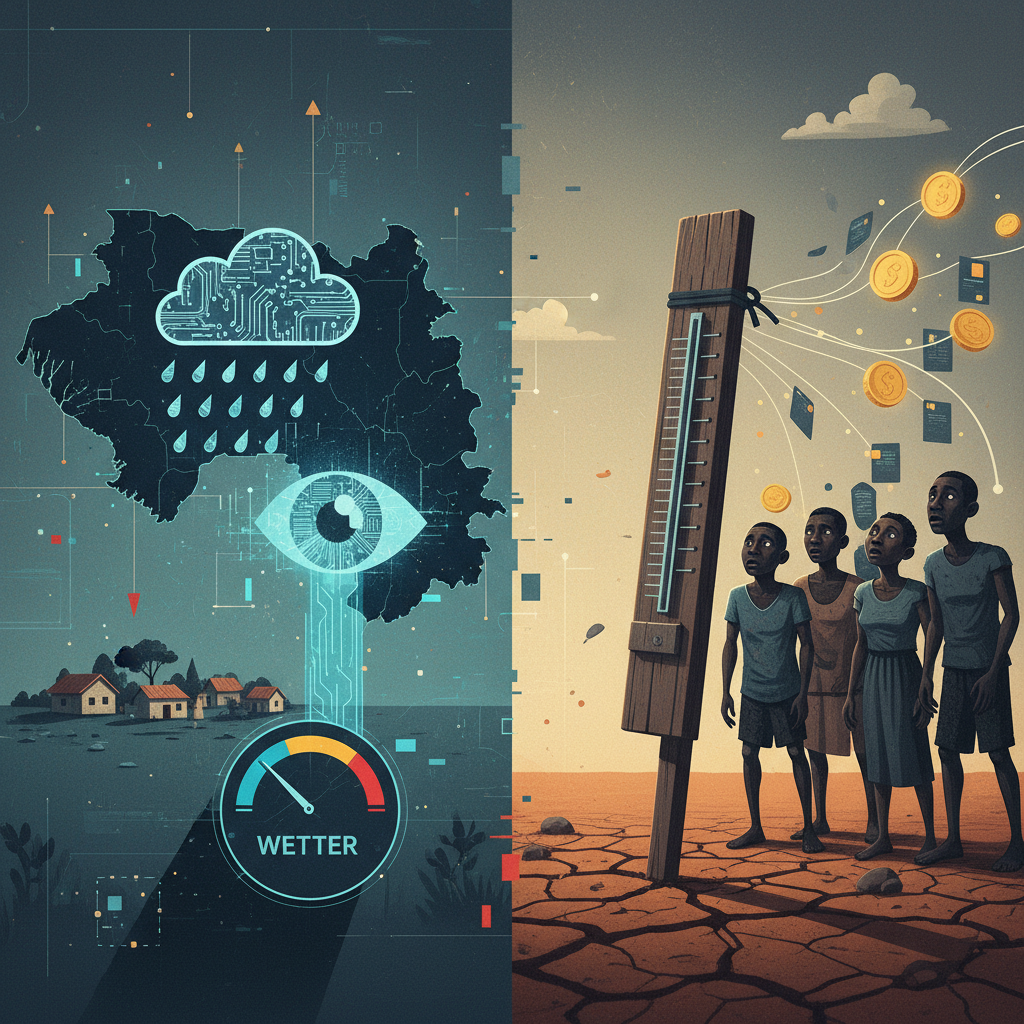
Global tech behemoths are pouring resources into AI-powered climate modeling, promising to predict extreme weather events with unprecedented accuracy. Google DeepMind, for instance, has been a prominent player, developing sophisticated models that integrate satellite imagery, historical meteorological data, and complex atmospheric physics to forecast everything from flash floods to prolonged droughts. Their 'Wetter' model, as some in the scientific community informally refer to it, represents a significant leap from traditional numerical weather prediction, leveraging deep learning to identify patterns that human analysis might miss. The potential benefits for a nation like Guinea, which frequently grapples with devastating floods and unpredictable agricultural seasons, are seemingly immense.
The risk scenario, however, is not simply about whether these models work. It is about who controls them, who benefits from them, and what unforeseen consequences they might unleash upon societies already vulnerable. Imagine a scenario where critical infrastructure decisions, agricultural planning, and even emergency response protocols are entirely reliant on predictions generated by proprietary AI models developed thousands of kilometers away. What happens when the model's biases, inherent in its training data, disproportionately affect certain regions or communities? What if access to its most accurate insights becomes a commodity, available only to those who can afford it?
Technically, these AI models, often large neural networks, are trained on petabytes of global climate data. They excel at identifying non-linear relationships and complex interactions within the Earth's systems. Unlike traditional models that rely on explicit physical equations, AI can learn these relationships implicitly, often leading to more precise, localized forecasts. Researchers at institutions like the European Centre for Medium-Range Weather Forecasts (ecmwf) have demonstrated AI's ability to outperform conventional methods in short-to-medium range predictions, particularly for high-impact events. This is not a trivial advancement; it could mean the difference between life and death for communities in low-lying coastal areas or drought-prone regions. The promise is alluring, almost intoxicating.
But here's the catch: the training data itself is often skewed. Historical meteorological records are far more abundant and granular in the Global North than in many parts of Africa. This data imbalance can lead to models that perform exceptionally well in predicting European storms or American hurricanes, but falter when confronted with the unique atmospheric dynamics of the Guinean coastline or the Sahelian drought patterns. As Dr. Fatima Diallo, a climatologist at the University of Conakry, recently stated, "While the algorithms are powerful, their 'understanding' is only as good as the data they are fed. If our local nuances, our specific microclimates, are underrepresented in the global datasets, then these models risk becoming sophisticated tools for misdirection, not precision, for us." This sentiment resonates deeply, echoing the historical imbalances that have long plagued scientific and technological development.
The expert debate surrounding AI in climate modeling is multifaceted. On one side, proponents like Dr. James K. W. Lee, a senior research scientist at Google DeepMind, emphasize the humanitarian potential. He was quoted in a recent Reuters article saying, "Our goal is to provide actionable intelligence that saves lives and livelihoods, especially in regions most impacted by climate change. The accuracy gains are undeniable, and we are actively working on making these tools accessible." This perspective highlights the genuine desire to leverage technology for good, a narrative often championed by Silicon Valley. Indeed, the ability to predict a severe monsoon flood even 24 hours earlier could allow for evacuations that save hundreds, if not thousands, of lives in areas like our own Forécariah or Boffa prefectures.
However, a counter-narrative, championed by ethicists and some climate scientists from the Global South, raises critical questions about data sovereignty and technological dependence. Dr. Anya Singh, a policy expert at the United Nations Environment Programme, articulated this concern in a recent Wired piece: "We must ensure that AI tools for climate adaptation do not inadvertently create new forms of digital colonialism. The infrastructure, the expertise, and the decision-making power must ultimately reside with the affected communities, not solely with distant corporations." This is not merely an academic point; it is a practical imperative for nations striving for self-determination in the face of global challenges.
The real-world implications for Guinea are profound. Our economy, heavily reliant on agriculture and mining, is acutely sensitive to weather patterns. Unpredictable rainfall can decimate rice harvests, leading to food insecurity and economic instability. Flash floods, like those that regularly inundate parts of Conakry, displace thousands, destroy homes, and strain our already limited emergency services. If AI models can provide earlier, more accurate warnings, it could revolutionize disaster preparedness and agricultural planning. The Ministry of Agriculture could advise farmers on optimal planting times, reducing crop loss. The National Agency for Disaster Management could pre-position resources more effectively. The benefits are tangible.
Yet, the devil is in the details. Who owns the intellectual property of these models? What are the terms of access? Will Guinea be a recipient of predictions, or an active participant in their development and refinement? If our local meteorological services become mere conduits for foreign-generated data, what happens to our own capacity building? What if the algorithms, designed for global applicability, fail to account for the unique vulnerabilities of a community built on a floodplain, or a farming practice tied to specific local microclimates? I dug deeper and found something troubling: the lack of transparency in how these complex models arrive at their conclusions, often termed the 'black box' problem, makes it difficult for local experts to scrutinize or adapt them. This opacity can erode trust, a vital component in effective disaster response.
What should be done? First, there must be a concerted effort to invest in local data collection infrastructure across Africa. This means more weather stations, more hydrological sensors, and better training for local meteorologists and data scientists. Without robust, localized data, even the most advanced AI will operate with significant blind spots. Second, international partnerships must prioritize genuine capacity building and technology transfer, not just data sharing. This includes training Guinean engineers and scientists in AI development and deployment, allowing us to build, adapt, and own our solutions. Organizations like the African Union and Ecowas should champion frameworks for data sovereignty and ethical AI deployment in climate action.
Furthermore, regulatory bodies, both national and international, must establish clear guidelines for the development and use of AI in critical sectors like climate prediction. This includes mandates for explainability, bias auditing, and accountability. We cannot afford to outsource our climate resilience to opaque algorithms without understanding their inner workings or their potential pitfalls. The promise of AI is immense, a powerful tool that could help us navigate the turbulent waters of climate change. But like the Niger River, which brings both life-giving water and destructive floods, its power must be understood, respected, and most importantly, controlled by those who live by its banks. Our future, much like our past, depends on our ability to read the signs, whether they come from the sky or from a server farm far away. For more on the broader implications of AI in African development, consider reading about The Silent Scramble for Senegal's Data [blocked]. The lessons are often universal.