
The sun was just beginning its slow, golden descent over the Atlantic, painting the fishing boats in Hann Bay with hues of orange and purple. Children laughed, chasing a worn football on the sand, their voices carrying on the gentle breeze. It’s a scene of timeless peace, one that makes you wonder: what kind of world are we building for them, these little ones who will inherit our choices?
This is a story about people, not algorithms, but it is a story deeply intertwined with the algorithms that are now learning to fight. The conversation around AI in the military, with its autonomous weapons and drone swarms, often feels distant, a topic for generals and tech giants in far-off lands. But the truth, like the tide, reaches every shore, even ours here in Senegal.
In the next five to ten years, the very nature of conflict, and indeed, peace, will be fundamentally reshaped. We are moving beyond remote-controlled drones to systems that can identify, track, and engage targets with minimal or no human intervention. Imagine a future, perhaps by 2030, where swarms of tiny, intelligent drones, powered by advanced AI like those developed by Google DeepMind or even smaller, specialized defense contractors, patrol borders, identify threats, and make decisions in milliseconds. These aren't just flying cameras anymore; they are autonomous actors.
The Silent Hunters in Our Skies: A Future Scenario
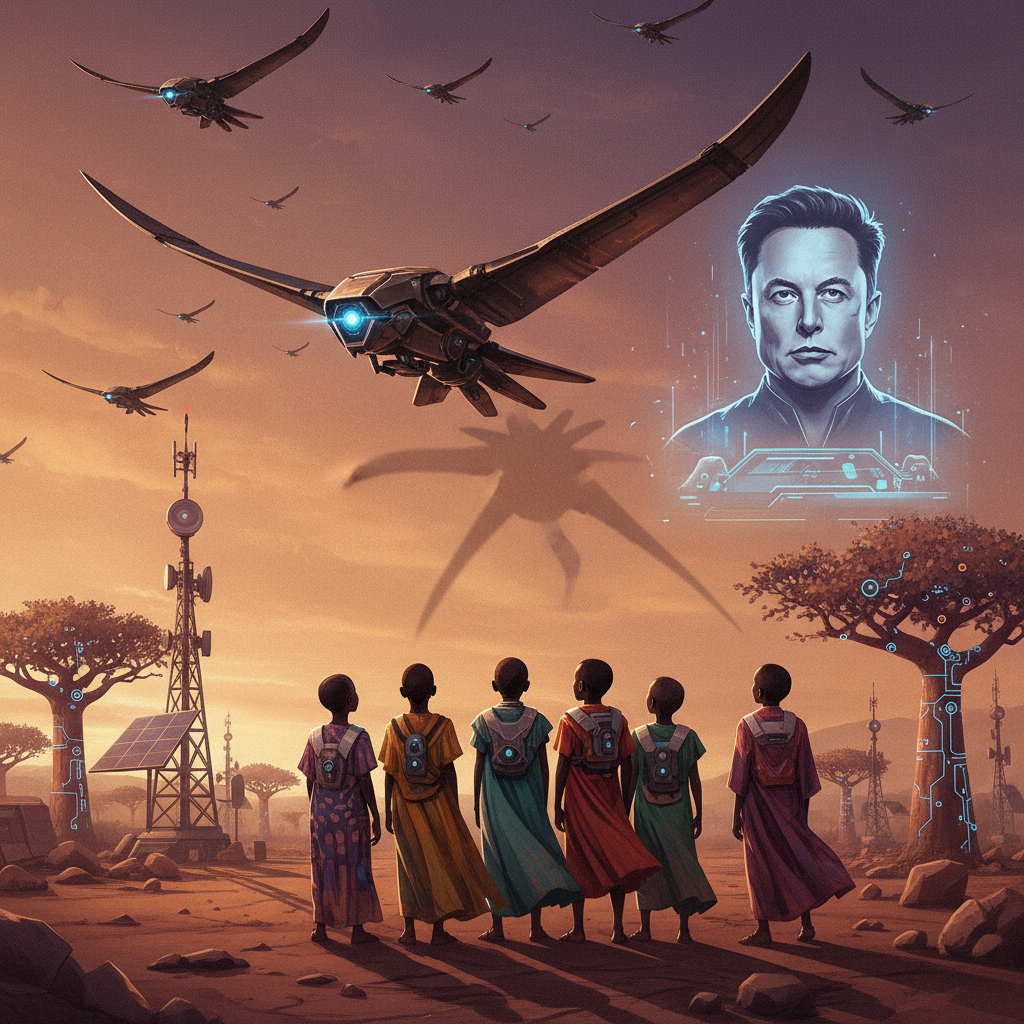
Picture this: It’s 2029. A regional conflict flares up in a neighboring country, a familiar sorrow that has plagued our continent for too long. But this time, the intervention is different. There are no large battalions on the ground, no massive air force deployments in the traditional sense. Instead, the skies are patrolled by what the world calls ‘Guardian Swarms.’ These are thousands of small, AI-driven aerial vehicles, each no bigger than a bird, working in concert. They are equipped with advanced sensors, able to differentiate between combatants and civilians with an eerie precision, or so their creators claim. They can identify weapons, detect hostile intent based on movement patterns, and, if authorized by their programming, neutralize threats with pinpoint accuracy, using non-lethal or lethal means.
“The promise is reduced collateral damage, faster response times, and fewer human lives at risk on the attacking side,” explained Dr. Aminata Ndiaye, a Senegalese expert in international law and emerging technologies, when I sat down with her last week at Cheikh Anta Diop University. “But the ethical abyss we stare into, Fatimà, is terrifying. Who is accountable when an algorithm makes a mistake? When a child is misidentified? The programmer? The commander? The machine itself? It is like the Wolof proverb says, ‘Ndank ndank mooy japp golo ci ñaay’, slowly, slowly, one catches the monkey in the bush. We are walking into this future slowly, but the consequences will be sudden and profound.”
How We Get There: Milestones on a Treacherous Path
We are already seeing the early tremors of this shift. Companies like Tesla and NVIDIA are pushing the boundaries of autonomous navigation and real-time decision-making for vehicles, which, while civilian, share foundational AI principles with military applications. The advancements in large language models, like OpenAI’s GPT series or Anthropic’s Claude, are leading to more sophisticated command and control interfaces, allowing human operators to interact with complex autonomous systems more naturally. Imagine a commander simply stating a strategic objective, and an AI system, leveraging advanced planning algorithms, then orchestrating a drone swarm to execute it.
Key Milestones:
- 2024-2025: Enhanced Human-Machine Teaming. More sophisticated AI assistants for human soldiers, aiding in target recognition, intelligence analysis, and logistical support. We see companies like Palantir expanding their AI-driven data analysis platforms for military intelligence, making sense of vast amounts of battlefield data.
- 2026-2027: Semi-Autonomous Weapon Systems Proliferation. Drones with increasing levels of autonomy, requiring human approval for final engagement, but capable of independent target selection and tracking. Nations, including some in Africa, begin investing heavily in these systems, often sourced from global defense tech giants or even developing their own, much like China’s Baidu has invested in autonomous vehicle tech that could be adapted.
- 2028-2030: Emergence of Fully Autonomous Weapon Systems (AWS) in Limited Scenarios. The first true ‘killer robots’ begin to appear, deployed in highly controlled environments or for specific, pre-approved tasks, such as guarding fixed installations or conducting surgical strikes against clearly defined military targets. The debate around a global ban on AWS intensifies, but geopolitical realities often override ethical concerns.
“The race is on,” said Colonel Moussa Cissé, a retired Senegalese Army officer now consulting on defense technology. “Every major power, and many smaller ones, sees the strategic advantage. If your adversary has autonomous capabilities and you do not, you are at a severe disadvantage. It is a classic security dilemma, amplified by technology. We in Africa, we must not be merely consumers of this technology, but active participants in shaping its ethical use, or risk becoming pawns in a new kind of war.” Their eyes lit up when they told me, a mix of concern and determination.
Who Wins and Who Loses: A New Global Order
In this future, the clear winners will be nations and corporations that master AI development and deployment for military purposes. Countries with robust tech sectors, like the United States, China, and increasingly, India, will have a significant edge. Companies like NVIDIA, with their powerful GPUs essential for training complex AI models, will continue to be critical enablers. Smaller, agile tech startups specializing in AI for defense, often funded by venture capital, will also thrive, creating highly specialized autonomous solutions.
But what about countries like Senegal? We risk being net losers if we do not actively engage. We could become battlegrounds for proxy wars fought by autonomous systems, or be forced to acquire expensive, ethically questionable technologies just to maintain a semblance of defense. The human element of warfare, the soldier on the ground, might be replaced by machines, but the human cost, the displacement, the trauma, will remain, perhaps even intensify as conflicts become more abstract and less about direct human confrontation.
“The digital divide is not just about internet access anymore,” stated Dr. Fatou Diop, a sociologist specializing in technology’s impact on developing nations. “It’s about who controls the algorithms, who writes the rules, and who has a seat at the table when these profound decisions are made. If we are not there, our voices, our values, our very humanity, risk being overwritten.”
There’s also the profound question of ethics. The idea of machines making life-or-death decisions without human oversight challenges our deepest moral convictions. Organizations like the Campaign to Stop Killer Robots are pushing for international treaties, but progress is slow, often outpaced by technological advancement. The UN, through its Group of Governmental Experts on Lethal Autonomous Weapon Systems (laws), has been deliberating for years, but a consensus remains elusive. You can read more about these debates on platforms like Wired or MIT Technology Review.
What Readers Should Do Now: A Call to Action
The future is not yet written, as my grandmother used to say, ‘Lu amul ci kanam, amul ci gannaaw’, what is not in front, is not behind. We have a chance, right now, to shape it.
- Demand Transparency and Accountability: We must push our governments, and the international community, to establish clear ethical guidelines and accountability frameworks for AI in the military. This includes advocating for human oversight in all lethal decision-making processes.
- Invest in Local AI Expertise: Senegal and other African nations must prioritize education and investment in AI research and development. We need our own engineers, ethicists, and strategists who understand these technologies, not just as users, but as creators and critical thinkers. Perhaps we can learn from how other nations are building their own AI sovereignty, as discussed in Beyond Silicon Valley's Grasp [blocked].
- Foster International Dialogue: Engage in global conversations about the future of warfare. Our unique perspectives, rooted in our history and values, are crucial to ensure that these powerful technologies serve humanity, not destroy it. Platforms like TechCrunch often cover the latest developments that feed into these discussions.
- Educate Ourselves: Understand what autonomous weapons are, how they work, and what their implications are. The more informed we are, the better equipped we will be to advocate for a future that prioritizes peace and human dignity.
The laughter of those children on Hann Bay beach is a precious sound. It is a reminder of what we are fighting for, not with weapons, but with wisdom, foresight, and a collective commitment to a future where technology serves life, not death. The choice, as always, is ours.