The air in San José, even with its urban hum, always feels a little cleaner, a little more alive, than in many other capitals. It is a constant reminder of what we value here: the natural world, the pura vida. It is also a reminder that some of the most profound technological advancements do not need to emerge from the usual tech hubs. Sometimes, they sprout from unexpected places, nurtured by a different kind of vision. This is the story of Dr. Carlos Vargas and his company, Quantum Leap Labs, a name that perfectly encapsulates his ambition.
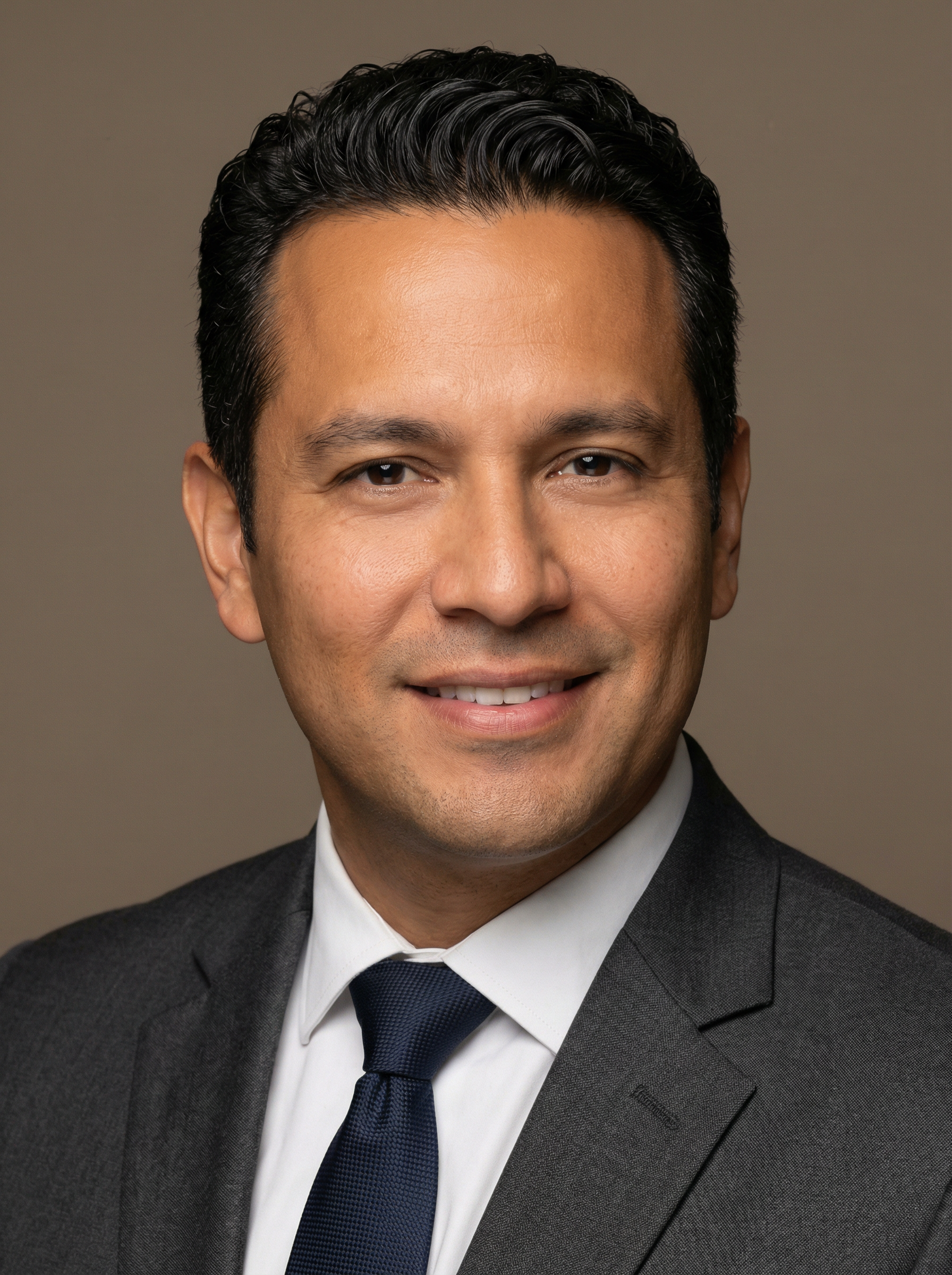
I met Dr. Vargas at his modest, yet bustling, office near the University of Costa Rica. The space, filled with whiteboards covered in complex equations and the quiet hum of servers, felt more like a university research lab than a startup headquarters. He is a man of quiet intensity, his eyes alight when he speaks of quantum mechanics and artificial intelligence, but always grounded in practical applications. He is not interested in hype, only in what works, and what can genuinely make a difference. His journey, from a curious boy in Heredia to a leading voice in quantum AI, is a testament to the power of focused, purpose-driven innovation.
Vargas grew up immersed in the vibrant biodiversity of Costa Rica. His childhood was spent exploring the cloud forests, fascinated by the intricate systems of nature. This early exposure to complex, interconnected biological systems, he tells me, subtly shaped his later interest in physics and computational complexity. "Nature, in its essence, is the ultimate complex system," he explains, sipping his local coffee, "and understanding it, optimizing it, that is a problem for the most powerful tools we can build." His academic path led him to the University of Costa Rica, where he excelled in physics and mathematics, before earning a scholarship to pursue his doctorate in theoretical quantum physics at a prestigious European institution. It was there, amidst the abstract world of quantum entanglement and superposition, that the seeds of Quantum Leap Labs were sown.
His early career involved postdoctoral research at institutions known for their pioneering work in quantum information science, including a stint at the Perimeter Institute for Theoretical Physics in Canada. He published several papers on quantum algorithms and their potential applications in materials science and drug discovery. However, a growing unease began to settle in. He saw immense theoretical progress, but a disconnect from real-world, impactful problems, especially those affecting developing nations or global sustainability. He realized that the cutting edge of quantum computing was often focused on financial modeling or cryptography, while the urgent challenges of climate change and resource management were often overlooked.
This realization sparked a pivotal moment. "I came back to Costa Rica with a clear idea," Vargas recounts, "that we could apply these incredibly powerful quantum and AI tools to problems that truly matter for our planet, not just for profit margins." He saw the potential for quantum-enhanced AI to revolutionize areas like sustainable agriculture, renewable energy grid optimization, and biodiversity monitoring. He knew it would be an uphill battle to build a deep tech company in Costa Rica, far from the venture capital epicenters, but he was undeterred. He believed in the talent here, and in the unique perspective that a country like Costa Rica could bring to global challenges.
He found his co-founder, Dr. Sofia Hernández, a brilliant computer scientist specializing in machine learning and optimization, through a mutual contact at the University of Costa Rica. Hernández, who had spent years working on AI applications in logistics for a multinational corporation, shared Vargas's vision for impact-driven technology. Their skills complemented each other perfectly: Vargas brought the quantum theory and Hernández the practical AI implementation. Together, they founded Quantum Leap Labs in late 2021.
Building the company was, as expected, a challenge. Attracting top-tier quantum physicists and AI engineers to Costa Rica required conviction and a compelling mission. They offered not just competitive salaries, but a chance to work on problems with global significance, all while enjoying the pura vida lifestyle. "We do not have the endless capital of Silicon Valley," Vargas admits, "but we have something perhaps more valuable: purpose, and a truly inspiring environment." He points to the window, where the vibrant green of a nearby park is visible. "Our team is motivated by more than just equity, they are motivated by making a tangible difference." This practical innovation in paradise has attracted talent from across Latin America and even Europe.
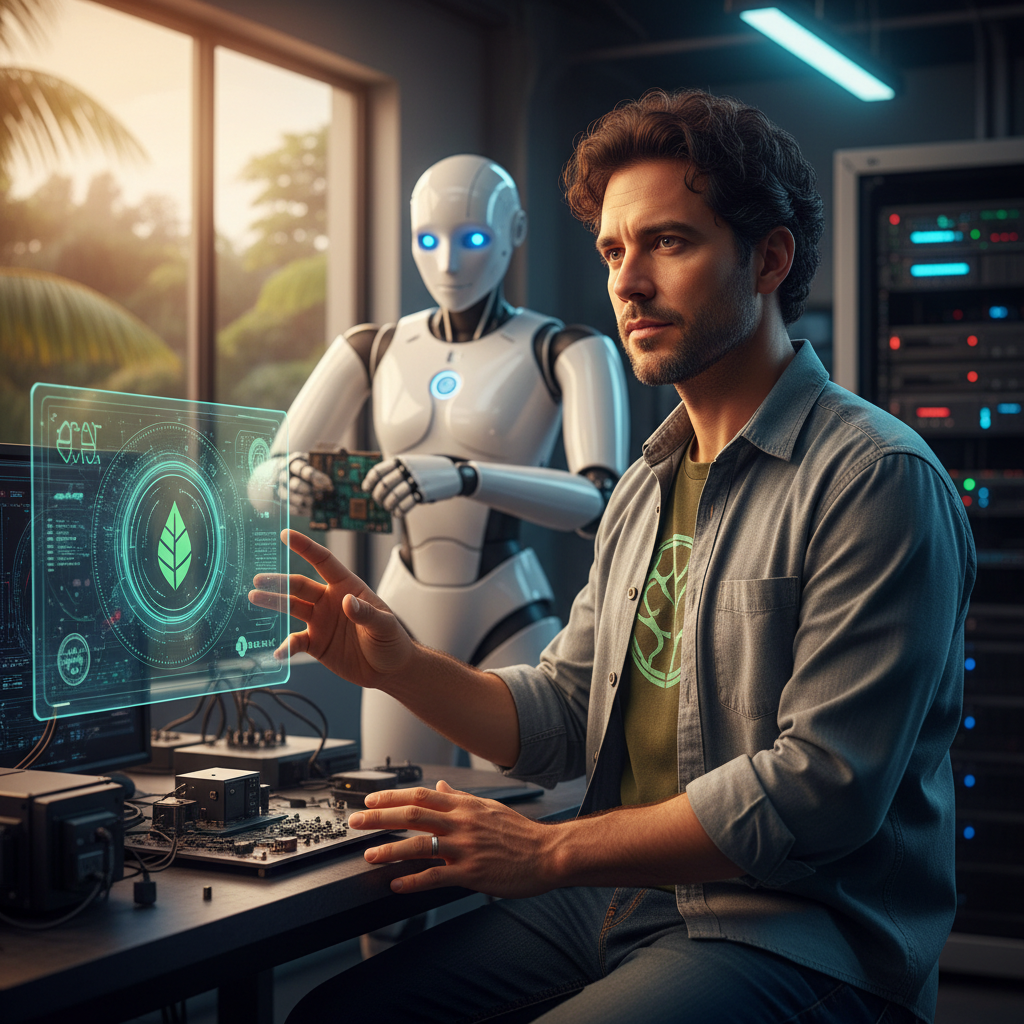
Quantum Leap Labs initially focused on developing quantum-inspired optimization algorithms for renewable energy grids. Their early prototypes showed promising results, demonstrating how quantum annealing and quantum machine learning could significantly improve the efficiency and stability of complex energy networks, reducing waste and maximizing the output of solar and wind farms. This caught the attention of local energy providers and, eventually, international investors. Their first seed round, secured in 2023, was modest by global standards, but it was enough to validate their approach and accelerate their research and development. "It proved that Costa Rica proves you don't need Silicon Valley to build world-class technology," Vargas says with a proud smile.
Their recent breakthrough involves using quantum-enhanced AI for advanced climate modeling and biodiversity analysis. By leveraging the immense computational power of quantum algorithms, even in their nascent stages, they are able to process vast datasets from satellite imagery, sensor networks, and environmental monitoring stations with unprecedented speed and accuracy. This allows for more precise predictions of climate patterns, better identification of species at risk, and more effective strategies for conservation. They are currently collaborating with the Ministry of Environment and Energy (minae) on a pilot project to monitor deforestation in protected areas, providing real-time insights that traditional AI models struggle to deliver.
Today, Quantum Leap Labs is a team of nearly 40 scientists and engineers. They have secured a Series A funding round led by a European deep tech fund, with participation from a major Latin American impact investor. While they are still a relatively small player compared to giants like IBM Quantum or Google AI, their specialized focus and innovative approach are earning them recognition. Their work on optimizing carbon capture processes using quantum machine learning has recently been highlighted in a leading scientific journal, drawing interest from several industrial partners.
What truly drives Carlos Vargas is not the pursuit of a unicorn valuation, but the tangible impact his technology can have. He sees quantum AI not as a futuristic fantasy, but as a necessary tool for humanity's survival. "The pura vida approach to AI," he muses, "is about building technology that enhances life, that respects our planet, and that serves a greater good. It is about wisdom, not just speed." He believes that small nations, unburdened by legacy systems or the pressure to chase every fleeting trend, are uniquely positioned to lead in this space.
Looking ahead, Vargas envisions Quantum Leap Labs expanding its collaborations with research institutions and governments across Central and South America, creating a regional hub for quantum AI innovation focused on sustainability. He sees a future where quantum sensors, combined with advanced AI, can provide hyper-local environmental data, empowering communities to make informed decisions about their resources. It is an ambitious vision, but one rooted in the practical realities and urgent needs of our world. As the global conversation around AI intensifies, Vargas and his team are a quiet, powerful reminder that the most profound innovations often come from those who are not just building technology, but building a better future, one quantum leap at a time. For more on the broader implications of AI, you can read about AI developments globally. Their work is a testament to the idea that truly transformative technology can emerge from anywhere, even from a country known more for its rainforests than its supercomputers, challenging the notion that all significant tech must originate from established centers. TechCrunch often covers startups in this space.