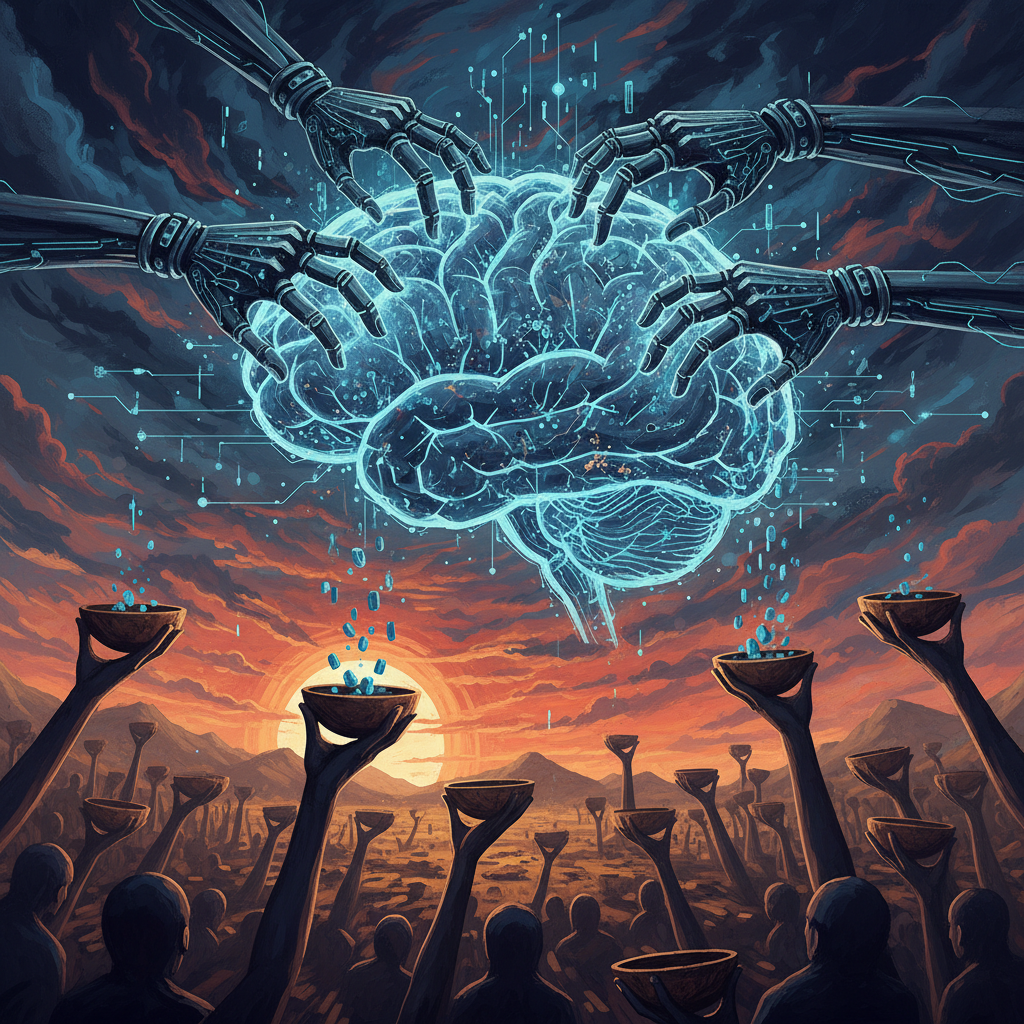

Let us be honest, when you hear about the latest AI marvel from OpenAI or Google DeepMind, do you ever stop to think about the human element behind the curtain? No, you are probably picturing sleek servers humming in climate-controlled data centers, not a young woman in a small office in Kochi meticulously tagging images of cats and dogs for eight hours a day. Oh, the irony. We celebrate the 'intelligence' of these systems, yet conveniently forget the often-exploited human intelligence that painstakingly trained them.
This is not some abstract ethical dilemma for a philosophy seminar, this is a very real, very urgent issue concerning AI workers' rights, particularly here in India. Our nation has become a global hub for data annotation and labeling, a critical, yet largely invisible, component of the machine learning pipeline. Companies, from the behemoths like Microsoft and Amazon to countless startups, outsource this foundational work to places where labor is cheap and regulations are, shall we say, 'flexible.'
The risk scenario is stark: a massive, underpaid, and often exploited workforce, primarily in the Global South, is building the very foundations of the AI revolution without adequate protection, fair wages, or even basic benefits. Their mental health suffers from repetitive, often disturbing, content moderation tasks. Their physical health is impacted by long hours staring at screens. And their economic stability is a constant tightrope walk, dependent on fluctuating project volumes and the whims of algorithms that dictate their pay.
Technically speaking, these 'AI workers' are not coding the next GPT model or designing neural architectures. They are performing what is known as 'human-in-the-loop' tasks. This includes everything from transcribing audio, identifying objects in images and videos, moderating harmful content, to evaluating the quality of AI outputs. Without this human input, AI models cannot learn. They cannot distinguish a cat from a cow, or a hate speech comment from a harmless joke. These are the people teaching the machines to 'see' and 'understand' our world. They are the unsung heroes, or perhaps, the unsung victims, of the AI boom.
“The sheer volume of data required to train these large language models is staggering, and a significant portion of that data needs human refinement and labeling,” explains Dr. Anjali Sharma, a leading researcher in human-computer interaction at IIT Madras. “When you consider a model like Google's Gemini or Anthropic's Claude, the foundational work done by thousands of annotators is what gives these systems their perceived intelligence. Yet, these workers are often treated as disposable cogs in a global supply chain.”
The expert debate on this is, predictably, split. On one side, you have the AI giants and their proponents arguing that these are entry-level jobs, providing employment in developing regions. They claim they are creating opportunities. “We are providing valuable work and skills development to communities that might otherwise lack such opportunities,” stated a spokesperson for a major US-based data labeling firm, speaking anonymously. “Our partners adhere to local labor laws, and we strive for fair compensation.” Strive, mind you, not guarantee.
On the other side, labor advocates and ethicists are screaming from the rooftops. “Fair compensation often means minimum wage, which is barely enough to survive on in many parts of India, especially with rising costs,” argues Rajesh Kumar, a labor rights activist based in Bengaluru. “These companies are profiting immensely from AI, yet the people doing the grunt work see only a fraction of that wealth. It is a modern form of digital colonialism, if you ask me.” He is not wrong. Many of these workers are paid on a per-task basis, creating immense pressure to work faster, often at the expense of accuracy and their own well-being. The gig economy model, which these platforms often adopt, strips workers of benefits like health insurance, paid leave, and job security, all things that Silicon Valley employees take for granted.
The real-world implications for India are profound. We are talking about hundreds of thousands, if not millions, of individuals whose livelihoods are tied to this industry. Many are young, educated, and desperate for work, making them vulnerable to exploitation. I have heard stories from Kerala, my home state, where graduates with engineering degrees are doing mind-numbingly repetitive tasks for meager wages, all while being told they are part of the 'future.' It is a future built on shaky ground for them.
Consider a scenario where a content moderator, tasked with reviewing graphic and violent imagery for an AI model, develops severe psychological trauma. This is not hypothetical, it is a documented phenomenon. Yet, the companies employing them often provide little to no mental health support. “I saw things that still haunt my dreams,” recounted Priya, a former content moderator from Chennai who worked for a major social media platform through a third-party vendor. “They told us it was for AI safety, but who was ensuring our safety?” Her voice was laced with a weariness that went beyond mere fatigue. This is a health crisis waiting to explode, not just for individuals but for communities. The long-term societal cost of this neglect will far outweigh any short-term savings these companies are making.
So, what should be done? First, transparency is paramount. AI companies need to be upfront about their human labor supply chains. This means auditing their third-party vendors and ensuring ethical labor practices are enforced, not just aspirational. Second, fair wages and benefits are non-negotiable. If a company can afford to invest billions in AI research, it can afford to pay its human trainers a living wage and provide essential benefits. This is not charity, it is basic human decency and a recognition of their invaluable contribution.
Third, mental health support and safe working conditions must be mandated, especially for content moderation tasks. This could involve stricter limits on exposure to harmful content, mandatory breaks, and accessible psychological counseling. Fourth, governments, particularly in countries like India, need to step up. We need stronger labor laws that specifically address the unique challenges of the digital gig economy and data labeling work. The current frameworks are simply not equipped to handle this new breed of digital labor.
Finally, consumers and investors have a role to play. We need to demand ethical AI, and that includes ethically sourced human labor. If we are truly concerned about AI safety and fairness, we must extend that concern to the human beings who make AI possible. Otherwise, we are just building a brilliant, shiny future on the backs of an invisible, suffering workforce. File this under 'things that make you go hmm' and then, hopefully, make you act. The future of AI should uplift all, not just the privileged few. For more on the hidden costs of AI, you might want to check out reports on AI ethics and society or the latest research on human-in-the-loop systems. The conversation is just beginning, and it needs to include everyone.