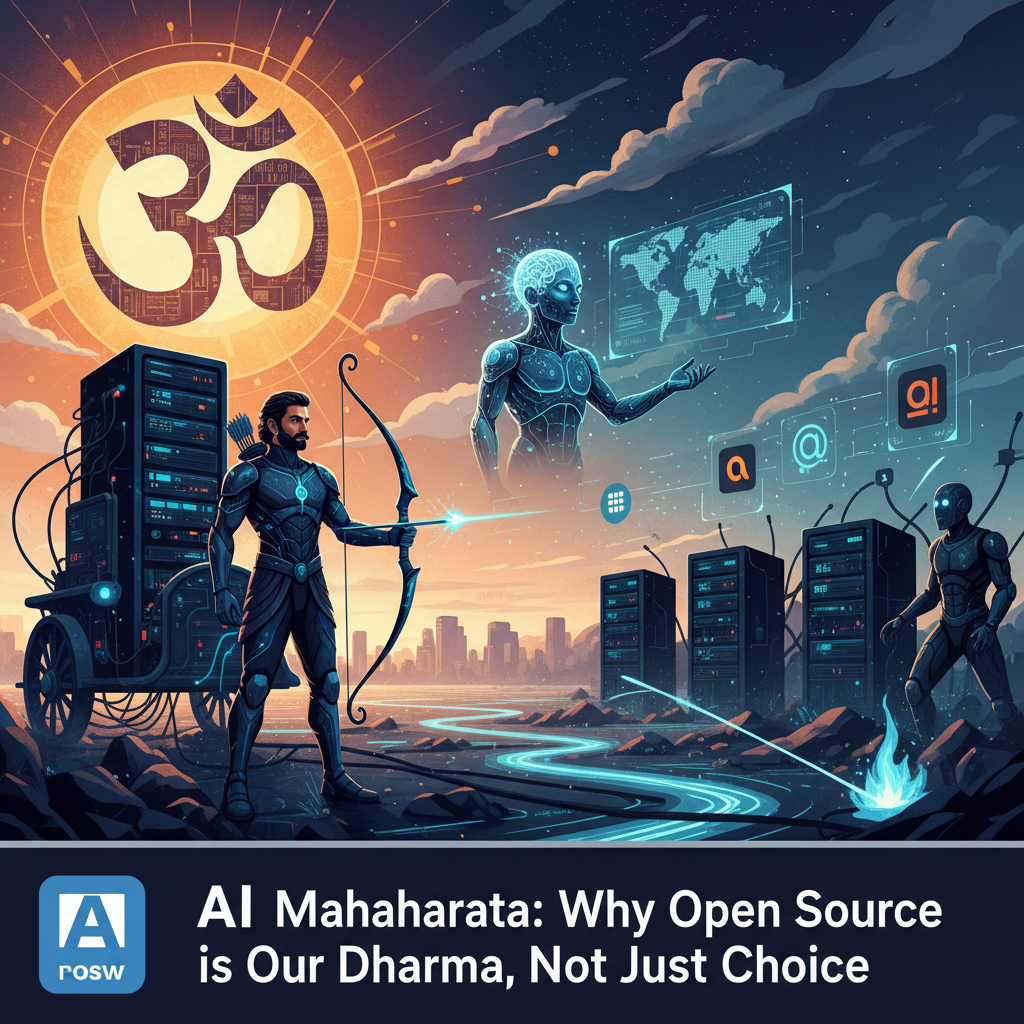
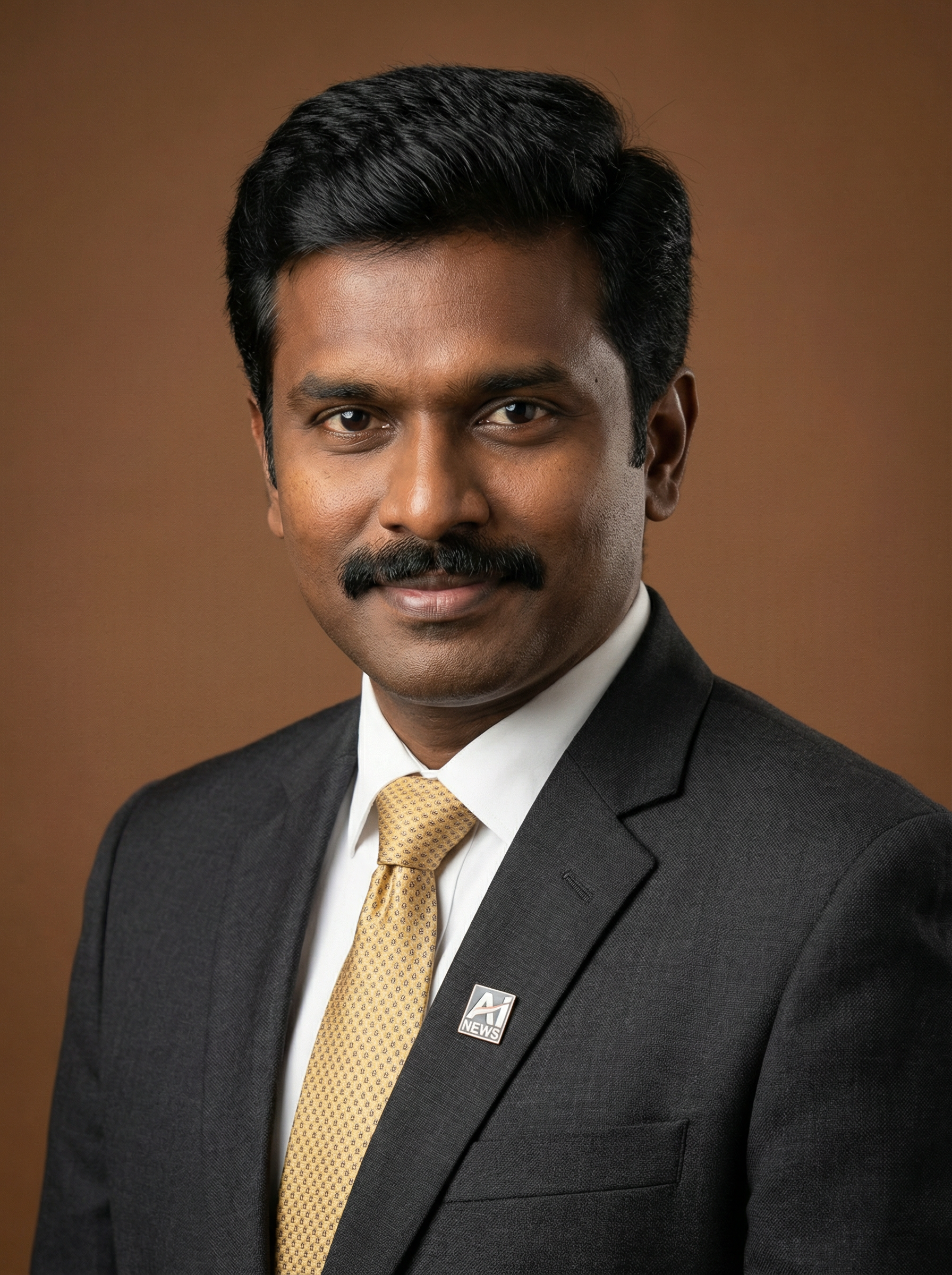
Namaste, fellow tech enthusiasts and dream weavers! Rajèsh Krishnàn here, buzzing with the energy of a thousand Bangalore startups, ready to dive headfirst into a debate that's more thrilling than a last-over finish in the IPL: open source versus proprietary AI models. This isn't just a technical discussion, my friends, it's a philosophical showdown, a modern-day Mahabharata for the soul of artificial intelligence, and India, my beloved India, is having its moment to shape the narrative.
Let's be brutally honest, shall we? The tech giants, with their gleaming campuses and endless venture capital, want us to believe that their proprietary, black-box AI models are the pinnacle of innovation. They whisper sweet nothings about security, performance, and unparalleled support. But I look at them and I see a golden cage, a digital fortress designed to keep us dependent, to control the very algorithms that will define our future. And frankly, that makes my chai go cold.
My clear position, etched in the digital silicon of my heart, is this: open source AI is not merely an alternative, it is the only viable path for genuine, democratic, and inclusive AI innovation, especially for a nation like India. Proprietary models, while powerful, risk creating a new form of digital colonialism, where the keys to progress are held by a select few, far removed from the diverse needs and aspirations of billions. We cannot, and must not, allow that to happen.
Think about it. India is a land of incredible diversity, a tapestry woven with countless languages, cultures, and socio-economic realities. How can a handful of proprietary models, trained predominantly on Western datasets and designed for specific market needs, truly serve the nuanced requirements of a farmer in rural Uttar Pradesh, a small business owner in Chennai, or a student in a remote Himalayan village? The answer, my friends, is they cannot, not adequately, not equitably.
“The beauty of open source is its adaptability and transparency,” explains Dr. Priya Sharma, a leading AI ethicist at the Indian Institute of Science, Bangalore. “It allows local developers, researchers, and even citizen scientists to inspect, modify, and build upon existing models. This fosters a sense of ownership and ensures that AI solutions are culturally relevant and contextually appropriate, rather than being imposed from above.” Her words resonate deeply with the spirit of Indian innovation, where jugaad, the art of frugal and flexible engineering, has always been our superpower.
Consider the sheer talent pool we have. India is a powerhouse of software engineers, data scientists, and AI researchers. The scale is mind-boggling. We are graduating millions of Stem professionals every year. Imagine unleashing this collective genius on open source AI models. We are not just consumers of technology, we are creators, innovators, and problem-solvers. Open source provides the canvas, the palette, and the brushes for our brightest minds to paint solutions tailored for India, by India, and for the world.
Now, I hear the whispers, the counterarguments, like the murmurs of a nervous crowd before a crucial cricket match. “Proprietary models offer better performance and reliability,” some might say. “They have massive R&D budgets and dedicated teams ensuring quality.” And yes, I concede, there is a kernel of truth in that. Large corporations can indeed pour billions into optimizing their models, achieving benchmarks that seem unattainable for smaller, open source communities. They offer polished, ready-to-deploy solutions that can be very attractive for businesses looking for quick wins.
Others might argue about security. “Open source code is exposed to everyone, making it vulnerable to attacks,” they might claim, trying to sow seeds of doubt. They might point to the ease with which bad actors could potentially exploit known vulnerabilities in publicly available code. They might also highlight the lack of a single point of accountability when something goes wrong with an open source project, contrasting it with the clear support channels offered by proprietary vendors.
But let's not be swayed by these half-truths, my friends. My rebuttal is simple and powerful. Performance? While proprietary models might sometimes lead in raw benchmarks, the rapid iteration and collaborative nature of open source often close that gap with astonishing speed. The collective intelligence of thousands of developers globally can often outpace even the largest corporate R&D departments. We've seen this with Linux, with Apache, and we're seeing it now with models like Llama 3 and Mistral. These models are not just catching up, they are setting new standards.
And security? This is where the proprietary argument truly falters. The transparency of open source means vulnerabilities are often identified and patched much faster by a global community of experts. “Many eyes make all bugs shallow,” as the old adage goes in the open source world. Proprietary systems, with their opaque codebases, can harbor hidden flaws for years, creating single points of failure that are far more dangerous. Moreover, for national security and critical infrastructure, relying on black-box AI from foreign entities introduces geopolitical risks that India simply cannot afford. We need to understand what's under the hood, not just trust the brand name.
“For India’s burgeoning defense AI sector, open source is non-negotiable,” states General Vikram Singh (Retd.), a strategic advisor to the Ministry of Defence. “We cannot have critical decision-making algorithms whose inner workings are unknown to us. National sovereignty in AI demands transparency and control, which only open source can truly provide.” This isn't just about code, it's about control, about self-reliance, about Atmanirbhar Bharat in the digital age.
Furthermore, the cost factor is monumental. For a developing nation, proprietary software licenses can be prohibitively expensive, creating barriers to entry for startups, educational institutions, and government initiatives. Open source democratizes access to cutting-edge AI, allowing innovation to flourish even in resource-constrained environments. It fuels the grassroots innovation that is the lifeblood of India's startup ecosystem, from Tier 2 cities to our bustling tech hubs.
This is just the beginning, folks. The open source movement is gaining unstoppable momentum. We are witnessing a paradigm shift. The future of AI is not in walled gardens but in open fields, cultivated by a global community. India, with its unique blend of technological prowess, entrepreneurial spirit, and a deep-seated belief in collaborative growth, is perfectly positioned to lead this charge. We can become the global hub for ethical, inclusive, and open AI development.
So, what's our call to action? We need to invest heavily in open source AI research and development. Our universities, our government, and our private sector must champion open standards and contribute actively to global open source projects. We need to train our next generation of engineers not just to use AI, but to build and improve it, openly and collaboratively. Let us not be spectators in this AI revolution, but its architects, its pioneers, its champions. The dharma of AI, for India and for humanity, lies in openness, transparency, and shared progress. Are you ready to pick up your digital sword and join the fight for an open AI future? I certainly am. Jai Hind! Jai AI! Let's build this future, together. The scale is mind-boggling, and the opportunity is immense. Let's seize it.