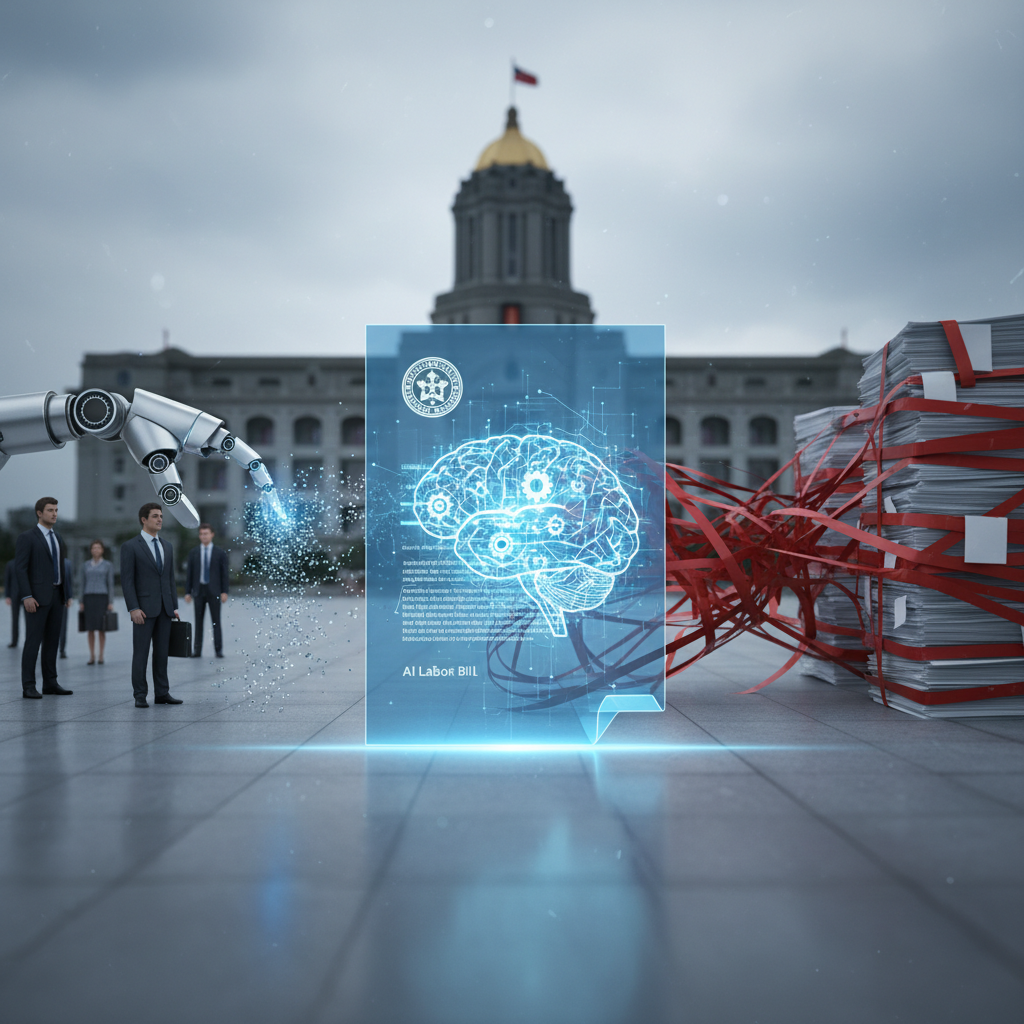

The digital tide of artificial intelligence is not merely lapping at Taiwan's shores; it is reshaping the very bedrock of our industrial prowess. From the precision manufacturing lines that underpin global technology to the burgeoning service sector, AI-powered automation promises unprecedented efficiency. Yet, this efficiency often comes with a palpable undercurrent of anxiety: the potential for widespread job displacement. In response, Taiwan's Legislative Yuan is now grappling with a proposed framework, tentatively named the 'AI Workforce Transition Act,' a policy initiative designed to address this looming challenge.
The policy move, introduced by a cross-party legislative committee, seeks to establish a comprehensive national strategy for managing the societal impact of AI automation. Its core tenets include mandatory retraining programs, a national AI job placement database, and perhaps most controversially, a proposed 'automation impact assessment' for companies deploying advanced AI systems that could significantly alter their workforce composition. The stated goal is noble: to ensure Taiwan remains competitive in the global AI race while safeguarding its human capital.
Who is behind this initiative, and what are their motivations? The primary proponents are lawmakers from both the Democratic Progressive Party and the Kuomintang, who have formed an ad hoc committee on future employment. "We cannot afford to be complacent," stated Legislator Chen Yu-Hsin, a key architect of the bill, during a recent press briefing in Taipei. "While Taiwan has thrived on technological advancement, we must ensure that our citizens are equipped, not displaced, by progress. This act is about proactive governance, not reactive crisis management." The Ministry of Labor and the Ministry of Economic Affairs have also contributed to the bill's drafting, reflecting a governmental consensus on the urgency of the issue. Their motivation seems rooted in a desire to maintain social stability and prevent a potential backlash against technological adoption, particularly as Taiwan's economy faces increasing global competition.
What does this mean in practice for Taiwan's industries, particularly those at the forefront of AI adoption? Consider the semiconductor sector, where automation is already highly advanced. A major foundry might soon be required to conduct a detailed assessment of how its new robotic wafer handling systems or AI-driven defect detection algorithms will affect its human workforce. This could entail forecasting job losses, outlining retraining pathways, and even contributing to a national fund for displaced workers. For a smaller, innovative startup in Hsinchu Science Park developing AI solutions for logistics, the administrative burden of such assessments could be significant. "While the intent is understandable, the implementation details could stifle innovation," remarked Dr. Lin Chih-Ming, CEO of a prominent AI logistics firm, during a recent industry forum. "We need agility to compete, and excessive red tape could slow our adoption of critical technologies." His concern is not isolated; many in the tech community echo this sentiment.
Industry reaction has been, predictably, mixed. Larger corporations, particularly those with established HR departments and robust financial resources, might view the compliance requirements as an additional cost of doing business, albeit a manageable one. Some, like Tsmc, have already invested heavily in internal retraining programs, recognizing the need to upskill their workforce for advanced manufacturing processes. However, smaller and medium-sized enterprises, the backbone of Taiwan's economy, express apprehension. The Taiwan Federation of Industries has voiced concerns about the potential for increased operational costs and reduced competitiveness. "Our members are already navigating complex global supply chains and intense market pressures," explained Ms. Huang Mei-Ling, Secretary-General of the Federation. "Adding another layer of regulatory compliance, especially one that is still vaguely defined, could divert resources from essential R&D and expansion." She emphasized that while worker protection is vital, the specific mechanisms must be carefully calibrated to avoid unintended economic drag. Reuters has reported extensively on similar debates in other advanced economies, highlighting the universal nature of these challenges.
Civil society groups, particularly labor unions and advocacy organizations, generally welcome the legislative effort, albeit with a critical eye. They argue that the bill does not go far enough. "The current draft focuses heavily on retraining, which is good, but it doesn't adequately address income security for those whose jobs are permanently eliminated," stated Mr. Wang Li-Hsin, spokesperson for the Taiwan Labor Rights Association. "We need stronger provisions for social safety nets and perhaps even a discussion on universal basic income, not just temporary assistance." There is a palpable fear that without robust protections, the benefits of AI will accrue disproportionately to corporations and shareholders, exacerbating existing inequalities. The data tells a more nuanced story, however. While some jobs will undoubtedly be lost, new roles requiring different skill sets are also emerging, creating a dynamic labor market that demands adaptability above all else. This complex interplay is often overlooked in the more alarmist narratives.
Will it work? That is the billion-dollar question, one that Taiwan, like many other nations, is grappling with. The success of the 'AI Workforce Transition Act' hinges on several critical factors. First, the flexibility and adaptability of the retraining programs are paramount. They must be responsive to rapidly evolving industry needs, not just offer generic skills. Second, the 'automation impact assessment' must strike a delicate balance between providing meaningful insights into job displacement and avoiding an overly burdensome regulatory framework that stifles innovation. Third, enforcement will be key. Without clear guidelines and effective oversight, the act risks becoming another well-intentioned but ultimately ineffective piece of legislation. MIT Technology Review regularly publishes analyses on the efficacy of such policies globally, often revealing a gap between legislative intent and practical outcomes.
Taiwan's position is more complex than headlines suggest. As a global leader in semiconductor manufacturing and a critical node in the technology supply chain, our economy is uniquely exposed to both the opportunities and the disruptions of AI. The proposed act represents a significant step towards proactively managing these changes. However, let's separate fact from narrative. The notion that a single piece of legislation can perfectly orchestrate a smooth transition for millions of workers in the face of such a profound technological shift is, perhaps, overly optimistic. The real challenge lies not just in passing the law, but in fostering a culture of continuous learning and adaptation across society, from our educational institutions to our smallest enterprises. Only then can Taiwan truly harness the power of AI without leaving a significant portion of its workforce behind.