SK Hynix Leads AI Memory Surge, K-Manpower Pivots to High-Tech Roles
SK Hynix's latest HBM4 development signals Korea's dominance in AI memory, prompting a national discussion on upskilling the male workforce for future high-tech demands and maintaining global economic leadership.
Click play to listen to this article read aloud using text-to-speech.
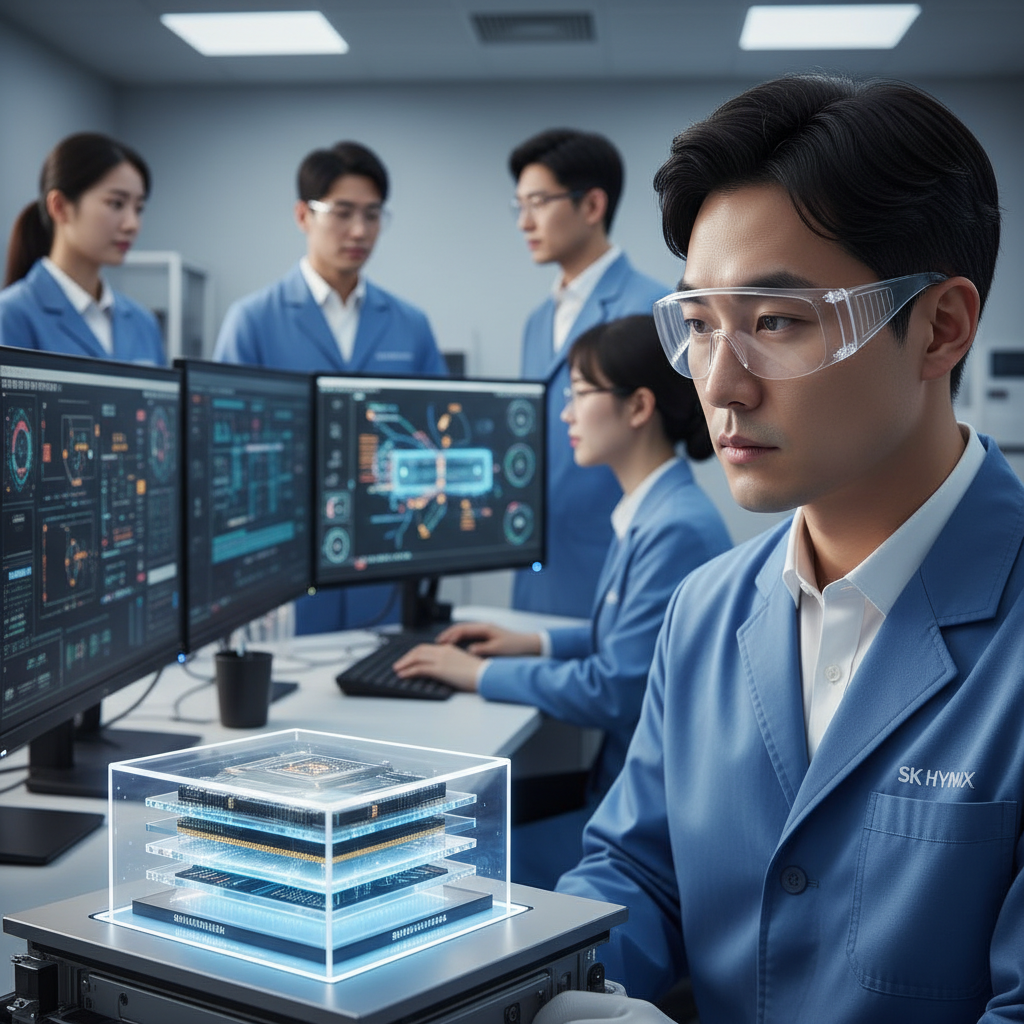

SEOUL, South Korea – The global race for artificial intelligence supremacy continues to heat up, and South Korea, particularly its formidable semiconductor industry, is once again at the forefront. This week, SK Hynix, a cornerstone of the nation's economic might, announced significant advancements in its High Bandwidth Memory (HBM4) technology, signaling a new era for AI infrastructure.
Industry insiders are buzzing about the implications. "This isn't just about faster chips; it's about solidifying Korea's indispensable role in the global AI ecosystem," stated Dr. Kim Min-jun, a senior researcher at the Korea Institute for Industrial Economics & Trade (KIET). "Our chaebol like SK Hynix and Samsung are not just manufacturing; they are innovating at a pace that keeps us ahead of competitors from Taiwan and the U.S."
The economic ripple effect of such technological leadership is profound, especially for the Korean male workforce, or K-manpower. Historically, sectors like manufacturing, shipbuilding, and construction have been significant employers for men. However, as AI and automation reshape these industries, there's a growing imperative for a strategic pivot.
"The paradigm is shifting," observed Professor Lee Dong-ho from Seoul National University's Department of Economics. "The traditional 'iron rice bowl' mentality, where a man could expect a lifelong career in a single large enterprise, is evolving. We're seeing a push towards re-skilling and up-skilling, particularly for men in their 30s and 40s who need to transition into roles that complement, rather than compete with, AI."
The government, through initiatives like the Ministry of Science and ICT's 'Digital New Deal 2.0,' is actively promoting AI literacy and specialized training programs. Companies are also investing heavily. A recent survey by the Federation of Korean Industries (FKI) indicated that over 70% of major Korean firms plan to increase their investment in AI-related training for their employees over the next three years.
However, challenges remain. The intense pressure on Korean men to secure stable, high-status employment often creates resistance to career changes, despite the long-term benefits. "There's a cultural aspect," explained Mr. Park Sang-hyun, a career counselor specializing in male career transitions. "The expectation to be the primary breadwinner, coupled with a highly competitive job market, makes taking a step back for retraining a difficult decision for many. But the alternative is being left behind."
As SK Hynix pushes the boundaries of HBM technology, it underscores Korea's commitment to leading the digital future. The nation's ability to adapt its formidable K-manpower to these new high-tech demands will be crucial in ensuring continued economic prosperity and maintaining its global competitive edge in the AI era. The future of the Korean economy, and indeed, the role of the Korean man within it, is intrinsically linked to this technological evolution.
Related Articles
Vietnamese Women Lead AI Ethics Dialogue Amidst Rapid Digital Transformation
 Ngo Thi Huừngé
AI's 'Digital Concierge' Boom: Japanese Women Leading the Charge in Service Sector
 Yuki Tanakà
AI-Powered "Green Silk Road" Initiative Empowers Women in Sustainable Agriculture
 Mei-Líng Zhāng
UAE's AI Strategy: Empowering Emirati Women in the Digital Economy
 Layla Al-Mansourì