
Seoul's AI Ethics Push: Navigating the 'Digital Gungjung' for National Security
South Korea intensifies its focus on AI ethics, particularly concerning national security and the 'Digital Gungjung' concept, amidst global tech competition. Experts warn against 'AI-jusa' risks while advocating for a balanced regulatory approach.
Click play to listen to this article read aloud using text-to-speech.
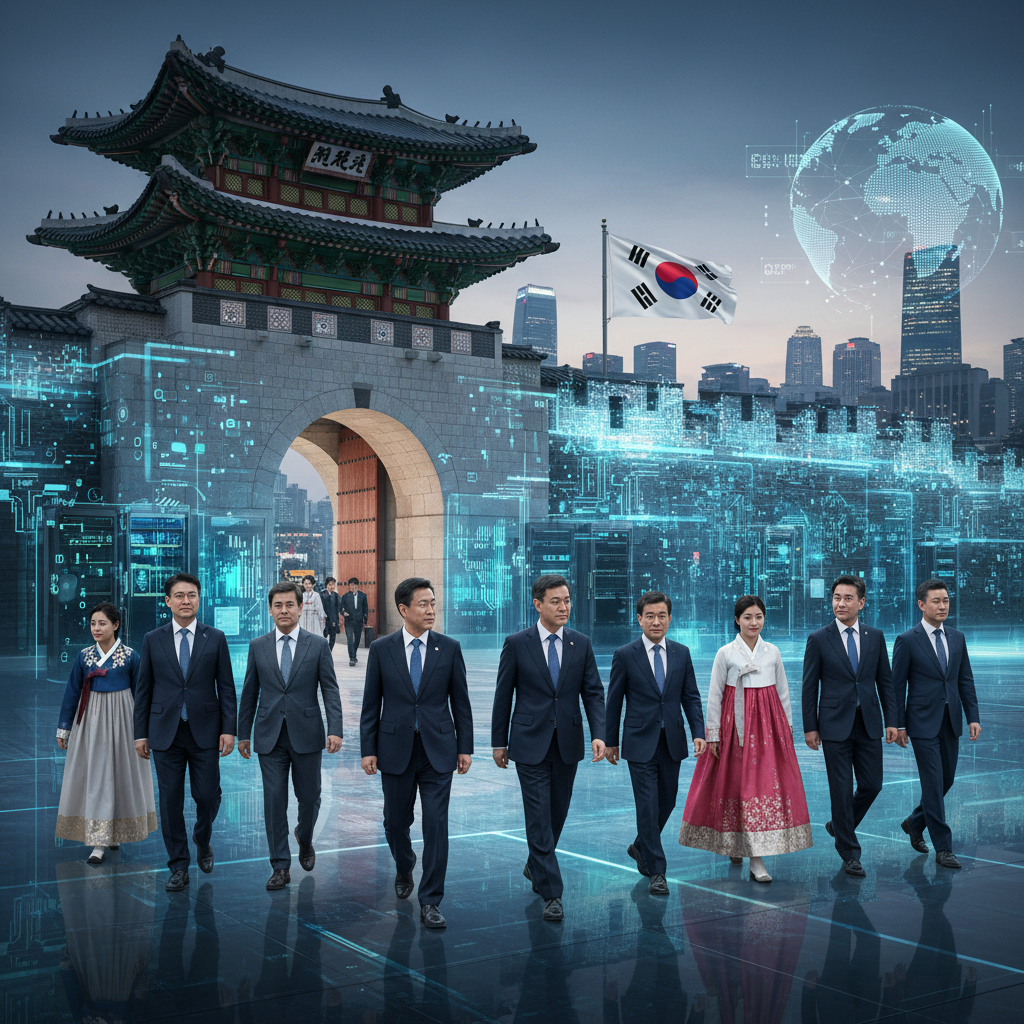

SEOUL, South Korea – As the global race for AI dominance intensifies, South Korea is not merely a participant but a proactive architect, particularly in the realm of AI ethics and governance. The Yoon administration, through the Ministry of Science and ICT (MSIT) and the Presidential Committee on the Digital Platform Government, is spearheading initiatives to ensure that AI development aligns with national values and security imperatives, a concept increasingly referred to as the 'Digital Gungjung' – a modern interpretation of the royal court's ethical and strategic foresight.
Recent discussions within the National Assembly's Science, ICT, Broadcasting, and Communications Committee (과학기술정보방송통신위원회) have highlighted growing concerns over the potential misuse of advanced AI, especially by hostile foreign entities. "We must be vigilant against 'AI-jusa' (AI-driven self-reliance ideology) where external powers attempt to compromise our digital sovereignty through sophisticated AI tools," stated Representative Kim Min-joon of the ruling People Power Party (국민의힘). "Our national security is intertwined with the ethical robustness of our AI systems."
This sentiment resonates deeply within the Korean man's perspective, where collective security and national interest often supersede individualistic approaches. The push for a robust AI ethics framework is seen not just as a global best practice but as a strategic necessity for a nation constantly navigating complex geopolitical dynamics.
Dr. Lee Sang-hoon, a senior researcher at the Korea Advanced Institute of Science and Technology (KAIST) AI Policy Center, elaborated on the challenges. "The 'Digital Gungjung' demands that our AI policies are not just reactive but anticipatory. We need to cultivate an 'AI-innyeo' (AI human resource) pool that understands both technological prowess and ethical implications, especially in areas like defense and critical infrastructure," Dr. Lee explained during a recent policy forum at the National IT Industry Promotion Agency (NIPA).
The MSIT recently announced a new task force dedicated to developing 'AI Trust Guidelines for National Security,' focusing on data provenance, algorithmic transparency, and bias mitigation in AI systems deployed in sensitive sectors. This move comes after reports of sophisticated cyber-attacks, potentially AI-assisted, targeting government agencies and critical infrastructure in the past year.
However, some voices urge caution against over-regulation that could stifle innovation. "While ethical safeguards are paramount, we must avoid creating a 'Gisaeng-chung' (parasitic) regulatory environment that drains our competitive edge," commented Professor Park Ji-hyeok of Seoul National University's Department of Computer Science. "The balance lies in fostering 'AI-gongsaeng' (AI symbiosis) where industry, academia, and government collaborate to build trustworthy AI without undue burdens."
The government's strategy appears to be a two-pronged approach: strengthening domestic ethical guidelines while actively participating in international forums like the OECD AI Policy Observatory and the UN's AI initiatives. The goal is to position South Korea not just as an AI powerhouse, but as a leader in responsible AI governance, ensuring that the digital future is secure and aligned with the nation's enduring values.
Related Articles

Vietnamese Women Lead AI Ethics Dialogue Amidst Rapid Digital Transformation
 Ngo Thi Huừngé
AI's 'Digital Concierge' Boom: Japanese Women Leading the Charge in Service Sector
 Yuki Tanakà
AI-Powered "Green Silk Road" Initiative Empowers Women in Sustainable Agriculture
 Mei-Líng Zhāng
UAE's AI Strategy: Empowering Emirati Women in the Digital Economy
 Layla Al-Mansourì