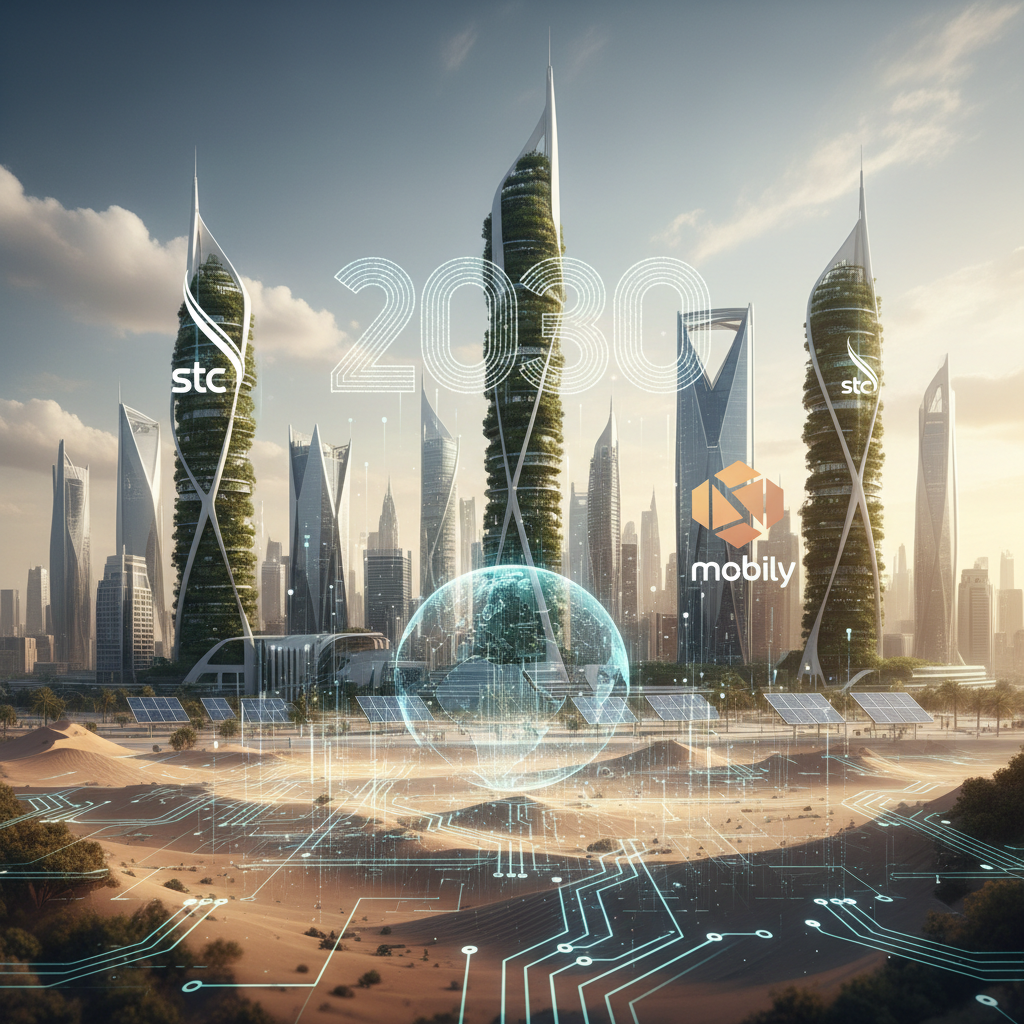

The desert is blooming with data centers, a testament to the Kingdom's unwavering commitment to a digital future. In Saudi Arabia, the discourse around artificial intelligence is not confined to academic papers or Silicon Valley boardrooms; it is a tangible force reshaping critical national infrastructure. Specifically, the telecommunications sector, a cornerstone of any modern economy, is undergoing a profound transformation driven by AI, with companies like STC and Mobily leading the charge. This is not a matter of choice, but of strategic necessity; The Kingdom's Vision 2030 demands results, not promises, and AI is proving to be the indispensable engine.
For too long, the narrative around AI has been dominated by speculative forecasts and abstract concepts. Here, however, we observe concrete investments and measurable outcomes. The primary focus for telecom operators has been threefold: optimizing network performance, enhancing customer service, and laying the groundwork for the advanced capabilities of 5G and the nascent 6G. These are not disparate initiatives but interconnected pillars supporting a national digital edifice.
Network optimization, for instance, has moved beyond traditional algorithms. Modern AI models, often leveraging deep learning, are now predicting traffic surges, identifying potential bottlenecks before they impact users, and dynamically reallocating resources. This proactive management is crucial in a region experiencing exponential data growth. According to recent reports from the Communications and Information Technology Commission (citc), mobile data consumption in Saudi Arabia has increased by 45% year-on-year, a figure that underscores the immense pressure on existing networks. "Our legacy systems simply could not keep pace with this demand," stated Dr. Fahad Al-Qahtani, Chief Technology Officer at STC. "We are deploying NVIDIA's AI platforms to analyze petabytes of network data in real-time, allowing us to predict congestion with 92% accuracy and adjust network parameters autonomously. This translates directly to fewer dropped calls and faster internet speeds for our customers, a fundamental expectation in today's digital age."
The implications for customer service are equally significant. The era of frustrating automated phone trees is slowly giving way to AI-powered virtual assistants capable of understanding complex queries and resolving issues with remarkable efficiency. Companies like Mobily are integrating large language models, similar to OpenAI's GPT series or Google's Gemini, into their customer interaction platforms. These systems are trained on vast datasets of customer interactions, product information, and technical documentation, enabling them to provide personalized support around the clock. "Our AI-driven chatbot, 'Saif,' now handles approximately 70% of routine customer inquiries, freeing our human agents to focus on more complex cases," explained Ms. Layla Al-Hammadi, Head of Digital Transformation at Mobily. "This has reduced average resolution times by 35% and significantly improved customer satisfaction scores, as evidenced by our latest Net Promoter Score increase of 15 points. It is a clear demonstration of how oil money meets machine learning to deliver tangible benefits."
The strategic foresight extends to the next generation of wireless technology. The rollout of 5G is well underway, and planning for 6G has already begun in earnest. AI is not merely an adjunct to these technologies; it is intrinsic to their very design and operation. For 5G, AI is critical for managing massive Mimo antennas, optimizing beamforming, and orchestrating network slicing to deliver tailored services for diverse applications, from autonomous vehicles to industrial IoT. Looking ahead, 6G networks are envisioned to be even more intelligent, self-organizing, and capable of supporting truly immersive experiences, requiring AI at every layer of the architecture. "The theoretical bandwidth of 6G is staggering, but without AI, managing its complexity would be an insurmountable task," remarked Professor Omar Sharif, Director of the King Abdullah University of Science and Technology's (kaust) AI Initiative. "We are researching AI-driven spectrum management and predictive maintenance for 6G infrastructure, ensuring that Saudi Arabia remains at the forefront of telecommunications innovation. This requires significant investment in both hardware, particularly from companies like NVIDIA, and the development of local AI talent."
Indeed, the investment figures are substantial. STC, the Kingdom's largest telecom operator, announced plans in late 2025 to invest SAR 15 billion, approximately USD 4 billion, over the next five years specifically into AI-driven network upgrades and digital transformation initiatives. Mobily and Zain KSA have followed suit with their own multi-billion riyal commitments. These investments are not solely for purchasing off-the-shelf solutions; they include significant allocations for research and development, talent acquisition, and the establishment of local AI innovation hubs. The goal is not just to consume technology, but to contribute to its advancement, fostering a vibrant domestic AI ecosystem.
However, the path is not without its challenges. Data privacy and cybersecurity remain paramount concerns. As AI systems become more deeply embedded in critical infrastructure, the potential for vulnerabilities increases. Robust regulatory frameworks, coupled with advanced AI-powered cybersecurity solutions, are essential to safeguard national data and ensure the integrity of telecommunications networks. The Citc has been proactive in developing guidelines for AI deployment in critical sectors, emphasizing ethical considerations and data governance. "Our regulatory approach is pragmatic, balancing innovation with security," stated Eng. Sara Al-Mansour, a senior advisor at Citc. "We are collaborating with international bodies and leading AI companies to establish best practices that protect our citizens and our digital assets. The goal is to build trust in these advanced systems."
Furthermore, the demand for skilled AI professionals far outstrips the current supply. Universities and vocational training centers across the Kingdom are working to bridge this gap, but it is a long-term endeavor. Partnerships with global tech giants, such as Microsoft and Google, are facilitating knowledge transfer and offering specialized training programs to cultivate a new generation of Saudi AI engineers and data scientists. This human capital development is as crucial as the technological infrastructure itself.
The strategic deployment of AI in Saudi Arabia's telecommunications sector is a clear indicator of the nation's broader digital ambitions. It is a calculated, data-driven approach to building a resilient, efficient, and future-proof digital backbone. The focus on network optimization, customer service, and 5G/6G planning demonstrates a practical application of AI that moves beyond mere speculation. As the Kingdom continues its journey towards Vision 2030, the success of these AI initiatives will be a critical measure of its progress. The integration of AI into telecommunications is not merely an incremental improvement; it is a fundamental re-architecture, ensuring that the digital veins of the nation pulse with efficiency and intelligence. For more insights into how AI is transforming industries globally, consider exploring reports on MIT Technology Review. The commitment is clear, and the execution is underway, transforming the very fabric of how the Kingdom connects and communicates. To understand the broader implications of AI in various sectors, one might also consult resources like Reuters Technology. This concerted effort is positioning Saudi Arabia not just as a consumer of advanced technology, but as a significant player in its global deployment and evolution, a fact often overlooked by external observers. The ongoing advancements in AI are regularly covered by industry publications, including TechCrunch.
This is not a fleeting trend; it is a fundamental shift. The Kingdom's digital future, powered by AI, is being built with precision and purpose, one optimized network segment and intelligent customer interaction at a time.