
The world woke up today to a chilling reality: the AI cold war is no longer a theoretical exercise, a mere skirmish fought in academic papers or corporate boardrooms. It is a full-blown, high-stakes geopolitical confrontation, and its latest battleground is, predictably, the very heart of South Korea's technological prowess. Specifically, Samsung Electronics, and by extension, NVIDIA.
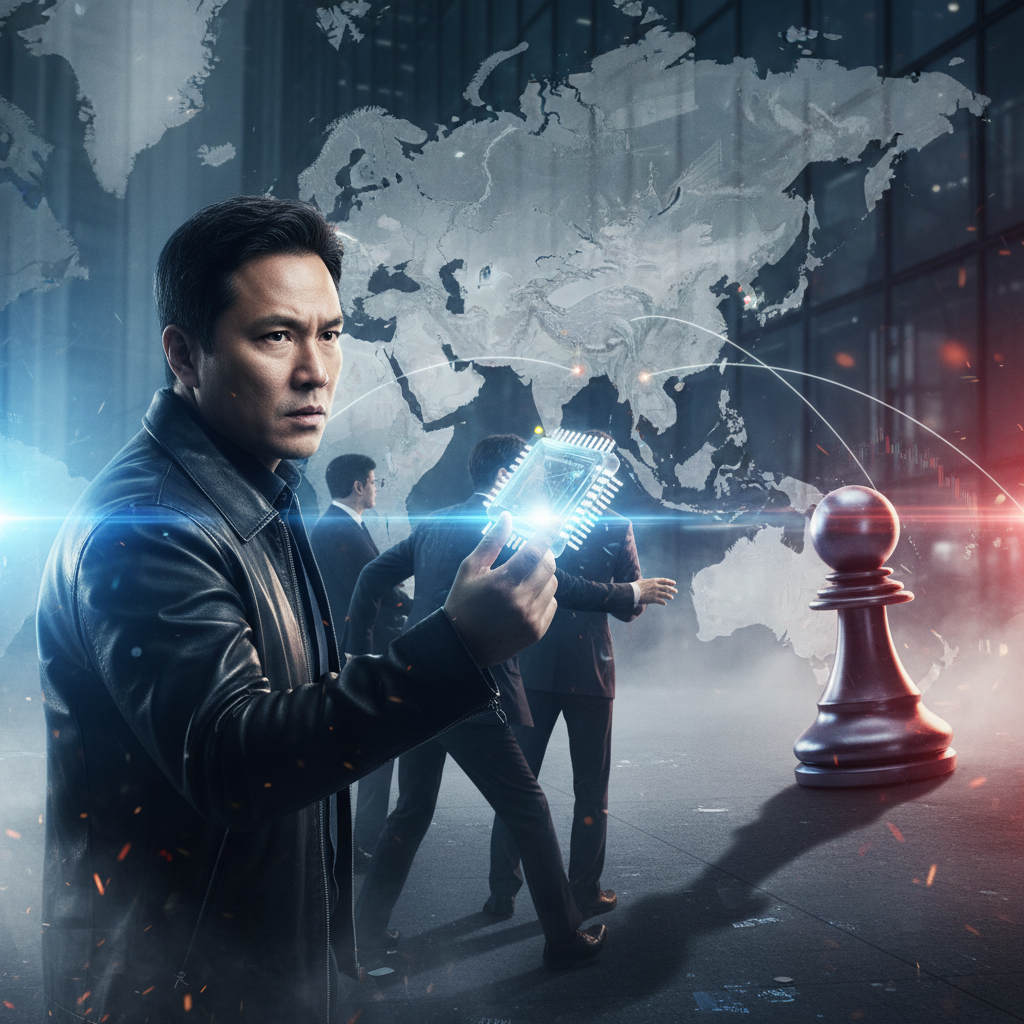
Breaking news confirms what many of us have whispered for months: a clandestine agreement between Samsung and a major, unnamed state-backed entity from a rival superpower has been unearthed. This isn't about smartphones or consumer electronics; this is about the absolute cutting edge of AI infrastructure, the very chips that power the next generation of large language models and autonomous systems. The deal, reportedly valued at an astronomical $18 billion over three years, involves Samsung's advanced High Bandwidth Memory, or HBM, specifically tailored for a new line of AI accelerators that directly compete with NVIDIA's H100 and upcoming Blackwell series.
My sources, deep within the Ministry of Science and ICT, indicate that the agreement was brokered under extreme secrecy, bypassing traditional diplomatic channels and raising immediate red flags in Washington and Brussels. "This isn't just a commercial transaction; it's a strategic realignment," stated Dr. Park Ji-hoon, a senior analyst at the Korea Institute of Science and Technology (kist), his voice tight with concern. "The implications for global supply chain stability and national security are profound. Seoul has a different answer to the question of who controls the future of AI, and it's not the one Washington wants to hear."
The immediate fallout has been seismic. NVIDIA, the undisputed titan of AI silicon, finds itself in an unprecedented bind. Jensen Huang, the company's charismatic CEO, has always navigated the treacherous waters of global politics with a certain detached pragmatism, selling his coveted GPUs to anyone with the cash and the ambition. But this Samsung deal changes everything. If Samsung is now directly enabling a competitor, especially one backed by a geopolitical rival, NVIDIA's carefully constructed dominance could begin to unravel. The company's stock took a 7% hit in pre-market trading, wiping billions off its valuation, as investors grappled with the news.
"NVIDIA's entire business model relies on being the indispensable partner, the sole provider of the most advanced AI hardware," explained Ms. Lee Eun-joo, an independent tech policy consultant based in Gangnam. "This Samsung move, whether intentional or not, positions them as a kingmaker, or perhaps more accurately, a king-breaker, in this escalating tech war. It forces NVIDIA to confront a choice: maintain its 'neutral' stance and risk empowering its rivals, or align more closely with one superpower and alienate others. There is no easy path here."
The official reaction from the South Korean government has been predictably measured, almost evasive. A spokesperson for the Ministry of Trade, Industry and Energy issued a terse statement this morning, emphasizing the nation's commitment to free trade and technological innovation. "South Korea is a sovereign nation, and our companies operate within the bounds of international law, pursuing legitimate commercial opportunities," the statement read. It was a diplomatic non-answer, designed to placate without revealing the true depth of the strategic calculus at play. But anyone paying attention knows this isn't just about commerce; it's about survival in a world increasingly bifurcated by technology.
Experts are now scrambling to understand the full ramifications. The chips in question are not merely incremental improvements; they are rumored to incorporate novel architectural designs that could offer significant performance advantages for specific types of AI workloads, particularly those favored by the rival superpower's research institutions. This isn't just about manufacturing capacity; it's about intellectual property and strategic technological advancement.
"This isn't just about who builds the chips; it's about who designs them, who controls the software stack, and ultimately, who dictates the pace and direction of AI development," said Professor Kim Min-joon, a semiconductor expert at Kaist. "If this rival power gains access to Samsung's HBM expertise and integrates it with their own accelerator designs, they could rapidly close the performance gap with NVIDIA, fundamentally altering the competitive landscape. We are talking about a potential shift in the global balance of power, not just market share."
The immediate future is fraught with uncertainty. Will the US government impose sanctions on Samsung, citing national security concerns? Will NVIDIA retaliate by diversifying its HBM suppliers away from South Korea, potentially impacting Samsung's lucrative memory business? And what does this mean for other South Korean tech giants, like SK Hynix, which also produces critical HBM components? The ripple effects could be devastating for the meticulously balanced global semiconductor ecosystem.
For the ordinary citizen, the consequences might seem distant, abstract. But make no mistake, this is not some esoteric debate among tech elites. The control of advanced AI underpins everything from economic prosperity to military dominance, from healthcare breakthroughs to the very fabric of our digital lives. If the flow of these critical components is weaponized, if supply chains become battle lines, then everyone suffers. Innovation slows, prices rise, and the promise of AI for global good recedes further into the distance.
Everyone's wrong about this if they think South Korea can simply remain a neutral manufacturing hub in this escalating global AI arms race. The K-wave is coming for AI too, but this time, it's not just about entertainment or pop culture; it's about strategic national interest and technological sovereignty. Samsung's bold, some might say reckless, move has dragged the nation squarely into the heart of the storm. The question now is whether Seoul can weather it, or if it will be torn apart by the competing gravitational pulls of the world's AI superpowers.
The coming months will be critical. Expect frantic diplomatic activity, veiled threats, and perhaps even overt economic pressure. The world is watching, and the future of AI, and perhaps global stability, hangs in the balance. For more in-depth analysis on the semiconductor industry's role in this geopolitical struggle, you can refer to Reuters' technology section. For a broader perspective on the AI cold war, Wired often provides excellent coverage. The implications for finance and fintech, particularly regarding investment in AI infrastructure, are immense, as discussed in Bloomberg Technology.
This is not just a story about chips; it's a story about power, ambition, and the dangerous dance of nations in the age of artificial intelligence. And South Korea, whether it likes it or not, is now leading the choreography. The music has started, and it sounds like a warning. The clock is ticking. What happens next will define the decade. Will Samsung's gamble pay off, or will it be a costly lesson in the perils of playing both sides? Only time will tell, but the stakes have never been higher.