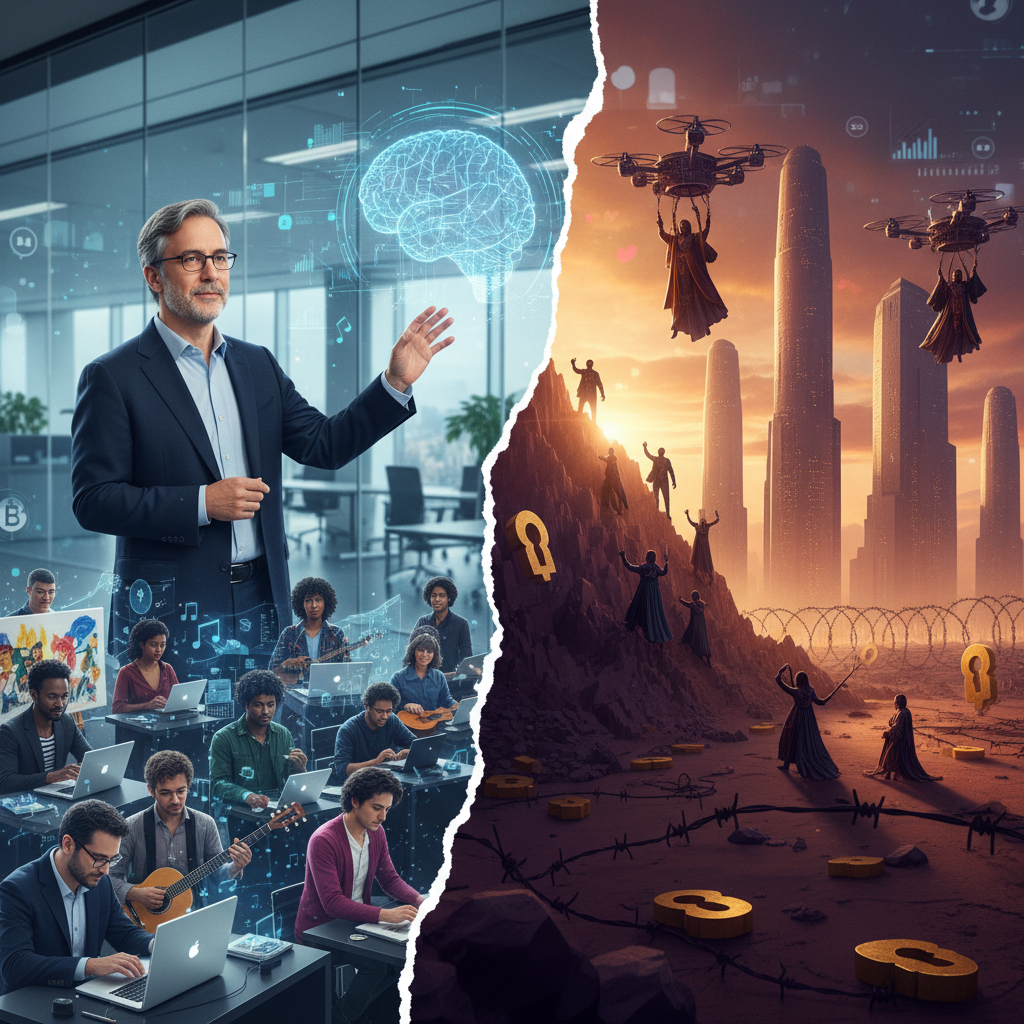
Let's be real, the buzz around AI and the creator economy sounds like a broken record from Silicon Valley, doesn't it? Every time a new tech wave hits, we hear the same old song and dance about 'democratization' and 'empowerment.' But when you peel back the layers of venture capital hype and shiny press releases, you often find the same old power structures, just with a fresh coat of digital paint.
Right now, everyone from OpenAI's Sam Altman to Google's Sundar Pichai is tripping over themselves to tell us how their latest generative AI models like GPT-4o or Gemini are going to revolutionize how artists, musicians, writers, and designers make a living. They say these tools will be co-pilots, assistants, idea generators, freeing up creators to focus on the 'truly creative' parts of their work. Sounds great on paper, like something out of a utopian sci-fi novel, but for many independent creators in places like Brooklyn, Atlanta, or even the indie music scene in Austin, it feels more like a threat than a helping hand.
Uncomfortable truth time: the creator economy, for all its supposed independence, has always been a precarious landscape. Most artists are already fighting tooth and nail for fair compensation, battling algorithms on platforms like Spotify and YouTube that often pay pennies on the dollar. Now, we're being told to embrace AI tools that were largely trained on their life's work, often without consent or compensation, and then compete against outputs generated by these very same systems. It's a classic case of 'heads I win, tails you lose' for the tech giants.
Consider the visual artists. Adobe, a company that many digital artists rely on daily, is integrating generative AI features directly into its Creative Cloud suite. On one hand, it offers new possibilities for rapid prototyping and idea generation. On the other, it raises serious questions about the value of human skill and originality. "We're seeing a fundamental shift in how creative labor is valued," says Dr. Aisha Rahman, a professor of digital media ethics at Howard University. "When an AI can generate a thousand variations of an image in minutes, what does that mean for the graphic designer who spent years honing their craft? The market is already flooded, and this just exacerbates the race to the bottom." Her point is sharp, and it cuts to the core of the issue.
Musicians are grappling with similar anxieties. The rise of AI-generated music, capable of mimicking specific styles or even creating entirely new compositions, has sent shivers down the spines of many artists. Companies like Google's DeepMind have showcased models that can produce incredibly complex and emotive tracks. While some see this as a tool for experimentation, others fear it will devalue human-made music. "My entire career is built on my unique sound, my voice, my lived experience," explains Maya 'Lyric' Jones, an independent R&B artist from Philadelphia. "If an AI can just synthesize something that sounds 'like me' and then flood the market, how do I compete? Who owns that AI-generated track? Who gets paid?" These are not minor questions; they are existential ones for an industry already struggling with streaming royalties.
And let's not forget the writers. OpenAI's GPT models have shown an uncanny ability to produce everything from marketing copy to full-length articles. While some journalists and content creators might use these as drafting tools, the fear of being replaced is palpable. The numbers are already starting to reflect this shift. A recent report by the MIT Technology Review indicated that up to 15% of entry-level content creation jobs in the US have seen significant AI integration or outright replacement in the last year alone. This isn't just about efficiency; it's about employment.
Here's what the tech bros don't want to talk about: the vast majority of these AI models are trained on massive datasets scraped from the internet, often without the explicit consent or compensation of the original creators. This isn't just a legal gray area; it's an ethical black hole. Artists on platforms like DeviantArt and ArtStation have protested, demanding opt-out options and fair compensation. Musicians are exploring class-action lawsuits. Writers are forming unions to protect their intellectual property. This isn't just a minor inconvenience; it's a foundational challenge to intellectual property rights in the digital age.
Silicon Valley has a blind spot the size of Texas when it comes to understanding the human element of creation. They see data, algorithms, and efficiency. They don't always see the years of struggle, the cultural context, the emotional investment, or the sheer human ingenuity that goes into making something truly original. They talk about 'scaling creativity' but often mean 'scaling output' at the expense of unique human expression.
"The promise of AI empowering creators is seductive, but we must ask: empowering whom, and at what cost?" questions Dr. Marcus Thorne, a legal scholar specializing in digital rights at Ucla. "Without robust legal frameworks and ethical guidelines that prioritize human creators, we risk creating a future where the tools of creation become the masters, and the artists become mere data points." He's right to be concerned. The current legal landscape is playing catch-up, and the tech companies are moving at warp speed, often leaving creators in the dust.
What's the solution? It's not about rejecting AI outright. That's a naive position in 2026. It's about demanding a seat at the table. It's about advocating for policies that ensure fair compensation for data used in training, clear attribution for AI-assisted works, and robust protections against algorithmic exploitation. It's about supporting platforms and initiatives that prioritize human creativity and ethical AI development. For example, some independent platforms are emerging that use blockchain technology to track and compensate creators for their contributions to AI training data, offering a glimpse of a more equitable future. You can read more about these emerging models on sites like TechCrunch.
We need to shift the narrative from 'AI will replace you' to 'AI must serve you.' This means pushing back against the idea that efficiency is the ultimate good, and reminding everyone that true value in the creator economy comes from human connection, originality, and the stories only we can tell. Otherwise, we're not just automating tasks; we're automating away the very soul of human expression, and that's a price too high to pay, no matter how many billions OpenAI or Google are raking in. The fight for fair play in the creator economy is just beginning, and it's a fight we can't afford to lose. It's about our culture, our livelihoods, and the very definition of what it means to create. The future of creative work, in America and beyond, hangs in the balance. It's time to choose wisely. For more on the societal impact of AI, check out Wired's AI section.