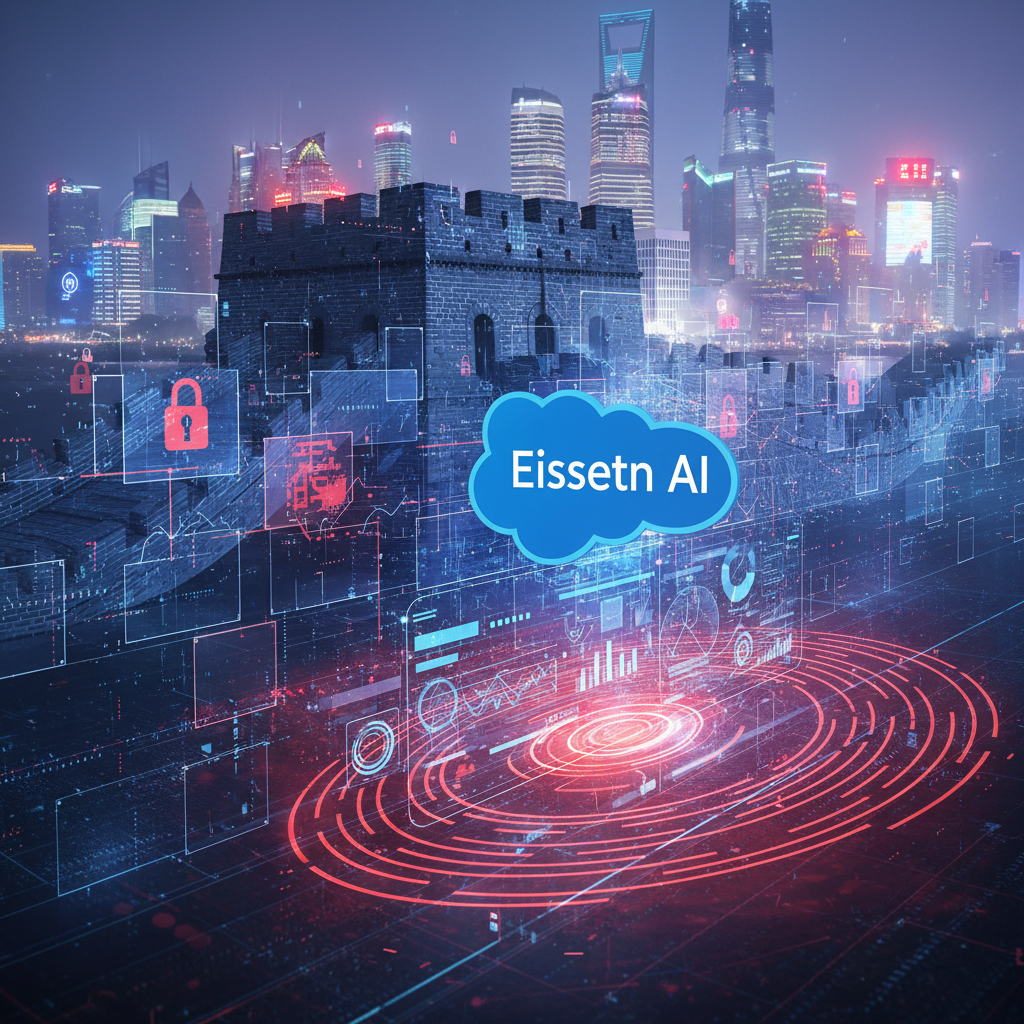

The digital silk road is paved with data, and every multinational tech giant wants a piece of it. Salesforce, with its omnipresent Einstein AI, is no exception. They speak of a global CRM revolution, powered by predictive analytics and personalized customer journeys, yet the reality on the ground in China tells a more complex tale. As an investigative journalist based here, I've watched Western companies grapple with our market's intricacies for years, and Salesforce's ambition to dominate the CRM space with AI is perhaps their biggest test yet.
Globally, Salesforce Einstein AI has been lauded for its ability to transform customer relationship management. From automating service responses to predicting sales trends, its capabilities are impressive. Companies like Coca-Cola and Adidas have reported significant gains in efficiency and customer engagement after integrating Einstein into their operations. However, China is not just 'another market' for enterprise software, it is a digital ecosystem unlike any other, shaped by stringent data sovereignty laws, fierce local competition, and a unique cultural approach to business relationships.
"The promise of AI in CRM is undeniable, but the execution in China requires a complete re-evaluation of Western playbooks," explains Dr. Li Wei, a senior researcher at the Chinese Academy of Social Sciences, specializing in digital economy policy. "It is not merely about translation, it is about fundamental adaptation to our regulatory framework, our cloud infrastructure, and our business practices. Data localization, for instance, is not a suggestion, it is a mandate. This fundamentally alters how a global platform like Salesforce can operate." Dr. Li Wei's insights highlight a critical divergence: what works in San Francisco does not necessarily work in Shanghai.
Salesforce has long operated in China through partnerships, a common strategy for foreign tech firms. Their collaboration with Alibaba Cloud, announced years ago, was seen as a pragmatic move to comply with local regulations and access the vast Chinese market. This partnership allows Salesforce to host its core services within China's borders, addressing the crucial data localization requirement. But merely hosting data locally is only the first step. The real story is in the supply chain of data, the flow of information, and the algorithms that process it. How much autonomy does Salesforce truly retain over its Einstein AI models when they are deployed on a partner's infrastructure, and what level of oversight do Chinese authorities maintain?
My sources, who wish to remain anonymous due to the sensitivity of discussing these matters, suggest that the integration is far more intricate than public statements reveal. "It is a delicate dance," one former Alibaba Cloud engineer told me, "where every data point, every API call, is scrutinized. Salesforce provides the intellectual property, the algorithms, but the operational control, the data governance, is very much localized. This means continuous negotiation and adaptation, not just a one-time setup." This continuous negotiation is where the rubber meets the road for Einstein AI. Its effectiveness relies on vast datasets and seamless integration, but in China, that seamlessness is constantly challenged by the need for compliance.
Consider the healthcare AI sector, a burgeoning area where CRM tools could offer immense value. Patient data, medical records, and treatment histories are among the most sensitive categories of personal information globally. In China, the regulations governing such data are particularly stringent, with a strong emphasis on national security and individual privacy, albeit under state control. "Salesforce Einstein's predictive capabilities could revolutionize patient outreach and personalized care in China, but only if it can navigate the labyrinth of health data regulations," says Chen Jing, CEO of a Beijing-based health tech startup. "The sheer volume of data required for effective AI models often clashes with the strictures on cross-border data transfer and even domestic data sharing between different entities. It is a constant balancing act for any foreign player." This is not just a technical hurdle, it is a strategic one, forcing companies to reconsider the very architecture of their AI systems.
Beijing isn't saying this publicly, but the unspoken expectation is that foreign tech companies will contribute to China's indigenous AI capabilities. This extends beyond mere compliance; it often involves knowledge transfer, joint research, and even the development of China-specific AI models. For Salesforce, this could mean tailoring Einstein AI's algorithms to better understand Chinese consumer behavior, language nuances, and social media trends, which are vastly different from Western markets. We are talking about WeChat integration, Douyin marketing analytics, and understanding the intricate guanxi networks that underpin Chinese business.
Data from the Ministry of Industry and Information Technology indicates that the Chinese CRM market is projected to reach over 100 billion RMB by 2027, with AI-powered solutions expected to account for more than 40 percent of that growth. This is a prize too large for any global player to ignore. However, local champions like Kingdee and Ufida are not standing still. They are rapidly developing their own AI-driven CRM platforms, often with deeper integration into Chinese enterprise software ecosystems and a more intuitive understanding of local business needs. Their AI models are trained on Chinese datasets, giving them a distinct advantage in accuracy and relevance for local users.
"The competitive landscape is brutal," observes Wang Lei, a technology analyst at a Shanghai investment firm. "For Salesforce to truly succeed, they need to demonstrate not just technological superiority, but also a profound understanding of the local market's unique demands. It is not enough to simply offer a global product; they must offer a China-first product. This includes everything from user interface design to how their AI interprets customer sentiment, which can be very different culturally." This sentiment analysis, for example, requires training data rich in Chinese colloquialisms, internet slang, and cultural context, something generic global models often lack.
The US-China tech rivalry also casts a long shadow over these developments. While Salesforce is not directly in the semiconductor race like NVIDIA or Huawei, the broader geopolitical tensions inevitably influence how data and AI technologies are perceived and regulated. Any perception of data flowing outside China's digital borders, even for processing by an allied foreign entity, can raise red flags. This makes the trust factor paramount, and it is something that local companies inherently possess.
To truly connect the dots, we must look beyond the glossy press releases and examine the operational realities. Salesforce's strategy in China is a high-stakes gamble, balancing global ambition with local necessity. Their success will depend not just on the raw power of Einstein AI, but on their ability to weave it seamlessly into the fabric of China's digital economy, respecting its rules, understanding its culture, and perhaps, contributing to its indigenous innovation. The transformation of the CRM industry by AI is indeed global, but its manifestation in China will always be uniquely Chinese, a testament to the nation's distinct approach to technology and data sovereignty. The question remains: can Einstein AI truly become a native speaker in this complex digital dialect? Only time, and the relentless pursuit of data, will tell. For more insights into how technology is shaping global business, you can follow developments on Reuters Technology or explore research on MIT Technology Review. The journey of AI in China is a constant learning curve for everyone involved.