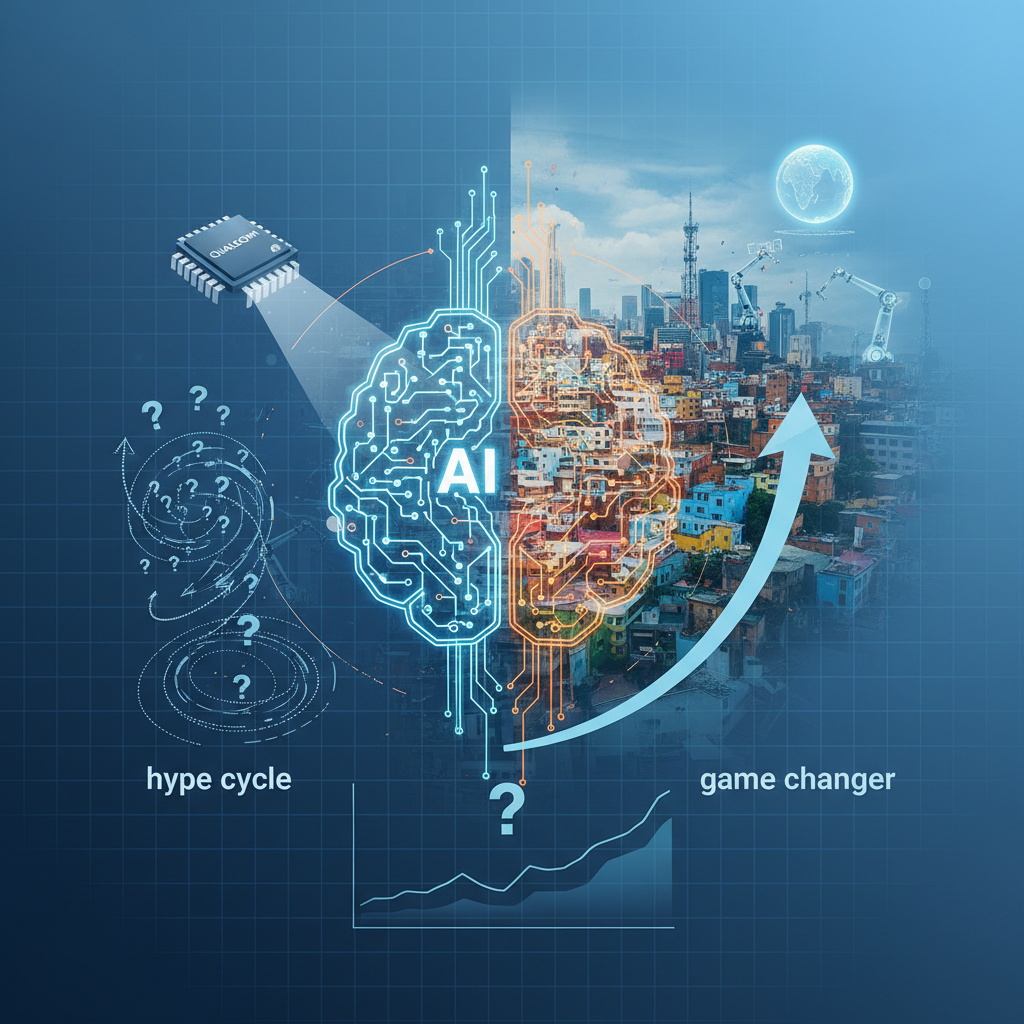

The tech world, bless its ever-optimistic heart, is once again in a frenzy. This time, the new darling is 'on-device AI,' and Qualcomm, with its Snapdragon chips, is leading the charge. They are promising a future where your smartphone, your drone, your smart speaker, even your refrigerator, can run complex AI models without needing to connect to some distant, power-hungry cloud server. It sounds good on paper, a vision of personalized, private, and lightning-fast AI. But from my vantage point here in Caracas, I have to ask: Is this a genuine revolution, or just another shiny object designed to distract us from the deeper issues of access and innovation?
Unpopular opinion from Caracas: The crisis created something unexpected, and it was not always what Silicon Valley predicted. While the tech giants chase the next big thing, the real breakthroughs often emerge from necessity, from the streets, from the places where resources are scarce and ingenuity is abundant. Qualcomm's push for on-device AI is fascinating, but let's not pretend it is some altruistic gift to humanity. It is a business strategy, a very smart one, to sell more chips and capture more of the AI value chain.
For years, the narrative around AI was dominated by the cloud. Massive data centers, consuming prodigious amounts of energy, were the only places powerful enough to train and run the truly intelligent models. Google, OpenAI, Microsoft, they all built their empires on this centralized model. Then came the realization: sending every single query, every image analysis, every voice command to a remote server is slow, expensive, and a privacy nightmare. Enter the 'edge.' The idea is simple: bring the processing closer to the data source, directly onto the device. Qualcomm, a company that has long dominated the mobile chip market, saw this coming and positioned itself perfectly. Their latest Snapdragon platforms, like the Snapdragon 8 Gen 3 for smartphones and their specialized chips for IoT and automotive, are packed with Neural Processing Units, NPUs, designed specifically for AI workloads. They are not just faster CPUs or GPUs; they are purpose-built silicon for inference at the edge.
The numbers are compelling, if you believe the hype. Qualcomm claims its latest mobile platforms can run generative AI models with billions of parameters directly on a phone, offering speeds and efficiencies previously unheard of. Analysts at Counterpoint Research reported that shipments of AI-capable smartphones are expected to grow significantly, reaching over a billion units by 2027. That is a massive market. Companies like Samsung are already integrating these capabilities into their flagship Galaxy phones, offering features like real-time translation and advanced photo editing powered by on-device AI. Even Meta, with its Llama models, is pushing for more efficient, smaller models that can run locally, a clear nod to this trend. Reuters has covered extensively how chipmakers are vying for this lucrative market.
But let's peel back the layers. What does 'on-device AI' really mean for the average person, especially in a place like Venezuela? Here, internet connectivity can be spotty, expensive, and unreliable. A phone that can do more without relying on a constant cloud connection sounds like a godsend, right? Imagine a medical diagnostic app that works offline, or an educational tool that does not chew through your data plan. This is where the promise truly shines. The ability to perform complex tasks locally could empower communities that are currently underserved by robust digital infrastructure.
However, there is a catch, as there always is. These advanced chips are not cheap. The latest flagship phones, equipped with these powerful NPUs, are luxury items in many parts of the world. While the technology promises decentralization, the access to it remains highly centralized among those who can afford the latest hardware. "The democratization of AI is not just about the technology itself, but about equitable access to the hardware that runs it," stated Dr. Elena Ramirez, a Venezuelan-born AI researcher now at Stanford University, speaking at a recent virtual conference. "If on-device AI only lives in premium devices, it perpetuates the digital divide, it does not close it." Her point is sharp and undeniable.
Consider the practicalities. While a phone might run a smaller, optimized large language model locally, the truly cutting-edge, massive models from OpenAI or Google DeepMind will still require the cloud for training and the most complex inference tasks. On-device AI is fantastic for personal assistants, image processing, and perhaps even some forms of local generative AI, but it is not replacing the need for cloud infrastructure entirely. It is a complementary layer, not a complete substitute. "Qualcomm's strategy is brilliant for extending AI's reach, but we must be realistic about its limitations," noted Patrick Moorhead, a principal analyst at Moor Insights & Strategy, in a recent industry podcast. "The cloud will remain essential for the heaviest lifting, for training, and for models that require truly vast datasets." This echoes the sentiment that while the edge is growing, the core is not shrinking.
So, is this a fad or the new normal? I lean towards the new normal, but with a critical asterisk. On-device AI is here to stay because it solves real problems: latency, privacy, and cost for certain applications. It will enable new classes of applications and enhance existing ones. But it will not magically solve the global inequities in tech access. The innovations that truly change lives in places like Venezuela often come from adapting existing, more affordable technologies, not just from adopting the latest and greatest from Silicon Valley. MIT Technology Review has often highlighted the ingenuity born from resource constraints.
Venezuela's tech diaspora is reshaping AI globally, often by tackling problems that the big tech companies overlook. Many of these brilliant minds started their journey here, learning to innovate with limited resources, a skill that is invaluable when building efficient, on-device AI solutions. They understand that a powerful chip is only as useful as the problems it solves for the people who actually use it, not just the people who can afford it. The real test for Qualcomm's on-device AI will not be how many billions of parameters it can run, but how it impacts the lives of those beyond the affluent markets. Can it truly empower the unconnected, the underserved, the ingenious? Or will it simply create a new tier of digital privilege? The answer, I suspect, will depend less on the silicon itself and more on the creativity and determination of those who wield it, often against all odds. We have seen this story before, and we will see it again. The technology is just a tool; the impact depends on the hands that shape it.