
The air in São Paulo feels electric, not just from the usual urban hum, but from a different kind of energy: the palpable excitement and apprehension surrounding OpenAI's latest linguistic marvel, GPT-5. Sam Altman and his team have once again dropped a digital bombshell, promising unprecedented leaps in reasoning, creativity, and multimodal understanding. But as a journalist from Brazil, my first question is always: e daí? So what? What does this mean for us, for the developers in Florianópolis, the startups in Belo Horizonte, and the researchers in Rio de Janeiro?
For months, the rumors swirled like a summer storm over the Amazon rainforest. Whispers of a 'super-intelligent' model, capable of passing the Turing test with flying colors, dominated tech forums and investor calls. Now, with the official release and the initial performance benchmarks flooding the internet, the picture is becoming clearer. OpenAI claims GPT-5 outperforms its predecessor, GPT-4, by an average of 15% across a suite of complex reasoning tasks, and it reportedly achieves a staggering 92% on the Uniform Bar Exam simulation, a significant jump from GPT-4's already impressive 85%. In coding challenges, it's reportedly solving 78% of problems on platforms like LeetCode Hard, compared to GPT-4's 60%.
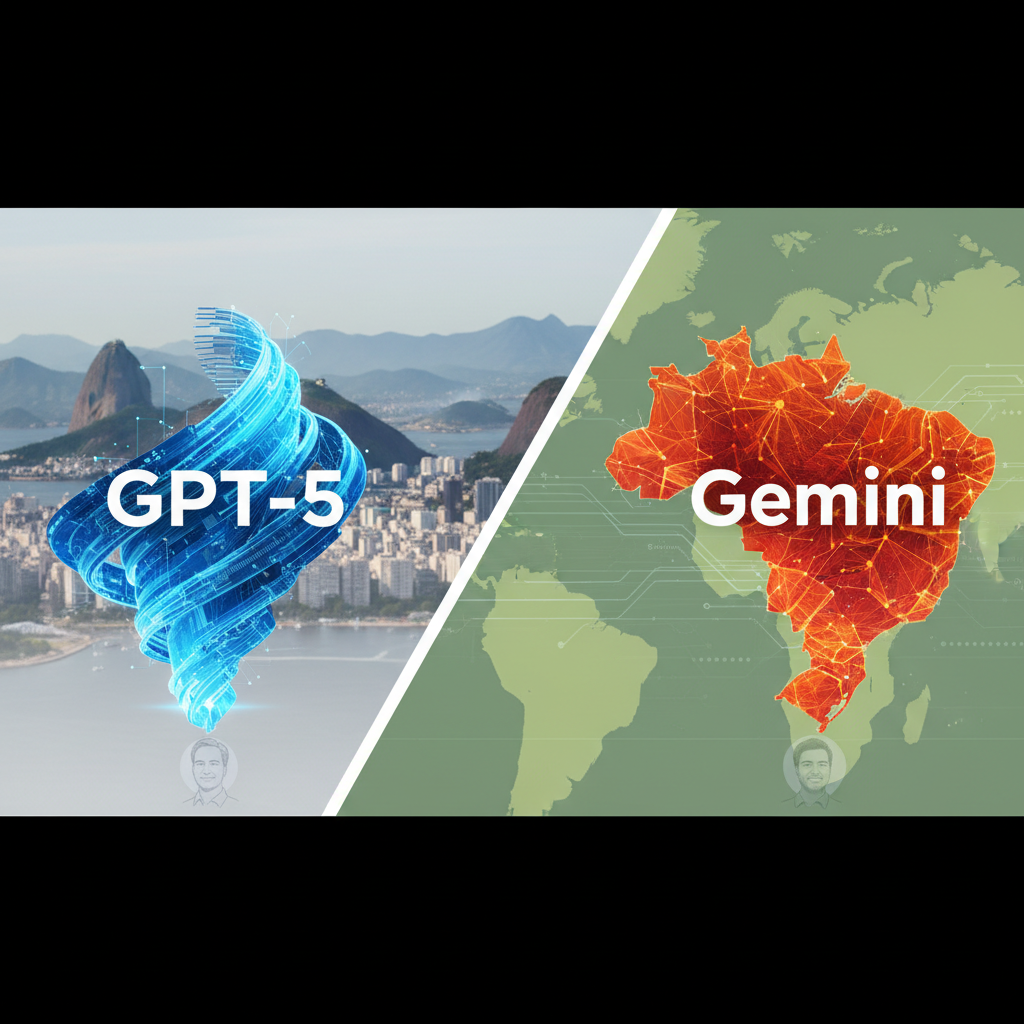
These numbers are impressive, no doubt. It's like watching a craque like Neymar dribble past defenders with even more finesse and speed. But the real game, the one that matters most to me and to DataGlobal Hub's readers, is played on the ground, in the real world. Here in Brazil, Google's Gemini, particularly its Ultra variant, has been deeply embedded in many enterprise solutions and developer workflows. Its strong multimodal capabilities and integration with Google Cloud services have given it a significant head start. So, the question isn't just about raw benchmark scores, but about practical applicability and competitive advantage.
Let me explain the architecture. GPT-5, like its predecessors, relies on a transformer architecture, but with a reported increase in parameter count to an estimated 2 trillion, alongside advancements in its training data curation and fine-tuning techniques. OpenAI has also emphasized its improved 'agentic' capabilities, meaning it can break down complex tasks into sub-tasks and execute them more autonomously. This is a big deal for automating workflows, from customer service to scientific research. "The leap in agentic capabilities is what truly differentiates GPT-5," explains Dr. Clara Mendes, a lead AI researcher at the Federal University of Minas Gerais. "It's moving beyond a sophisticated chatbot to something that can genuinely act as a digital assistant, understanding context and executing multi-step plans with remarkable coherence. This is where we will see the most immediate impact on productivity tools and specialized applications."
However, Google's Gemini, especially after its recent updates, is no slouch. Its native multimodal design, allowing it to process and understand text, images, audio, and video simultaneously, has been a key differentiator. While GPT-5 now boasts enhanced multimodal understanding, Gemini's integrated approach from the ground up gives it a certain elegance. "For many of our clients in the financial sector, Gemini's ability to analyze financial reports, market videos, and news articles in one go has been transformative," says Ricardo Silva, CEO of TechBridge Solutions, a São Paulo based AI consultancy. "OpenAI is catching up, but Google's ecosystem integration, particularly with its vast data centers here, presents a formidable challenge."
Performance benchmarks are one thing, but accessibility and cost are another. OpenAI has historically priced its models at a premium, reflecting their cutting-edge capabilities. For Brazil's developer community, which is massive and talented but often operates with tighter budgets, cost-effectiveness is a critical factor. Google has been aggressive with its pricing for Gemini, especially for large-scale enterprise deployments, leveraging its existing cloud infrastructure. This is a classic battle, like two football teams with different strategies: one relying on individual brilliance, the other on cohesive team play and a strong home advantage.
Another crucial aspect is language. While both models support Portuguese, the nuances of Brazilian Portuguese, with its unique slang, cultural references, and regional variations, are often a true test. Early reports from local developers indicate that GPT-5 shows marked improvement in understanding and generating culturally appropriate responses in Portuguese, but Gemini still holds a slight edge in certain colloquial contexts, likely due to Google's extensive data collection from Brazilian users over decades. "The code tells the real story," states Ana Paula Costa, a senior software engineer at a major e-commerce firm in Curitiba. "We've been running parallel tests with both models for our customer support bots. GPT-5's responses are more grammatically perfect, but Gemini sometimes 'gets' the Brazilian humor or frustration better. It's subtle, but it matters for user experience."
Beyond the corporate giants, the open-source movement continues to thrive, offering alternatives that are often more adaptable and cost-effective for smaller businesses and academic institutions. Models like Meta's Llama 3 and Mistral AI's latest offerings are constantly pushing the boundaries of what's possible with fewer resources. While they might not match GPT-5's raw performance on every metric, their flexibility and community support make them incredibly valuable, especially in a country like Brazil where innovation often blossoms from necessity and collaboration.
The implications for Brazil are profound. Improved AI models mean better tools for education, more efficient healthcare diagnostics, smarter agricultural practices, and more dynamic creative industries. Our startups can leverage these advancements to compete on a global stage, and our researchers can push the boundaries of knowledge. However, it also means a heightened need for digital literacy, ethical AI development, and robust data governance. We cannot simply be consumers of this technology; we must be active participants in shaping its future.
The race between OpenAI and Google, with Anthropic's Claude and Meta's Llama also fiercely competing, is far from over. GPT-5 has certainly raised the bar, but the field is crowded with innovation. For Brazil, the challenge and the opportunity lie in discerning which of these powerful tools best serves our unique needs, cultural context, and economic realities. We must ensure that these technological marvels truly empower our people and contribute to a more equitable digital future, rather than just widening existing divides. The data shows us the power, but our decisions will define its purpose. For more on how global AI trends are impacting local economies, you can check out reports from Reuters Technology or TechCrunch's AI section. The conversation continues, and the stakes are higher than ever.