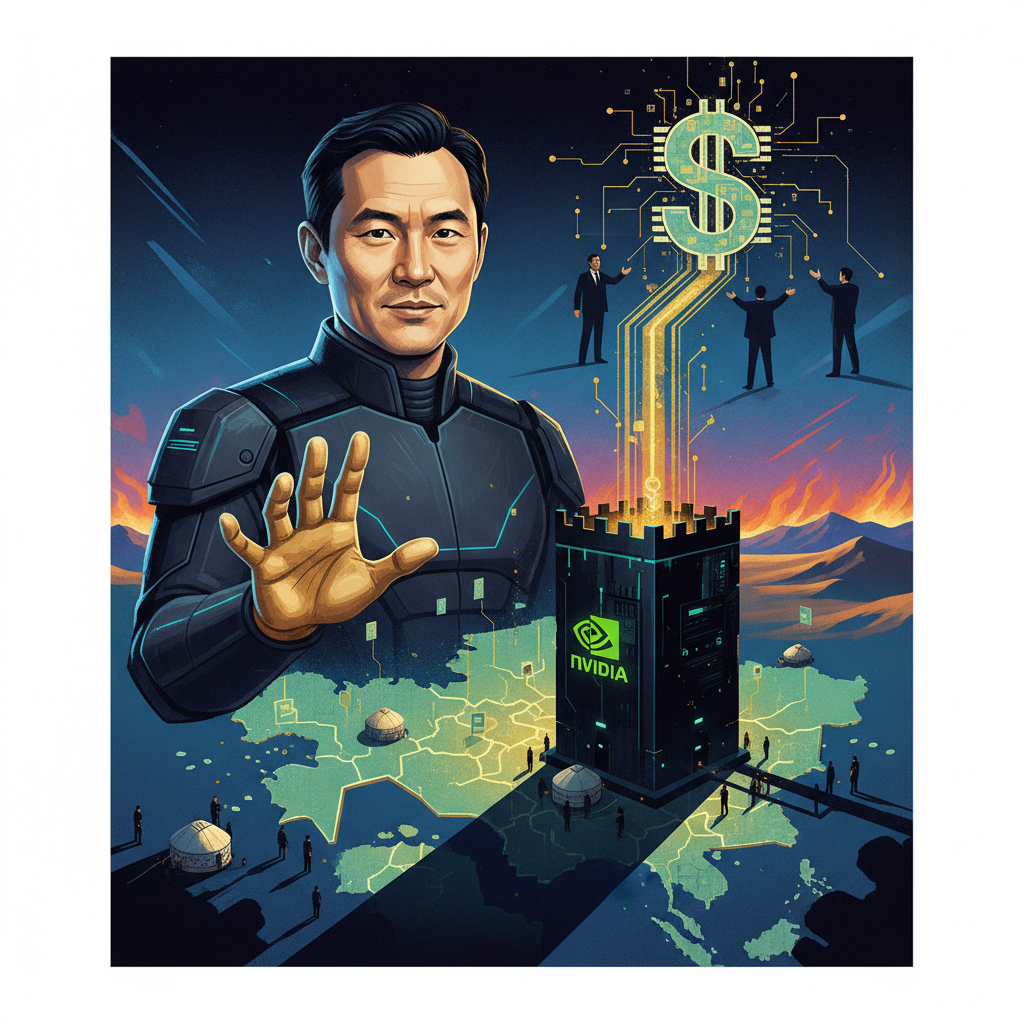

The pronouncements from Jensen Huang, NVIDIA's charismatic CEO, at recent industry gatherings have been nothing short of a technological sermon. He speaks of a new industrial revolution, powered by artificial intelligence, with NVIDIA's chips and software as its foundational bedrock. The market has responded with fervent belief, propelling NVIDIA to a trillion dollar valuation and beyond. From the gleaming stages of Silicon Valley, this narrative of inevitable progress and shared prosperity radiates globally. Yet, from my vantage point in Kazakhstan, a different, more complex picture emerges. This is not merely about technological advancement, it is about power, control, and the digital destiny of nations.
NVIDIA's dominance in the AI hardware sector is undeniable. Their Graphics Processing Units, or GPUs, are the engines driving the current AI boom, from large language models to complex scientific simulations. Huang’s keynotes, filled with grand visions of AI factories and digital twins, consistently highlight NVIDIA’s expanding ecosystem, encompassing hardware, software, and services. He articulates a future where every industry, every nation, will rely on this intricate web. For a country like Kazakhstan, with its own digital ambitions and a nascent but growing tech sector, this narrative presents a double-edged sword.
On one hand, the promise of AI is alluring. It offers potential for economic diversification, improved public services, and enhanced national capabilities. Kazakhstan's digital ambitions hide a complex reality, however. We aspire to become a regional digital hub, attracting investment and fostering innovation. The government has invested significantly in digital infrastructure and initiatives, recognizing the transformative potential of technology. Yet, the cost of entry into this AI-driven future is increasingly dictated by a single company. The money trail leads to NVIDIA, and the price of admission is steep, both financially and strategically.
Consider the sheer capital required to build modern AI infrastructure. Training a cutting edge large language model, for instance, demands thousands of high-end GPUs, each costing tens of thousands of dollars. This creates an immense barrier to entry for smaller nations and developing economies. As Dr. Aisha Karimova, a leading AI researcher at Nazarbayev University, recently observed, "While the rhetoric of AI democratization is strong, the practical reality is that access to foundational compute resources remains highly centralized. This creates a dependency that could stifle local innovation and data sovereignty in the long term." Her concerns echo those of many who watch the global tech landscape with a critical eye. MIT Technology Review has extensively covered the capital intensity of modern AI, underscoring the challenges for those outside the established tech giants.
Furthermore, NVIDIA's ecosystem extends beyond just hardware. Their Cuda platform, a parallel computing architecture, is the de facto standard for AI development. This proprietary lock-in means that developers and researchers who invest in NVIDIA hardware are often tied to their software stack, making it difficult to switch to alternative solutions, even if they emerge. This creates a powerful, almost inescapable, gravitational pull. For nations seeking to build their own sovereign AI capabilities, this proprietary ecosystem poses a significant challenge. It is reminiscent of the early days of personal computing, where one company's operating system became the dominant gatekeeper.
Some might argue that this concentration is simply the natural outcome of market forces and superior innovation. They would contend that NVIDIA has earned its position through relentless research and development, delivering unparalleled performance that benefits everyone. They might point to the efficiency gains and breakthroughs enabled by NVIDIA's technology, arguing that a rising tide lifts all boats. Indeed, the rapid progress in AI, from medical diagnostics to climate modeling, owes much to the computational power that NVIDIA provides.
However, this perspective overlooks the inherent power imbalances it creates. When a single entity holds such a critical choke point in a foundational technology, it inevitably gains immense leverage. This leverage can manifest in various ways: dictating pricing, influencing research directions, or even, in extreme scenarios, becoming a tool for geopolitical influence. For developing nations, particularly those in Central Asia, where digital infrastructure is still evolving, this dependency is a precarious position. We have seen how control over crucial resources, whether oil or rare earth minerals, can shape national destinies. AI compute power is rapidly becoming the new strategic resource.
My investigation reveals that while some Kazakhstani startups and academic institutions are indeed leveraging NVIDIA's platforms for their projects, the underlying concern about long term digital autonomy is palpable. There is a growing recognition that true digital sovereignty requires not just access to technology, but also the capacity to understand, adapt, and, crucially, to control it. The current trajectory risks turning many nations into mere consumers of AI, rather than active participants and innovators.
Consider the implications for data. As AI models become more sophisticated, they require vast amounts of data for training. Much of this data is sensitive, reflecting the unique cultural, social, and economic realities of a nation. Entrusting the processing of this data to systems ultimately controlled by foreign entities, even if well-intentioned, raises profound questions about privacy, security, and national interest. As Mr. Daniyar Akhmetov, a cybersecurity expert based in Almaty, recently stated,