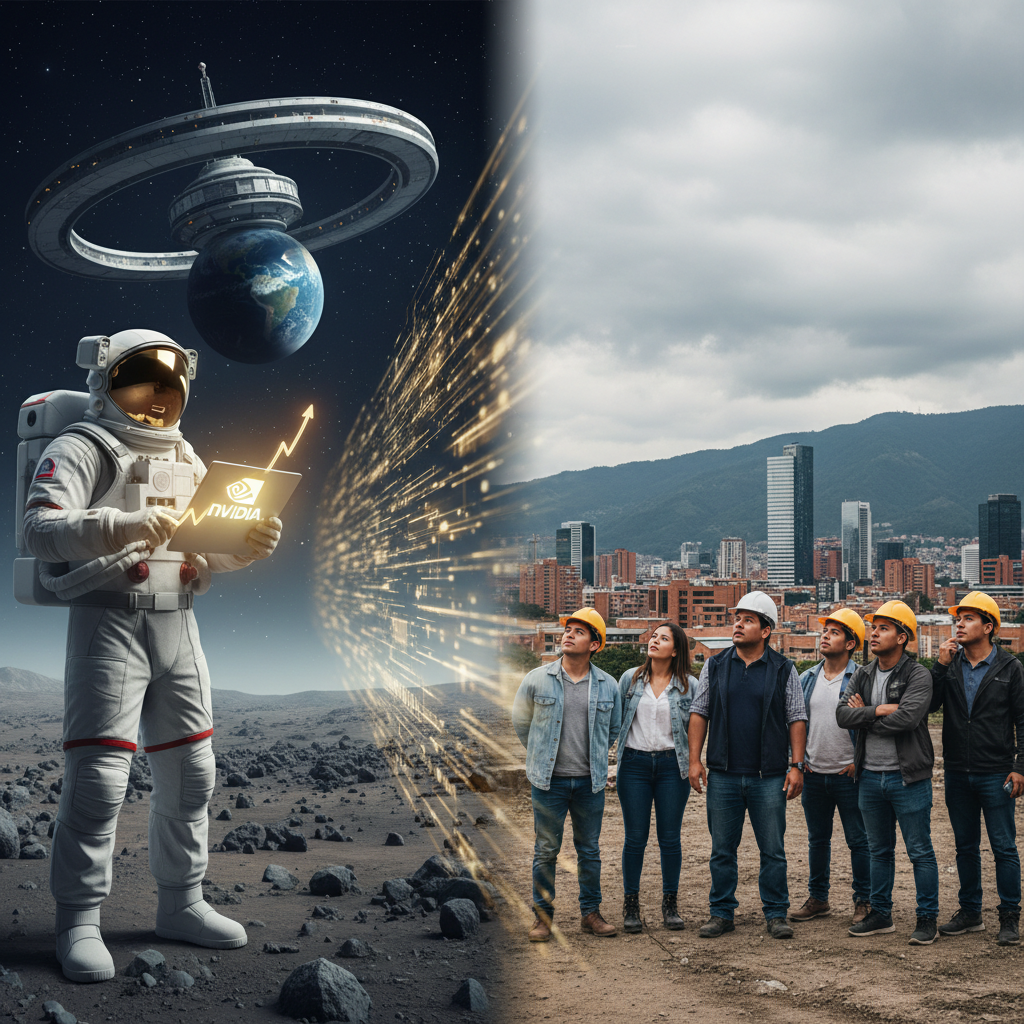

The headlines scream of triumph, of unprecedented wealth creation. We hear about NVIDIA's market capitalization soaring past the trillion-dollar mark, fueled by the insatiable demand for its GPUs that power the AI revolution. Jensen Huang, the company's visionary CEO, is lauded as a titan, a pioneer. And yes, these are remarkable achievements, a testament to human ingenuity and relentless innovation.
But from my vantage point here in Bogotá, looking at the vibrant, struggling heart of Colombia, I cannot help but ask: Who is truly benefiting from this AI gold rush? While a select few accumulate unimaginable fortunes, what about the millions of workers whose livelihoods are being reshaped, often precariously, by these very advancements?
This is about more than technology because it's about justice. It is about the growing AI wealth gap, a chasm that threatens to swallow the dreams of countless individuals, particularly in nations like ours, which are still grappling with deep-seated inequalities. We are told AI will create new jobs, and it will, but the transition is brutal, and the new opportunities often require skills that are out of reach for many today.
Consider the agricultural sector, a cornerstone of Colombia's economy. AI-powered drones and precision farming promise efficiency, higher yields, and reduced waste. On paper, it sounds fantastic. But what happens to the campesino, the small farmer who has tilled the land for generations, whose knowledge is empirical and deeply rooted in tradition, not algorithms? Will they be retrained, or simply displaced? The fear is palpable, a quiet hum beneath the celebratory pronouncements of Silicon Valley.
Then there is the burgeoning gig economy, which AI is supercharging. Delivery drivers, content moderators, data labelers, the invisible army that fuels many AI models. Their work is often precarious, low-paid, and now, increasingly managed by algorithms that prioritize efficiency over human well-being. We see it in the streets of Medellín and Cali, the constant hustle, the relentless pressure to meet algorithmic demands. This is not the dignified work that builds a middle class; it is often a race to the bottom, where the 'human in the loop' is treated as a disposable component.
I spoke recently with Dr. Clara Rojas, a prominent economist at the Universidad Nacional de Colombia. She articulated this concern with piercing clarity. "The current trajectory of AI development, largely driven by profit maximization in the global North, risks exacerbating existing inequalities," she told me. "Without deliberate policies for reskilling, social safety nets, and equitable access to AI education, we are creating a two-tiered society: the AI haves and the AI have-nots. Colombia's AI story deserves to be heard, and it must include the voices of those most vulnerable to disruption." Her words echo a sentiment I hear repeatedly, a plea for a more inclusive vision of progress.
The numbers are sobering. A report by the World Economic Forum in 2023 estimated that AI could displace 85 million jobs globally by 2025, while creating 97 million new ones. That net gain sounds reassuring, but it masks the immense human cost of transition and the mismatch in skills. The jobs being created are often highly specialized, requiring advanced technical knowledge, while those being lost are often routine, manual, or administrative roles that form the backbone of many developing economies.
And let us not forget the concentration of wealth. The companies at the forefront of AI, like OpenAI, Google, Microsoft, and NVIDIA, are experiencing unprecedented growth. Their founders and top executives are seeing their net worth skyrocket. This is not inherently wrong, innovation should be rewarded. But when this wealth accumulation happens at the expense of broad-based prosperity, when it deepens the divide between the ultra-rich and the struggling masses, we have a problem. The Gini coefficient, a measure of income inequality, is already high in many Latin American countries, and unchecked AI adoption could push it further into dangerous territory.
Even in the creative industries, where human ingenuity was once thought to be irreplaceable, AI is making inroads. Generative AI tools are now capable of producing art, music, and writing, raising questions about copyright, fair compensation, and the future of human creators. For a country rich in artistic talent like Colombia, this is not a distant threat, it is a very present concern for our musicians, artists, and writers.
So, what is to be done? We cannot simply halt progress. AI is here, and its transformative power is undeniable. But we must demand a more equitable path forward. Governments, corporations, and civil society must collaborate to ensure that the benefits of AI are broadly shared, not hoarded by a privileged few.
This means investing massively in education and vocational training programs that equip workers with the skills needed for the AI-driven economy. It means fostering local AI ecosystems, supporting Colombian startups that are building solutions tailored to our unique challenges, rather than just importing technologies designed elsewhere. It means advocating for ethical AI frameworks that protect worker rights, ensure data privacy, and prevent algorithmic bias.
We need to push for policies that consider universal basic income or other forms of social protection to cushion the impact of job displacement. We must challenge the notion that technological progress automatically leads to societal progress. It only does so if we intentionally design it that way.
Colombia has a chance to write its own chapter in the AI story, one that prioritizes people over profits, equity over expediency. We have brilliant minds, resilient communities, and a deep understanding of what it means to rebuild and innovate against the odds. Latin America is rising, and with it, the potential for a more inclusive, human-centered approach to AI.
This is not a utopian dream; it is an urgent necessity. The future of our workforce, the stability of our societies, and the very definition of progress depend on how we address this growing AI wealth gap. The conversations happening in Davos and Silicon Valley need to be informed by the realities on the ground in Bogotá, in Cartagena, in every corner of our world. As MIT Technology Review often highlights, the social implications of AI are as critical as the technological advancements themselves. We must ensure that the AI revolution uplifts all of humanity, not just a select few. For more insights on the challenges and opportunities for AI in developing nations, you can also explore articles on Reuters Technology.
We cannot afford to be passive observers. We must be active participants, shaping this future with our values, our needs, and our unwavering commitment to justice. The time for action is now, before the gap becomes an abyss. While some debate the intricacies of AI models, the human cost of this technological shift is growing, a topic I believe deserves more attention, perhaps even in discussions around AI safety and ethics [blocked] that often focus on abstract risks rather than immediate societal impacts.