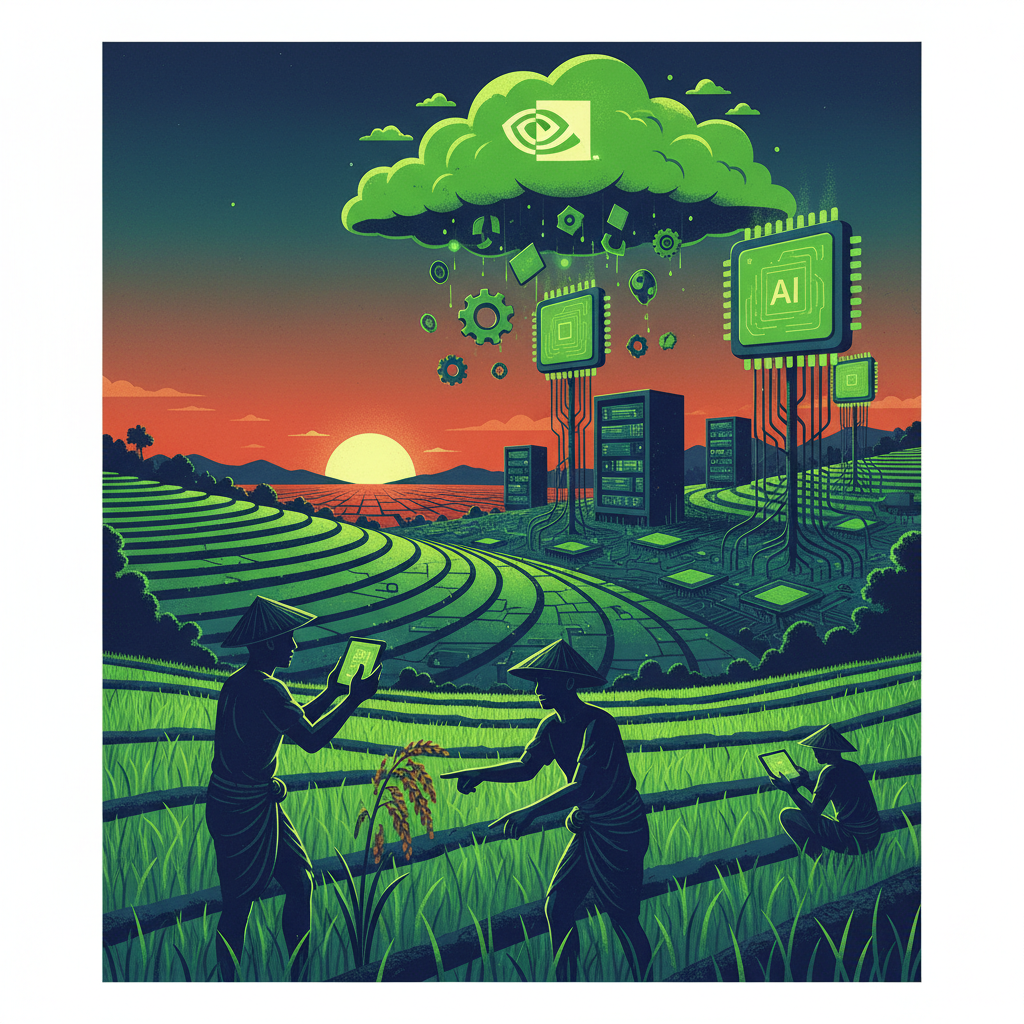

The monsoon rains have been erratic this year, a familiar and increasingly terrifying refrain for farmers across Myanmar. From the fertile Ayeyarwady plains to the terraced hills of Shan State, the rhythm of life here is inextricably tied to the land, and the land is struggling. When I hear the buzz about 'AI in agriculture' from the gleaming boardrooms of Silicon Valley, promising precision farming, crop monitoring, and yield optimization, my mind immediately turns to U Hla Win, a rice farmer in Magway, whose entire family's livelihood hangs by a thread. He does not need a drone mapping his fields if he cannot afford the seeds, or if the water supply is cut off by conflict.
This is not to say that the potential of AI in agriculture is lost on me. Far from it. In a country where 70% of the population relies on agriculture, and food security remains a constant, gnawing concern, any tool that can genuinely improve yields and resilience should be welcomed. But the narrative often presented by tech giants like NVIDIA, with their powerful GPUs pushing the boundaries of machine learning for agricultural analytics, feels detached from the ground realities of places like Myanmar. They speak of 'democratizing access' to advanced tools, but for whom, and under what conditions? My conviction tells me that without addressing the fundamental inequities, this 'green revolution' risks becoming a digital famine for the most vulnerable.
My argument is simple yet profound: AI in agriculture, as currently envisioned and deployed by many global players, risks exacerbating existing inequalities and dependencies in developing nations, rather than alleviating them. It often requires significant capital investment, stable infrastructure, and a level of digital literacy that is simply not present in many rural communities here. We are talking about farmers who struggle with basic electricity access, let alone high-speed internet for cloud-based AI models. The promise of satellite imagery and predictive analytics from companies like Google, while impressive on paper, often overlooks the human element, the local knowledge, and the socio-political complexities that dictate success or failure in our fields.
Consider the initial investment. A farmer, already battling rising input costs and fluctuating market prices, is expected to invest in drones, IoT sensors, or subscription services for AI-powered insights. "The cost of entry for these advanced AI systems is prohibitive for the vast majority of smallholder farmers in Myanmar," explains Dr. Khin Myat Thu, an agricultural economist at Yangon University. "We are seeing pilot projects, yes, but they are often funded by NGOs or international bodies, and their sustainability once that funding ends is a serious question mark. Who will maintain the infrastructure? Who will pay the recurring software licenses?" Her point is crucial: without a clear, affordable, and locally sustainable model, these innovations remain isolated experiments, not systemic solutions.
Furthermore, data ownership and privacy are colossal, yet often ignored, issues. When AI models learn from crop data, soil conditions, and weather patterns, whose data is it? Is it the farmer's, who toils the land, or the tech company's, which processes it? "We have seen instances where data collected from local farms is then used to develop products sold back to those very communities, sometimes at prices they cannot afford," says Maung Maung Latt, a digital rights advocate working with rural communities in Sagaing. "This creates a new form of digital colonialism, where our agricultural intelligence becomes a commodity for external profit. This is about survival, not convenience, and we must protect our farmers' autonomy."
Some might argue that these are teething problems, that with time, costs will come down, and infrastructure will improve. They might point to successful pilot programs in other parts of Asia, or even within Myanmar, where AI has reportedly increased yields by 15-20% and reduced water usage. They might highlight the potential for AI to detect crop diseases early, optimize fertilizer application, or even predict market prices, empowering farmers with invaluable information. I have read the reports, seen the glossy presentations from companies like Microsoft and their AI for Earth initiatives. I understand the optimism.
However, my rebuttal is grounded in lived experience. In Myanmar, the stakes are different. We are not just talking about incremental improvements; we are talking about basic sustenance, about preventing families from falling further into poverty. The 'trickle-down' theory of technology adoption has historically failed the most marginalized. While a large-scale commercial farm might benefit immensely from NVIDIA's advanced analytics to manage hundreds of acres, U Hla Win, with his few acres, needs solutions tailored to his context, his resources, and his immediate challenges. He needs robust, low-tech, and community-driven solutions, not necessarily the most sophisticated algorithms requiring constant connectivity and expensive hardware. Technology can be a lifeline, but only if it is accessible, affordable, and truly serves the people it claims to help.
Moreover, the digital divide is not merely about access to technology; it is also about knowledge and agency. Who trains the farmers to use these complex AI tools? Who translates the insights into actionable advice in local languages? Without robust, culturally sensitive training programs and ongoing support, these sophisticated systems become expensive white elephants. "We need an approach that prioritizes local capacity building, not just technology deployment," argues Daw Aye Aye Mar, who leads a community farming cooperative in Mandalay. "We need our own agronomists, our own data scientists, who understand our soil, our climate, and our people, to develop and adapt these tools. Relying solely on external expertise creates a dependency that is not sustainable in the long run."
Consider the broader geopolitical context. Myanmar has faced internet shutdowns, political instability, and ongoing conflicts that disrupt supply chains and infrastructure. Relying on cloud-based AI solutions from foreign companies becomes a significant vulnerability. What happens when internet access is cut, or when sanctions impact software licenses? The very tools meant to optimize survival could become liabilities. This is why local, resilient, and offline-capable AI solutions, perhaps running on edge devices with open-source models, are far more critical here than the latest, most powerful cloud-based platforms.
My call to action is for a fundamental re-evaluation of how AI in agriculture is approached in developing regions. Instead of simply pushing advanced, capital-intensive solutions, tech companies, governments, and NGOs must prioritize co-creation with local communities. This means investing in basic digital infrastructure, developing affordable and accessible AI tools, ensuring data sovereignty, and, most importantly, empowering local expertise. It means understanding that a 15% yield increase means very little if the farmer cannot afford the technology, or if the data collected is used against their interests. It means recognizing that the 'precision' of farming must extend beyond algorithms to include the precision of human needs and local contexts.
We must move beyond the Silicon Valley hype cycle and focus on solutions that genuinely uplift, rather than inadvertently marginalize. The future of food security in Myanmar, and in many similar nations, depends on it. We need AI that serves the farmer, not just the algorithm. For more insights into how AI is shaping global agriculture, you can explore reports from MIT Technology Review. The conversation needs to shift from what AI can do, to what AI should do, especially for those whose lives hang in the balance. We must ensure that the digital revolution in agriculture truly feeds the world, starting with the most vulnerable among us. For a broader perspective on AI's impact on supply chains, one might look at how Dr. Maeva Teihotu's AI Navigates the Pacific's Supply Chain Tides with Google's Gemini [blocked], though the challenges in Myanmar present a unique set of circumstances.