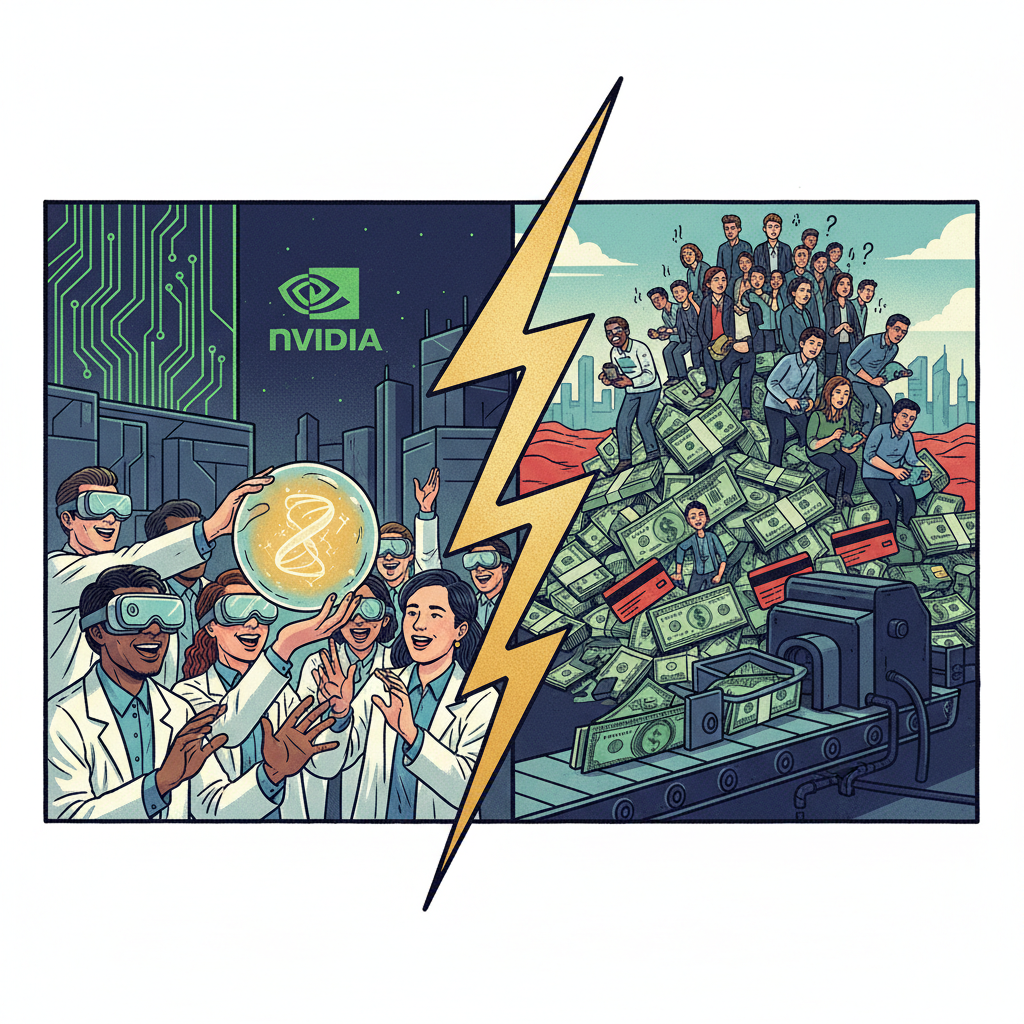

Let's be real. When you hear about AI accelerating discoveries at Cern, your first thought probably isn't about algorithmic bias or digital redlining. It's all about the wonder, the Higgs boson, the secrets of the universe. But for those of us watching from the sidelines, especially here in the USA where the tech industry's influence casts a long shadow, a different kind of question emerges: who exactly benefits from these 'accelerated discoveries,' and at what cost to the rest of us?
The headlines are glowing, right? AI is sifting through petabytes of data from particle accelerators, spotting anomalies, speeding up simulations, practically doing the work of a thousand PhDs in a coffee break. Companies like NVIDIA are front and center, selling their high-powered GPUs and specialized AI platforms to the world's most elite scientific institutions. Jensen Huang, NVIDIA's CEO, is practically a rockstar, and his company’s hardware is the engine behind much of this progress. It's impressive, no doubt. The sheer computational power is mind-boggling, allowing physicists to analyze collisions at unprecedented speeds, potentially unlocking breakthroughs that could redefine our understanding of reality. They're talking about finding new particles, understanding dark matter, maybe even glimpsing extra dimensions. Sounds like science fiction, but it's happening.
But here's what the tech bros don't want to talk about: the concentration of power and resources that this AI-driven science demands. This isn't just about smart algorithms; it's about access to cutting-edge hardware, proprietary software, and the specialized expertise to wield them. We're talking about multi-million dollar investments in infrastructure, the kind of money that only a handful of nations and corporations can comfortably throw around. So, while the scientific community celebrates a new era of discovery, I'm over here wondering if we're just building another ivory tower, taller and more exclusive than ever before.
Uncomfortable truth time: the narrative around AI in particle physics often ignores the very real disparities in technological access and scientific opportunity. While Cern, a European consortium, is pushing the boundaries, how many institutions in the Global South, or even underfunded universities right here in the US, can afford to participate in this high-stakes game? The answer is depressingly few. We're creating a scientific elite, a sort of 'AI aristocracy,' where only those with the deepest pockets and the most advanced tech stacks get a seat at the table. This isn't just about who gets to publish papers, it's about who shapes the fundamental understanding of our universe. And if that understanding is filtered through the lens of a privileged few, what biases are we unknowingly embedding into the very fabric of scientific inquiry?
Some will argue, of course, that this is simply the nature of big science. Particle physics has always been expensive, requiring massive collaborations and colossal machines. They'll say that the benefits of these discoveries will eventually trickle down to everyone, improving technology, inspiring new innovations. They'll point to the World Wide Web, born at Cern, as proof of trickle-down scientific benevolence. And sure, that's a nice story. But the digital divide is wider than ever, and the benefits of AI are notoriously unevenly distributed. We've seen it in healthcare, in finance, in nearly every sector touched by AI. Why would fundamental physics be any different?
“The promise of AI in fields like particle physics is immense, but we cannot ignore the infrastructure gap,” says Dr. Lena Hanson, a computational physicist at the University of California, Berkeley. “The algorithms themselves might be open source, but the compute power required to run them effectively, to contribute meaningfully to these global collaborations, is a significant barrier for many. It’s not just about having the data, it’s about having the supercomputers to process it.” Her point is critical: the data is there, but the ability to make sense of it is concentrated.
Moreover, the very nature of these AI systems, often developed by private companies, raises questions about transparency and control. When proprietary algorithms are making critical decisions about data analysis, how do we ensure fairness and prevent hidden biases from skewing results? This isn't some abstract philosophical debate; it's about the integrity of science itself. If the AI is trained on data or designed with assumptions that reflect a narrow worldview, could it miss phenomena that don't fit its preconceived patterns? Could it inadvertently perpetuate existing biases in scientific interpretation?
“Silicon Valley has a blind spot the size of Texas when it comes to equitable access and the long-term societal impacts of their innovations,” states Marcus Thorne, a policy analyst specializing in tech ethics at the Thurgood Marshall Institute in Washington, D.C. “They see the immediate scientific gain, the prestige, the market share. But the downstream effects, the widening chasm between those who can leverage these tools and those who cannot, often go unaddressed until it’s too late.” Thorne's observation hits home. We've seen this pattern repeat itself countless times.
Consider the implications for scientific talent. If only a select few institutions can afford the AI infrastructure, what happens to brilliant minds elsewhere? Are we inadvertently funneling all the top talent into a handful of well-funded hubs, stifling diverse perspectives and approaches that might come from less privileged backgrounds? The scientific community, like any other, needs diversity of thought to truly thrive. If the entry barrier for cutting-edge research becomes prohibitively high, we risk losing out on groundbreaking ideas simply because the brilliant minds behind them lack access to the necessary computational muscle.
This isn't to say that AI has no place in particle physics. Far from it. The potential for accelerating discovery is real and exciting. But we need to ask tougher questions about how these tools are developed, deployed, and accessed. We need to push for open-source initiatives, for global partnerships that prioritize equity, and for funding models that don't exclusively favor the already powerful. Otherwise, we risk a future where the universe's deepest secrets are unveiled by an exclusive club, and the rest of humanity is left to marvel at discoveries they had no hand in making, and perhaps, no real understanding of their implications.
As AI continues its march into every corner of human endeavor, from our daily lives to the furthest reaches of scientific exploration, we must remain vigilant. The wonder of discovery should not overshadow the imperative for justice and equity. Otherwise, we're just trading one set of gatekeepers for another, and that's a cosmic injustice no amount of AI can fix. For more on the economic implications of AI in big science, you might want to check out this piece on Reuters. The conversation about who benefits from these technological leaps is far from over, and it's one we all need to be a part of, not just the folks in white lab coats and venture capital boardrooms. For a broader look at AI's impact on culture and society, Wired often has insightful pieces. This isn't just about particle physics, it's about the future of knowledge itself, and who gets to write that story. And if you're interested in how AI's economic impact is being felt beyond the lab, you might find this article on NVIDIA's Particle Physics AI: Is Jensen Huang Building a New Tower of Babel or Just a Bigger Sandbox for Europe? [blocked] relevant.
Let's not let the dazzling light of scientific progress blind us to the shadows of inequality it might be casting. The universe is vast, and its secrets should be accessible to all who seek them, not just those with the most powerful GPUs.