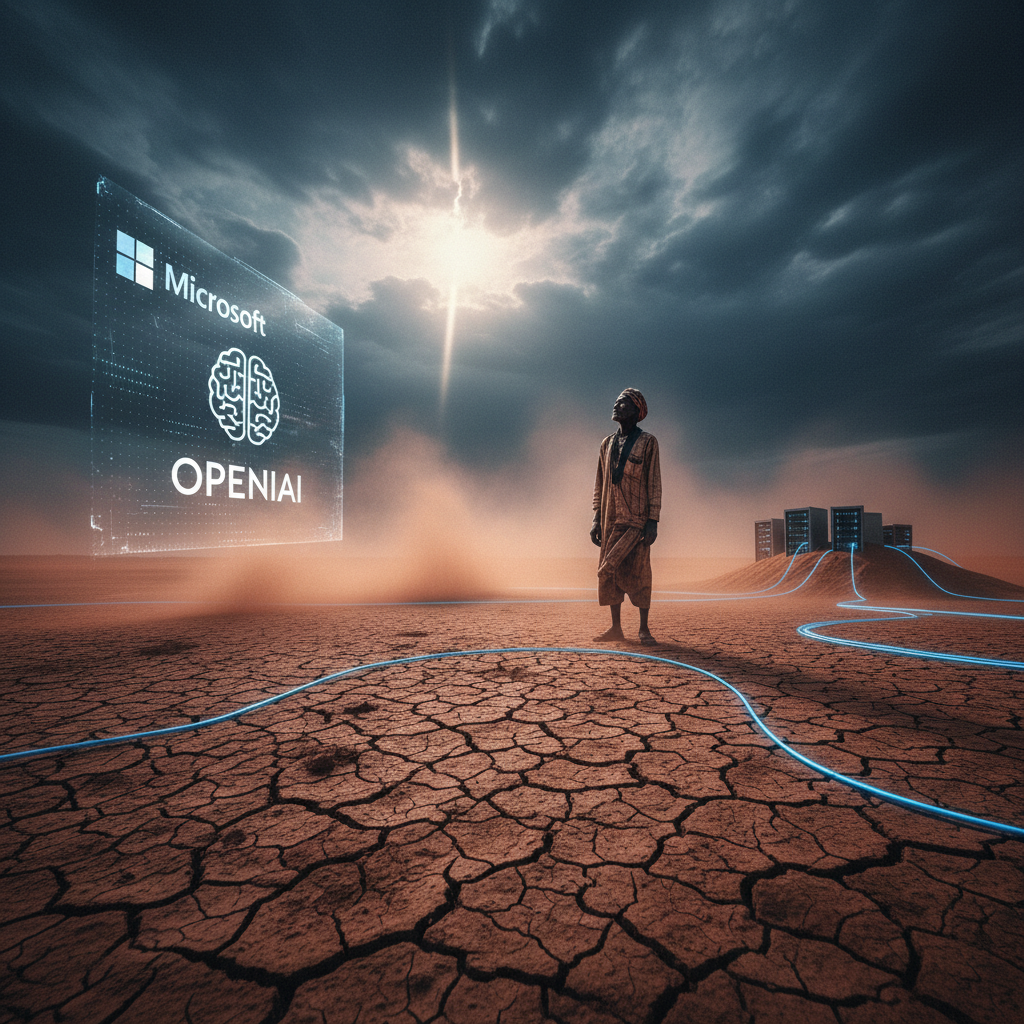
The news hit like a Harmattan wind, dry and full of promises. Microsoft, the American tech behemoth, had poured a staggering $13 billion into OpenAI, the company behind ChatGPT. The world buzzed about artificial general intelligence, about transforming industries, about a future where machines think like us, or better. But here in Burkina Faso, nestled in the heart of the Sahel, we often ask a different question: what does this mean for the farmer whose millet crop is failing, or the community struggling with water scarcity? Is this investment just a distant rumble of thunder, or will it actually bring rain to our parched lands?
For years, the narrative from Silicon Valley has been consistent: AI will solve humanity's biggest problems. Climate change, food security, disease. Grand pronouncements, often made from air-conditioned offices thousands of kilometers away. When Microsoft deepened its commitment to OpenAI, it wasn't just about code; it was about shaping the future of technology, and by extension, the world. The expectation was that this partnership would accelerate AI research and deployment, making advanced AI tools more accessible. But accessible to whom, and for what purpose, especially in regions like ours?
Breaking news this week suggests that some of that investment might finally be trickling down, albeit slowly, to the realities we face. A pilot program, quietly launched in collaboration with the Ministry of Agriculture and Hydro-Agricultural Development here in Burkina Faso, is attempting to leverage OpenAI's advanced models for localized climate prediction and agricultural advisory services. The idea is to use AI to analyze satellite imagery, historical weather patterns, and soil data, then provide actionable insights to smallholder farmers through mobile applications, even in local languages like Mooré and Dioula.
“We have been waiting for this,” stated Dr. Fatoumata Diallo, a leading agronomist at the Institut de l'Environnement et de Recherches Agricoles (inera) in Ouagadougou. “For too long, our farmers have relied on ancestral knowledge, which is invaluable, but also on the unpredictable skies. If AI can give us even a 10 percent better forecast for planting or irrigation, it means the difference between a harvest and hunger for countless families. The challenge, of course, is making it practical and affordable for everyone, not just a select few.” Her words echo the cautious optimism that often accompanies new technology here. We have seen many projects come and go, leaving little behind but broken promises.
Here's what actually happened this week: Microsoft announced a modest, but significant, expansion of its Azure AI services in West Africa, specifically mentioning Burkina Faso as a key beneficiary for agricultural initiatives. This expansion is directly linked, according to internal sources, to the strategic goals of the OpenAI partnership: to find real-world applications for their models beyond chatbots and content generation. The initial pilot, which involved about 500 farmers in the Sahel region near Dori and the Boucle du Mouhoun province, showed promising results in predicting localized drought conditions two to three weeks in advance. This allowed farmers to adjust planting times or conserve water more effectively.
“The early data is encouraging,” said Jean-Pierre Sawadogo, a local farmer participating in the pilot. “Last year, my neighbor lost half his sorghum crop because the rains came late. This year, with the messages on my phone, I waited. My yield is not perfect, but it is much better.” His testimony, delivered with a quiet dignity under the scorching sun, is the kind of data that truly matters. Forget the hype, this is what matters.
However, the reality on the ground is complex. Connecting these farmers to AI models requires infrastructure: reliable internet, affordable smartphones, and consistent electricity. These are not luxuries; they are necessities for any digital transformation. Burkina Faso, like many nations in the Sahel, faces significant hurdles in these areas. According to the Autorité de Régulation des Communications Électroniques et des Postes (arcep), internet penetration in rural areas remains below 20 percent, and access to stable electricity is even lower. This means that even the most brilliant AI solution can falter if the foundational elements are not in place.
Furthermore, the models themselves need to be culturally and linguistically appropriate. A direct translation of an English agricultural term might lose its meaning, or worse, be misinterpreted. This is where local expertise, like that of Dr. Diallo and her team, becomes critical. “It is not enough to just bring the technology; you must adapt it, nurture it, make it speak the language of the people,” Dr. Diallo emphasized. “This requires a sustained commitment, not just a one-off investment. It requires understanding our specific soil types, our traditional farming methods, and our unique climate challenges.”
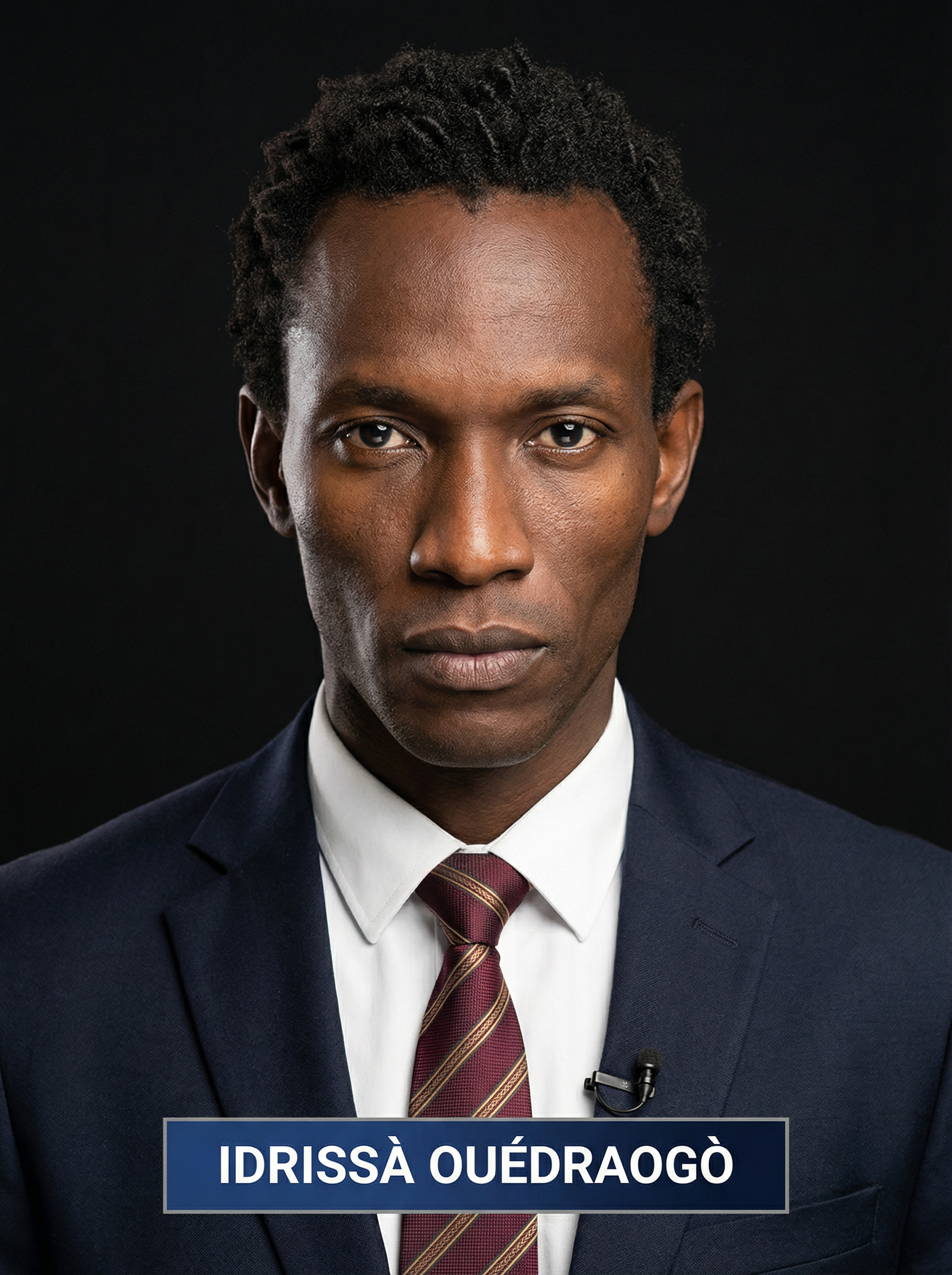
Official reactions have been cautiously optimistic. The Minister of Agriculture, Mr. Salifou Ouédraogo, speaking at a press conference in Ouagadougou, acknowledged the potential. “This collaboration with Microsoft and OpenAI represents a strategic step towards modernizing our agricultural sector and building resilience against climate change,” he stated. “We are committed to exploring how these advanced technologies can serve our people, but we also recognize the need for equitable access and local capacity building.” His words reflect the government's dual challenge: embracing innovation while ensuring it benefits the most vulnerable.
Expert analysis from organizations like the MIT Technology Review has often highlighted the disparity in AI deployment, with much of the focus remaining on developed economies. This pilot in Burkina Faso, small as it is, could be a crucial test case for whether the massive investments in foundational AI models can truly translate into tangible benefits for the Global South. “The real measure of OpenAI's success, and Microsoft's $13 billion bet, won't be in the complexity of their algorithms, but in their ability to impact lives in places like Burkina Faso,” commented Dr. Kwesi Botchway, an AI ethics researcher at the University of Ghana, speaking to DataGlobal Hub via video conference. “It’s about moving beyond abstract potential to concrete, measurable improvements in human well-being.”
What happens next? The pilot program is set to expand to cover an additional 2,000 farmers across three more provinces by the end of 2026. This expansion will also include a component for early warning systems for water resource management, a critical issue in a country where access to potable water remains a daily struggle for many. There are also plans to train local technicians and agricultural extension workers to manage and adapt these AI tools, fostering a sense of ownership and sustainability. This move towards local capacity building is vital, as it ensures that the technology does not remain a black box controlled from afar. For more on the broader implications of AI in Africa, one might consider the ongoing discussions around Africa's AI Sovereignty [blocked].
Why should readers care? Because the world is interconnected. The stability of food systems in the Sahel affects global markets. The success or failure of AI in addressing climate challenges here offers lessons for every corner of the planet. Microsoft’s $13 billion investment isn't just about a company's bottom line; it's a test of whether the most advanced technology humanity has ever created can genuinely serve all of humanity, especially those in the most precarious positions. If AI cannot help a farmer in Burkina Faso grow more food, then what good is all that intelligence, really? The answer to that question will define the true legacy of this AI era. The dust is still settling, but for the first time, some of us are seeing faint outlines of a path forward. We will be watching closely, here on the ground, to see if the rain finally comes. You can follow more developments in the AI industry on Reuters Technology.