Is the global clamor for protecting children from AI-generated content and manipulation a genuine turning point, or just another cycle of well-intentioned but ultimately insufficient policy pronouncements from afar? From my vantage point here in Ouagadougou, I see the headlines, the policy papers, and the pronouncements from Silicon Valley and Brussels. But the reality on the ground, especially for our children, often tells a different story.
We hear a lot about the dangers: deepfakes, algorithmic manipulation, inappropriate content, and privacy breaches. These are not just abstract fears; they are very real threats that can warp young minds and exploit vulnerabilities. The question is, are the solutions being proposed, largely by Western tech giants and governments, truly universal in their application, or do they leave vast swathes of the world, including our continent, exposed?
Let us consider the historical context. When the internet first became widely accessible, the concerns about child safety were immediate, though perhaps less technically complex. Governments and organizations developed filtering software, age verification systems, and educational programs. These efforts, while imperfect, laid a foundation. Then came social media, and the game changed. Suddenly, children were not just passive consumers of content, but active participants, creators, and targets. The rise of sophisticated algorithms meant personalized feeds, echo chambers, and the potential for addiction and mental health issues. We saw the proliferation of online bullying, the spread of misinformation, and the increasing commercialization of children's digital lives.
The current wave of concern, however, feels different because of the sheer power and generative capabilities of artificial intelligence. We are not just talking about filtering existing content; we are talking about AI that can create new, highly convincing, and potentially harmful content at scale. We are talking about AI companions that can form deep, manipulative bonds with vulnerable youth. We are talking about algorithms that can predict and exploit psychological weaknesses with unprecedented precision. This is not just an evolution; it is a revolution in the potential for harm.
Data from organizations like Unicef and the World Health Organization consistently highlight the increasing digital exposure of children globally. A 2023 report by the UN estimated that over one-third of internet users worldwide are children, and many are accessing platforms and content not designed for them. Here in Burkina Faso, while internet penetration is lower than in some Western nations, it is growing rapidly. The Agence Nationale de la Sécurité des Systèmes d'Information (anssi) reported a significant increase in internet users under 18 in the last three years, with mobile access being the primary gateway. Our children are not immune to these global trends; in fact, they might be more vulnerable due to limited digital literacy resources and less robust regulatory frameworks.
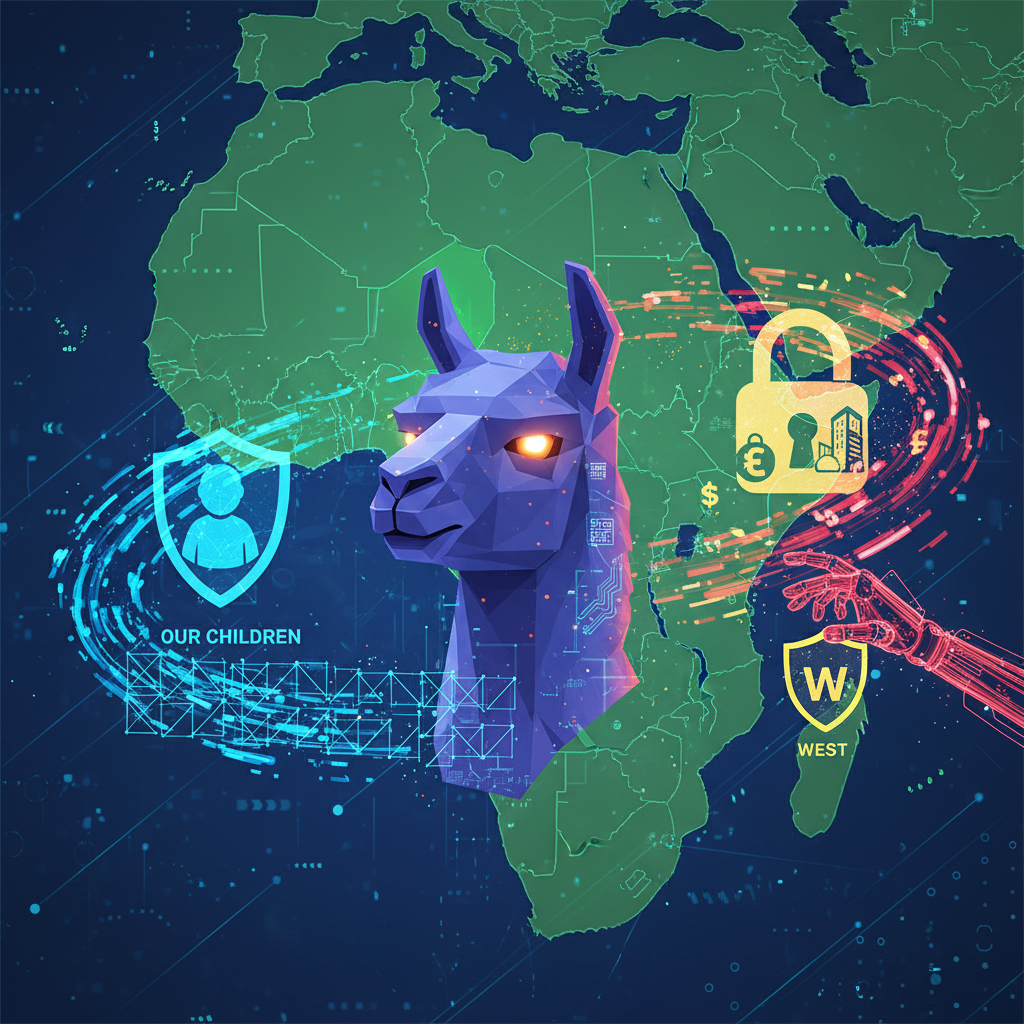
Major players are indeed making moves. Meta, for example, has been vocal about its efforts to protect minors on its platforms, including Instagram and Facebook. They have introduced age verification tools, stricter content moderation policies for accounts belonging to minors, and parental supervision features. Their open-source large language model, Llama, is used by many developers, and Meta has published guidelines for its responsible use, including avoiding generation of harmful content, particularly for children. Meta AI often highlights its safety protocols. Similarly, OpenAI, with its GPT models, has implemented guardrails to prevent the generation of child sexual abuse material and other inappropriate content, and they continually refine their safety policies. OpenAI's blog frequently details these updates.
However, the question remains: are these efforts truly adequate for a global context? When Meta designs its safety features, is it primarily thinking of a child in Paris or a child in Pô? When an AI model is trained on vast datasets, how much of that data reflects the diverse cultural norms, sensitivities, and vulnerabilities of children in different parts of the world? The biases embedded in training data can lead to models that misinterpret or mishandle content from non-Western contexts, potentially flagging innocuous content as harmful, or worse, failing to detect genuinely harmful content that falls outside Western cultural frameworks.
“We appreciate the efforts of global tech companies, but local context is everything,” says Dr. Aïcha Traoré, a child psychologist and digital safety advocate based in Abidjan, Côte d'Ivoire. “An image or a phrase that is harmless in one culture can be deeply offensive or even dangerous in another. AI models need to be trained with this nuance, and that requires more than just a blanket policy from a distant headquarters. It requires local input, local data, and local understanding.”
Another perspective comes from Professor Jean-Luc Ouattara, a cybersecurity expert at the Université Joseph Ki-Zerbo in Ouagadougou. “The challenge is not just about content filtering. It is about manipulation,” he explains. “AI can craft narratives, personalize advertising, and even simulate friendships in ways that are incredibly persuasive to a developing mind. For children in rural areas who may have less social interaction, an AI companion could become a powerful, and potentially dangerous, influence. We need robust digital literacy programs and parental guidance that is culturally appropriate, not just a translation of European guidelines.”
The European Union's AI Act, set to be fully implemented, includes provisions for protecting children, particularly concerning high-risk AI systems. It mandates transparency, risk assessments, and human oversight. While commendable, its primary focus is on the European market. The ripple effect might benefit other regions, but it is not a tailored solution. The reality on the ground is that many African nations, including Burkina Faso, are still developing comprehensive digital safety legislation, and enforcement capacity is often limited. We rely heavily on the goodwill and proactive measures of the tech companies themselves.
Here is what actually happened: a few months ago, a local school reported an incident where a child was exposed to highly inappropriate AI-generated images through a seemingly innocent online game. The game used a popular open-source AI model for its graphics. The parents were distraught, and the school felt helpless. The reporting mechanisms provided by the platform were cumbersome and not designed for our local languages or specific cultural context. This highlights a critical gap: the global nature of AI content creation clashes with the localized nature of its impact and the varied capacities for protection.
Forget the hype, this is what matters: real, tangible protection for our children. This means moving beyond generic safety statements. It means tech companies investing in localizing their safety protocols, training their models on diverse datasets, and collaborating closely with local governments, educators, and parents. It means developing AI tools that can identify and mitigate harm based on specific cultural and linguistic nuances. It also means empowering parents and educators with the knowledge and tools to navigate this new digital landscape.
Is this trend a fad or the new normal? The dangers posed by AI to children are undeniably the new normal. The question is whether the global response will mature beyond a Western-centric approach to embrace a truly inclusive, effective strategy. Without it, the digital playground will remain a dangerous place for many, especially for those of us far from the boardrooms where these powerful technologies are born. We must advocate for solutions that recognize our unique challenges and vulnerabilities, ensuring that our children are not left behind in the global race for AI safety. The future of our next generation depends on it. For more on the broader implications of AI in society, one might look to analyses from MIT Technology Review. The conversation must continue, and it must include all voices.