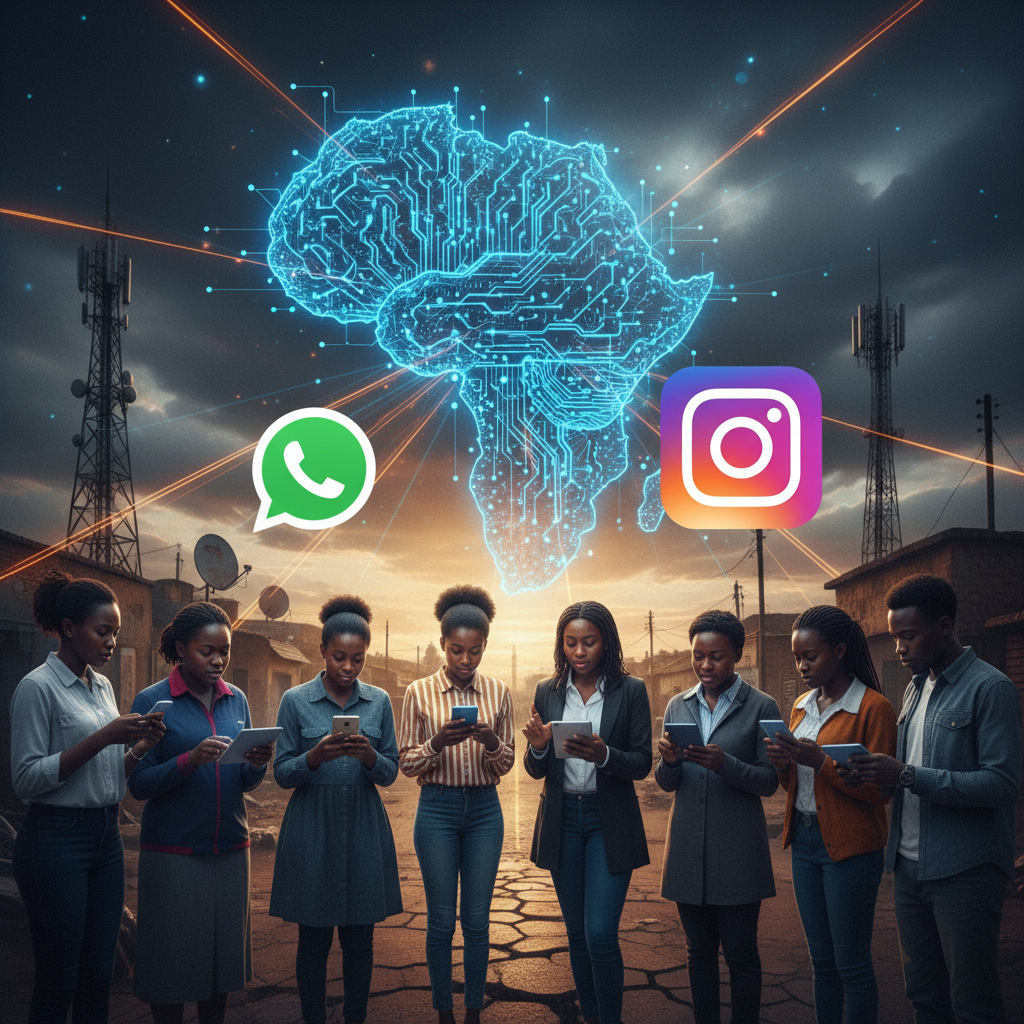

The morning sun was just beginning to warm the streets of Maboneng, painting the graffiti art in hues of orange and gold. Taxi drivers were already hooting, vendors setting up their stalls, and the familiar buzz of Johannesburg life was kicking into high gear. But today, the chatter on the street, and more importantly, in our pockets, felt different. It was about Meta. Again.
Breaking news this week confirms that Meta is rolling out its advanced AI features directly into WhatsApp and Instagram across several African markets, including our very own South Africa. This isn't some quiet update; it's a seismic shift poised to fundamentally alter how billions communicate, connect, and even think. From generating text and images within chats to summarizing long conversations and answering complex queries, Meta's AI is now deeply embedded in the platforms we use every single day.
For many, especially here in Africa, WhatsApp isn't just an app; it's the internet. It's how families separated by borders stay in touch, how small businesses conduct their daily trade, and how communities organize. Instagram too, has become a vibrant canvas for African creativity and entrepreneurship. So, when Meta decides to integrate powerful AI directly into these lifelines, the implications are profound, touching on everything from data privacy to cultural preservation.
Key Details of the Rollout
Meta's AI, powered by its Llama models, is designed to be a conversational assistant, much like OpenAI's ChatGPT or Google's Gemini. It can create images from text prompts, draft messages, answer questions, and even help users plan events, all without leaving the WhatsApp or Instagram interface. The company has been testing these features in select regions, but this week marks a significant expansion into the African continent. Users will find a new AI icon within their chat interfaces, inviting them to interact with the assistant.
According to Meta's official statements, the goal is to make these platforms more useful and engaging. "We believe AI can enhance human connection, not replace it," stated Mark Zuckerberg in a recent virtual address, emphasizing the potential for these tools to bridge communication gaps. While the promise of instant information and creative tools is alluring, the speed and scale of this rollout raise immediate concerns.
Official Reactions and Local Concerns
Local regulators and privacy advocates are already voicing apprehension. "We welcome innovation, but not at the expense of our citizens' rights," remarked Advocate Pansy Tlakula, South Africa's Information Regulator, in a statement released this morning. "Our office is actively engaging with Meta to understand the full scope of data collection and processing under these new AI features, and to ensure compliance with the Protection of Personal Information Act, Popia." Let that sink in. Our data, our conversations, are now directly feeding these powerful algorithms.
Across the continent, similar sentiments echo. Dr. Nanjira Sambuli, a renowned Kenyan digital rights advocate, expressed her concerns on a panel discussion, saying, "The digital divide isn't just about access; it's about agency. When powerful AI tools are dropped into our most intimate communication spaces, without robust digital literacy and regulatory frameworks, whose interests are truly being served?" Her words resonate deeply, reminding us that technology is never neutral.
Expert Analysis: A Double-Edged Sword
Here's the thing nobody's talking about enough: the immense power Meta now wields over information and perception. Imagine an AI that can subtly influence narratives, suggest responses, or even prioritize certain types of content in your private conversations. The potential for manipulation, even unintentional, is staggering. For a continent grappling with misinformation and digital colonialism, this development is not to be taken lightly.
Professor Barry Dwolatzky, Director of the Joburg Centre for Software Engineering, offered a more nuanced perspective. "On one hand, these tools could empower small businesses, help students access information, and even facilitate cross-cultural communication," he told DataGlobal Hub. "The sheer reach of WhatsApp means this AI could touch millions who might otherwise be excluded from advanced technological benefits. However, the ethical considerations, particularly around data privacy, bias in AI models, and the potential for surveillance, are monumental. We must demand transparency and accountability from Meta." His words highlight the complex tightrope we are walking.
Indeed, the training data for these AI models is predominantly Western, raising critical questions about cultural relevance and bias. Will the AI understand the nuances of isiXhosa idioms or the complexities of South African political discourse? Or will it impose a globalized, often Western, understanding onto our unique contexts? This isn't just a tech story because it's a justice story, a story about whose knowledge systems are valued and amplified.
What Happens Next
The immediate future will likely see a surge in user adoption, driven by curiosity and the undeniable convenience these features offer. However, expect increased scrutiny from privacy watchdogs and digital rights organizations across Africa. There will be calls for greater transparency from Meta regarding its data practices, the training data used for its Llama models, and the safeguards in place to prevent misuse or bias.
Governments may also feel compelled to update existing regulations or introduce new ones specifically tailored to AI in communication platforms. The African Union's ongoing discussions around a continental AI strategy will undoubtedly gain new urgency in light of this rollout. We might see a push for localized, culturally relevant AI models, perhaps even open-source initiatives that serve African needs first.
Why Readers Should Care
This isn't just about a new feature on your phone; it's about the future of our digital lives, our communities, and our very sense of self in an increasingly algorithm-driven world. The philosophy of Ubuntu teaches us that 'umuntu ngumuntu ngabantu', a person is a person through other people. Our connections, our conversations, are the fabric of our society. When an external, powerful AI begins to mediate these connections, we must ask ourselves what we gain, and what we risk losing.
For entrepreneurs using WhatsApp for business, the AI could streamline customer service or marketing. For students, it could be a powerful study aid. But for everyone, it represents a new layer of algorithmic influence over our daily interactions. We must remain vigilant, demand accountability, and actively shape the narrative around how these powerful tools are integrated into our lives. Otherwise, we risk becoming passive recipients of a digital future designed elsewhere.
The conversation has just begun, and it's one we cannot afford to ignore. The choices we make now, as users, as citizens, and as a continent, will determine whether Meta's AI becomes a tool for empowerment or another vector for digital inequality. The stakes, my friends, could not be higher. For more on the broader implications of AI in society, you can explore articles on MIT Technology Review. For specific news on Meta's AI developments, TechCrunch often has the latest. And for a deeper dive into the ethical considerations of AI, Wired provides insightful analysis.