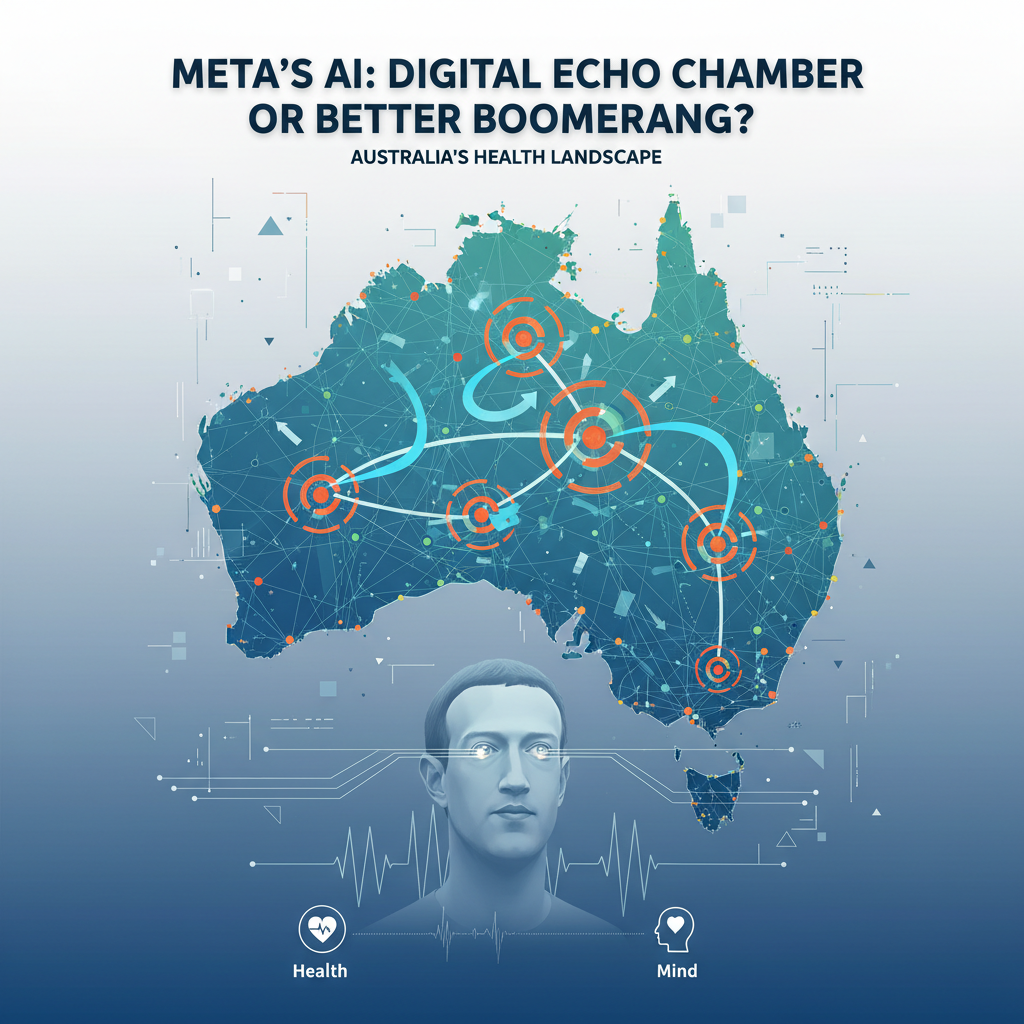

Remember the good old days, when your Facebook feed was just pictures of your mate's questionable holiday choices and the occasional baby photo? Simpler times, eh? Fast forward to April 2026, and scrolling through Meta's platforms feels less like catching up with friends and more like navigating a highly curated, AI-driven bazaar. The question on everyone's lips, from the tech titans in Silicon Valley to the blokes having a beer at the local RSL, is this: Is Mark Zuckerberg's relentless push for AI-powered content recommendation a stroke of genius, or is it just building a bigger, shinier digital echo chamber? Mate, this AI thing is getting interesting, and its effects on social media are undeniable.
Historically, social media algorithms were pretty rudimentary, a bit like a kelpie trying to herd sheep, mostly effective but occasionally sending them off in the wrong direction. Facebook, back in its infancy, used a simple EdgeRank algorithm, prioritising interactions and recency. Then came the era of machine learning, where algorithms started learning our preferences based on likes, shares, and comments. But what Meta is doing now, with its Llama models and increasingly sophisticated deep learning architectures, is a whole different beast. They are not just showing you what your friends liked, they are predicting what you might like, even before you know you like it. It is like having a digital mate who knows your taste in obscure indie bands better than you do, which is both impressive and a bit creepy, if you ask me.
This shift isn't just about tweaking a few lines of code, it is a fundamental re-engineering of how we consume digital information. Meta's own AI research division, Meta AI, has been publishing extensively on their advancements in large language models and multimodal AI, all geared towards making their recommendation engines more potent. The company has openly stated its ambition to make AI a central pillar of all its products, and the content feed is ground zero for this experiment. We are talking about billions of users, from Instagram's visual feast to Facebook's sprawling network, all being served content tailored by algorithms that are constantly learning and adapting. The sheer scale is mind-boggling.
Now, let's talk numbers, because that is where the rubber hits the road. While Meta doesn't break down engagement metrics specifically for AI-recommended content versus friend-generated content, anecdotal evidence and analyst reports suggest a significant uptick in time spent on platforms. A recent report by Reuters Technology indicated that Meta's investment in AI infrastructure, estimated to be in the tens of billions of dollars annually, is directly correlated with increased user retention and ad revenue growth. It is a virtuous cycle for them, where more engaging content means more eyeballs, which means more ad dollars. For users, however, it is a mixed bag. Some find the hyper-personalisation delightful, discovering new creators or interests they would never have stumbled upon otherwise. Others feel trapped in a filter bubble, constantly fed content that reinforces existing biases, making it harder to encounter diverse perspectives.
Here in Australia, we are seeing this play out in interesting ways. Our tech scene is like a good flat white, better than you'd expect, and we are not immune to these global shifts. Local businesses, content creators, and even our politicians are grappling with the implications. Dr. Sarah Miller, a digital ethics researcher at the University of Melbourne, recently commented on the phenomenon, saying, “Meta’s AI is incredibly powerful at identifying patterns and predicting engagement. The challenge, and frankly, the ethical tightrope, is ensuring that this power is used to enrich public discourse, not just to maximise screen time. We need transparency, and we need mechanisms for users to understand and even influence their algorithmic feeds.” She hit the nail on the head there, didn't she? It is about control, or the lack thereof.
Another perspective comes from Mr. David Lee, CEO of an Australian social media analytics startup based in Sydney. He noted, “From a business standpoint, Meta’s AI is a goldmine. It allows for incredibly precise targeting, which means better ROI for advertisers. For Australian brands, this means reaching niche audiences with unprecedented accuracy. However, the flip side is the increasing reliance on these platforms, and the potential for algorithmic changes to drastically impact reach overnight. It’s a double-edged sword, really.” His point about reliance is crucial. When an AI decides what gets seen, it holds immense power over livelihoods and public opinion.
Globally, the conversation is heating up. Regulators in Europe, already grappling with the Digital Services Act, are scrutinising the impact of these powerful recommendation engines on everything from mental health to democratic processes. In the US, there are ongoing discussions about algorithmic transparency and accountability. The concern is that these systems, while efficient, can inadvertently amplify misinformation, create echo chambers, and even contribute to polarisation. It is a heavy burden for an algorithm to carry, even a super smart one.
So, is Meta's AI-powered content recommendation a fad or the new normal? My gut feeling, and a good look at the trajectory of tech, tells me this is firmly the new normal. The genie is out of the bottle, and there is no putting it back. The efficiency and engagement benefits for Meta are too significant for them to revert to simpler systems. This isn't just a trend, it is a foundational shift in how social media operates. We are moving from a 'social graph' model, where connections dictated content, to an 'interest graph' model, where AI determines what you see based on predicted interests, regardless of who posted it. This is a profound change.
However, the effects of this new normal are still very much in flux. The pushback from users, researchers, and regulators will inevitably force Meta to evolve its approach. We might see more user controls over algorithmic feeds, greater transparency about how content is ranked, and perhaps even AI systems designed with explicit goals of promoting diverse viewpoints, rather than just engagement. The challenge will be to balance the commercial imperatives of a massive tech company with the societal responsibility that comes with influencing billions of people's daily information consumption. Down Under, we do things differently, and perhaps our pragmatic approach to technology can offer some lessons here, focusing on practical outcomes and less on the Silicon Valley hype.
The future of social media, it seems, will be a constant negotiation between human agency and algorithmic influence. We are not just passive consumers anymore, we are also data points, constantly feeding the beast that then feeds us. The question for us, the users, is how much of that control we are willing to cede, and how much we demand back. It is a conversation we all need to be having, because these algorithms are not just shaping our feeds, they are subtly shaping our world. For more on the broader implications of AI on digital platforms, you might find this article on Uzbekistan's data privacy [blocked] insightful, as it touches on similar themes of data and algorithmic influence. It is a complex dance, and we are all on the dance floor whether we like it or not.
The next few years will be critical in determining whether Meta's AI becomes a tool for genuine connection and discovery, or if it simply entrenches us deeper into our own digital biases. My bet is on a messy, iterative process, with plenty of public outcry and corporate adjustments along the way. It is the Australian way, isn't it, to question things and push for a fair go. Let's hope that spirit prevails in the digital realm too.