
Kerala's AI Policy: A Blueprint for Inclusive Digital Governance, Says Minister
Kerala unveils its ambitious AI policy, prioritizing ethical deployment and equitable access, drawing praise for its forward-thinking approach to digital governance in the subcontinent.
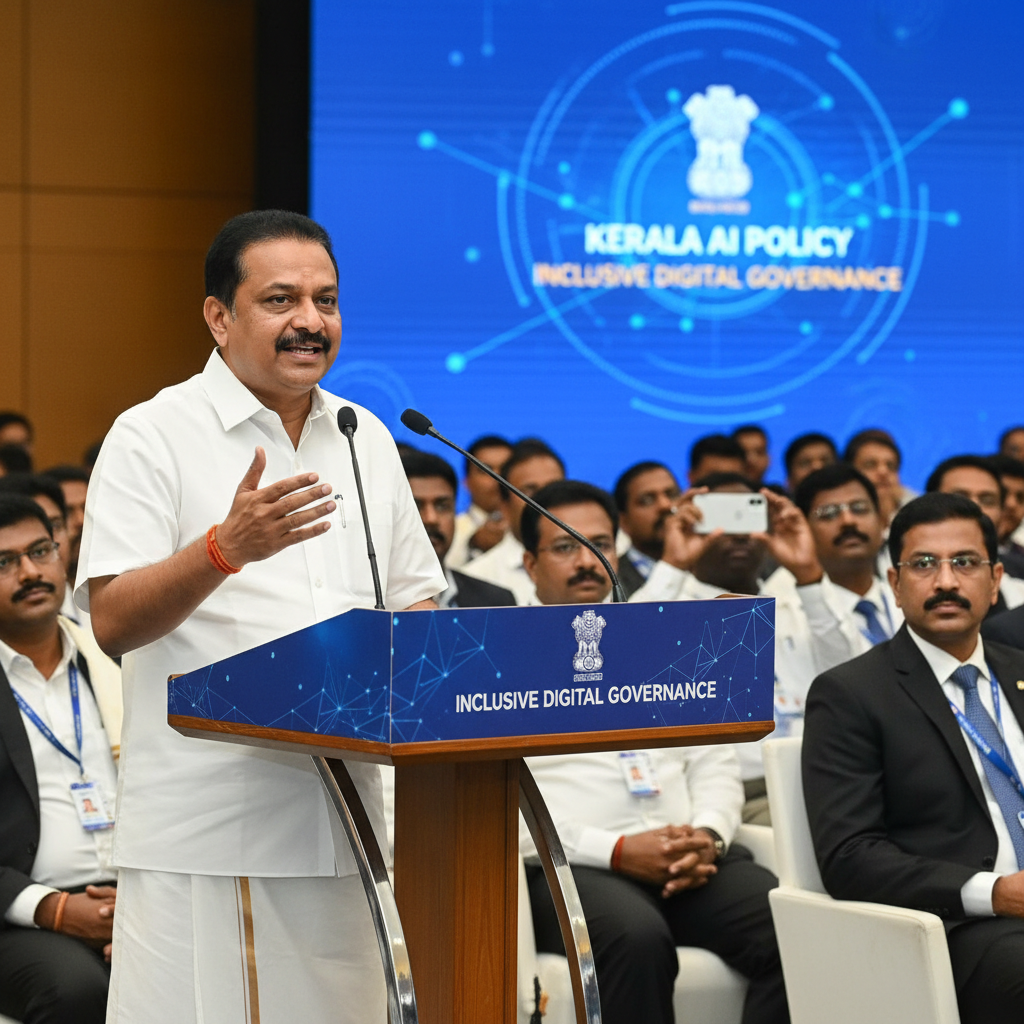

THRISSUR, KERALA – In a landmark move poised to redefine digital governance in India, Kerala has officially unveiled its comprehensive Artificial Intelligence policy, positioning the state as a trailblazer in the ethical and inclusive adoption of AI technologies. The policy, a culmination of extensive consultations with technologists, social scientists, and community leaders, emphasizes responsible AI development, data privacy, and the equitable distribution of benefits across all strata of society.
Speaking at a press conference in Thiruvananthapuram, Minister for IT and Electronics, Smt. K.K. Shailaja Teacher, a prominent figure known for her progressive stances, articulated the state's vision. "Our AI policy is not merely about technological advancement; it's about janaakeernam – people-centric development. We are committed to leveraging AI for public good, ensuring it addresses the unique challenges faced by our communities, from agricultural productivity in the Kuttanad region to enhancing healthcare accessibility in tribal areas of Wayanad." Her emphasis on local context resonated deeply, reflecting the state's long-standing commitment to social welfare.
The policy outlines several key pillars, including the establishment of an AI Ethics Council, a robust framework for data governance compliant with the Digital Personal Data Protection Act, 2023, and significant investments in AI skilling programs, particularly targeting women and marginalized communities. Dr. Anjana Menon, a distinguished AI ethicist from the Indian Institute of Technology Madras, commended Kerala's proactive stance. "This policy, with its strong emphasis on 'explainable AI' and 'fairness metrics,' sets a crucial precedent. It acknowledges that AI's impact is not uniform and demands culturally sensitive deployment, a lesson many Western models often overlook. Kerala's samathvam (equality) principle is clearly embedded here."
One of the policy's most innovative aspects is its proposal for 'AI for Local Governance' initiatives. This includes pilot projects for predictive analytics in disaster management, crucial for a state frequently impacted by monsoons, and AI-powered tools to streamline services at grama panchayat levels. "Imagine an AI assistant helping a farmer in Palakkad navigate complex government schemes in Malayalam, or an AI system identifying early signs of crop disease," explained Shri. Rajesh Kumar, Principal Secretary, IT Department. "This is about empowering our citizens, not replacing human judgment, but augmenting it with efficiency and precision."
The policy also addresses concerns about job displacement, proposing re-skilling initiatives and fostering an ecosystem for AI-driven entrepreneurship. Critics, while generally positive, have raised questions about the policy's implementation timeline and funding mechanisms. However, the state government remains optimistic, citing strong public-private partnerships and central government support through initiatives like the IndiaAI Mission.
As other Indian states grapple with the complexities of AI regulation, Kerala's policy could serve as a valuable blueprint. Its nuanced approach, blending technological ambition with a profound understanding of social equity and local needs, positions it as a leader in India's digital transformation journey, truly embodying the spirit of a 'Digital Kerala' that prioritizes its people.
Related Articles

AI-Powered Early Dementia Detection: A Beacon of Hope for Japan's Aging Society
 Yuki Tanakà
Tamil Nadu's AI Push: Bridging Digital Divide with Dravidian Tech Ethos
 Rajèsh Krishnàn
AI's Promise for Azerbaijani Women's Health: Early Detection of Gynecological Cancers
 Aynurè Abdullayevà
AI's Ethical Frontier: White House Task Force Grapples with Bias in Public Sector Algorithms
 Amèlia Whitè