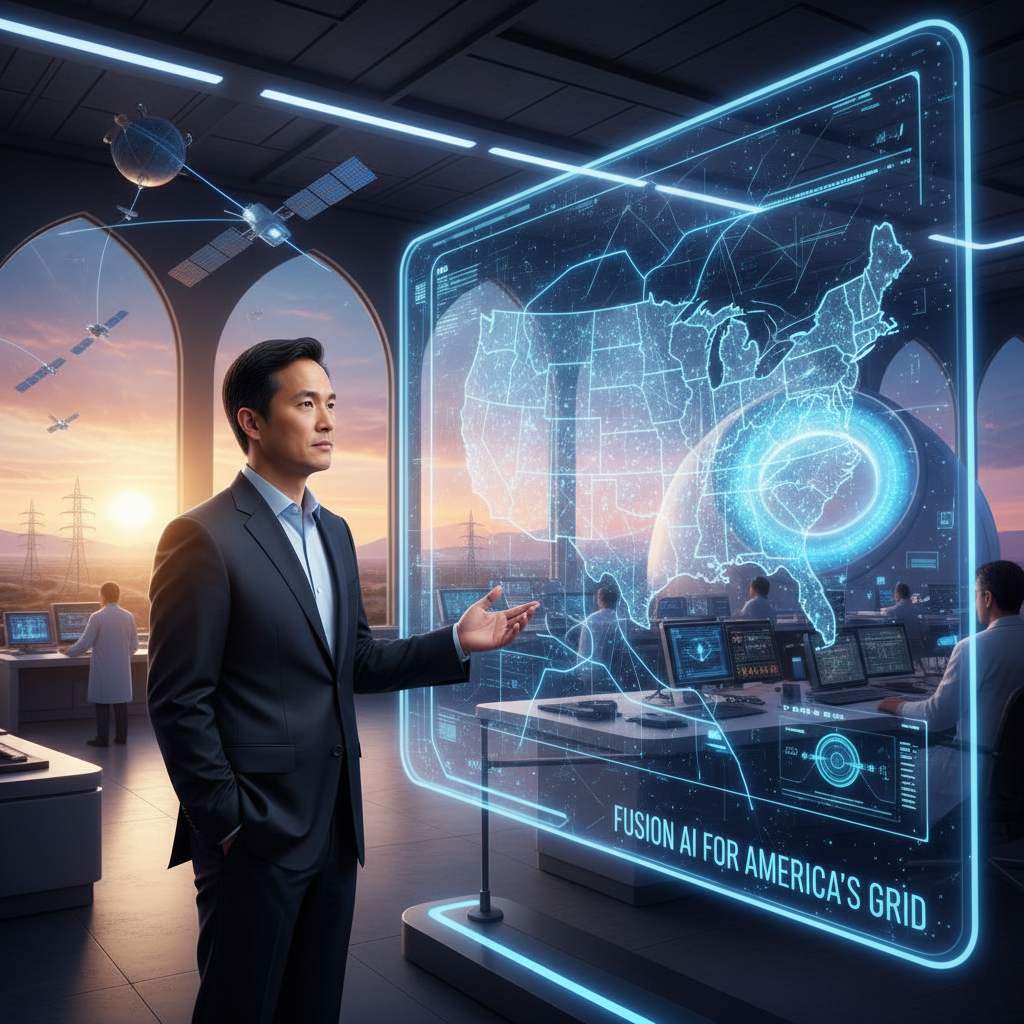
Let's be real for a minute. When we talk about AI, most folks picture a chatbot writing poetry or a self-driving car navigating rush hour on the 405. But the real game changer, the one that could fundamentally reshape our world and our energy future, is quietly unfolding in laboratories across the globe, right here in the USA. I am talking about nuclear fusion, the holy grail of clean energy, and the increasingly critical role AI plays in making it a reality. This isn't just some academic exercise, this is about powering our cities, our homes, and our industries without melting the planet. And frankly, the stakes couldn't be higher.
The challenge is monumental: how do you contain a plasma hotter than the sun for long enough to generate net energy? We are talking about temperatures exceeding 100 million degrees Celsius. Traditional control systems, based on classical physics and predictive models, simply cannot react fast enough or adapt to the chaotic, non-linear dynamics of a tokamak plasma. This is where AI steps in, not as a fancy accessory, but as an absolute necessity. Without it, fusion remains a pipe dream, a scientific curiosity rather than a practical power source.
The Technical Challenge: Taming a Star on Earth
The core problem in magnetic confinement fusion, particularly in tokamak reactors, is maintaining plasma stability and optimizing its performance. Plasma disruptions, which are sudden losses of confinement, can damage reactor components and halt operations. Furthermore, achieving high energy gain requires precise control over plasma density, temperature, and current profiles. The sheer volume of sensor data, the speed required for feedback loops, and the complex interplay of electromagnetic forces make this an ideal, albeit incredibly difficult, problem for advanced AI.
Consider the Diii-d tokamak at General Atomics in San Diego, a facility that has been pushing the boundaries of fusion research for decades. They are generating terabytes of data per experimental run, capturing everything from magnetic field fluctuations to electron density profiles. Manually sifting through this data for insights, let alone using it for real-time control, is impossible. This is the chasm AI is designed to bridge.
Architecture Overview: A Fusion of Sensors and Silicon
An AI-driven fusion control system is a complex beast, essentially a cyber-physical system operating at the bleeding edge. At its heart, you have a robust data acquisition layer, pulling information from hundreds of diagnostics: interferometers, bolometers, Thomson scattering systems, magnetics, and more. This raw data, often noisy and high-dimensional, is then fed into a pre-processing pipeline for feature extraction and dimensionality reduction. Think of it as a massive data refinery, preparing the fuel for the AI engine.
The core AI architecture typically involves a distributed system. Edge computing units, often powered by NVIDIA's specialized GPUs like the H100, handle real-time data processing and initial inference for immediate feedback loops. These units might run lightweight, pre-trained models to detect incipient instabilities or deviations from optimal plasma states. For more complex, slower timescale optimizations, data is aggregated and sent to centralized compute clusters, where larger, more sophisticated models are trained and deployed.
Key Algorithms and Approaches: From Reinforcement Learning to Predictive Control
Several AI paradigms are converging to tackle fusion's challenges:
- Reinforcement Learning (RL): This is the star player. Imagine an agent learning to play a video game, but the game is controlling a fusion plasma. RL agents, often using Deep Q-Networks (DQN) or Proximal Policy Optimization (PPO), interact with a simulated or real-world tokamak environment. They receive observations (sensor data), take actions (adjusting heating power, gas puffing, magnetic coil currents), and receive rewards (e.g., maintaining stability, maximizing energy confinement). The goal is to learn an optimal policy that maximizes long-term rewards. Google DeepMind has famously applied RL to control plasmas in the Swiss Plasma Center's TCV tokamak, demonstrating unprecedented precision in shaping the plasma.
Conceptual Example: An RL agent observes plasma current, temperature, and position. It decides to increase auxiliary heating power and adjust a specific magnetic coil. If the plasma remains stable and confinement improves, it receives a positive reward. Over thousands of simulated or real-world iterations, the agent learns the best sequence of actions for various plasma conditions.
-
Recurrent Neural Networks (RNNs) and Transformers: For predicting plasma disruptions, sequence models are crucial. LSTMs (Long Short-Term Memory networks) and more recently, Transformer architectures, can process time-series data from diagnostics to forecast instabilities seconds or even milliseconds before they occur. This early warning allows for mitigation strategies, like rapid shutdown or impurity injection, to prevent damage.
-
Surrogate Models and Digital Twins: Training RL agents on real tokamaks is expensive and risky. Instead, researchers build high-fidelity physics-based simulations or AI-driven surrogate models. These models, often trained using Gaussian Processes or deep neural networks, can accurately predict plasma behavior much faster than full-scale simulations. This creates a 'digital twin' of the reactor, allowing for rapid experimentation and policy learning in a safe, virtual environment.
Implementation Considerations: Speed, Robustness, and Data
The practical application of AI in fusion is fraught with challenges. Latency is king. Control actions need to be executed within microseconds to milliseconds. This demands highly optimized code, specialized hardware, and efficient data pipelines. Think about it: if your AI takes too long to decide, your plasma is already gone.
Data quality and quantity are also critical. Fusion experiments are complex, and diagnostic data can be noisy or incomplete. Robust data cleaning, imputation, and anomaly detection techniques are essential. Furthermore, the rarity of disruptive events means that datasets for training disruption prediction models are often imbalanced, requiring techniques like oversampling or synthetic data generation.
Interpretability is another huge hurdle. When an AI makes a decision that prevents a disruption or achieves a new performance record, scientists need to understand why. Black-box models, while powerful, can be a hard sell in a field where safety and scientific understanding are paramount. Efforts are underway to develop explainable AI (XAI) techniques to provide insights into model decisions.
Benchmarks and Comparisons: Outperforming Traditional Methods
Traditional control systems rely on pre-programmed rules and simplified physics models. While effective for basic operations, they struggle with the non-linear, chaotic nature of plasma. AI, particularly RL, has shown superior performance in several key areas:
- Disruption Avoidance: AI models have demonstrated the ability to predict disruptions with higher accuracy and earlier warning times than classical methods, often achieving over 90% accuracy in some scenarios.
- Plasma Shaping and Control: RL agents have achieved more precise and dynamic control over plasma shape, position, and current profiles, leading to improved confinement times and energy efficiency.
- Operational Optimization: AI can explore a much wider parameter space than human operators, discovering novel operating regimes that lead to higher performance or stability.
Code-Level Insights: Frameworks and Libraries
For those looking to dive into the code, the ecosystem is rich. Python is the lingua franca, with libraries like TensorFlow and PyTorch dominating the deep learning landscape. For RL, frameworks such as Ray RLib or Stable Baselines3 provide scalable implementations of various algorithms. Data processing often leverages NumPy, SciPy, and Pandas. For real-time execution, C++ or Rust might be used for critical control loops, integrating with Python-based inference engines via APIs. Distributed computing frameworks like Apache Spark or Dask are essential for handling the massive datasets generated by tokamaks. For hardware acceleration, Cuda and cuDNN are indispensable for leveraging NVIDIA GPUs.
Real-World Use Cases: Powering Progress
- Google DeepMind and the Swiss Plasma Center (TCV Tokamak): In a groundbreaking achievement, DeepMind's AI successfully controlled plasma in the TCV tokamak, demonstrating precise real-time manipulation of plasma shape and position. This was a critical step, showcasing AI's ability to handle the extreme conditions of fusion.
- General Atomics (diii-d Tokamak): Researchers at Diii-d are actively using machine learning for disruption prediction and mitigation. Their models analyze hundreds of diagnostic signals to identify precursors to instabilities, allowing for automated responses to prevent costly shutdowns.
- MIT's Plasma Science and Fusion Center (Alcator C-Mod, now Sparc): While Alcator C-Mod is decommissioned, its rich dataset continues to be a goldmine for AI research. The lessons learned are directly informing the design and control strategies for the Sparc compact tokamak, which aims for net energy gain.
- Princeton Plasma Physics Laboratory (pppl): Pppl is a hub for AI in fusion, developing advanced algorithms for optimizing plasma confinement and understanding complex turbulent transport phenomena. Their work contributes significantly to the Iter project, the international fusion experiment under construction in France.
Gotchas and Pitfalls: The Uncomfortable Truths
Uncomfortable truth time: while the promise is immense, the path is not smooth. Data scarcity in specific, high-performance regimes is a problem. Fusion experiments are expensive, and generating enough data for all possible scenarios is challenging. Generalization is another issue: a model trained on one tokamak might not perform well on another due to differences in geometry, diagnostics, or operational parameters. This points to the need for more robust, physics-informed AI models.
Then there's the human element. Integrating AI into existing control rooms, where highly experienced physicists and engineers have honed their intuition over decades, requires significant trust-building and validation. It's not just about the tech, it's about people and process. Silicon Valley has a blind spot the size of Texas when it comes to understanding how established, high-stakes industries operate, and fusion is definitely one of them. The tech-bro 'move fast and break things' mentality simply doesn't fly when you are dealing with multi-billion dollar reactors and plasma hotter than the sun.
Resources for Going Deeper: Your Journey to the Stars
For those ready to dive deeper, start with the foundational papers from Google DeepMind on fusion control. Explore the arXiv for the latest pre-prints on plasma physics and machine learning. The MIT Technology Review often features excellent articles on fusion energy. For practical implementation, check out open-source fusion data repositories and the documentation for popular ML frameworks. Consider online courses on reinforcement learning and time-series analysis. The future of energy might just depend on it.
This isn't just about building a better algorithm, it's about building a better world. But let's not forget that the benefits of this incredible technology, once realized, must be distributed equitably. We cannot allow this to become another example where the powerful hoard the gains, leaving the rest to scramble for scraps. The promise of clean, abundant energy should be for everyone, not just for those who can afford it. That's the real challenge facing us, and one that AI alone cannot solve.