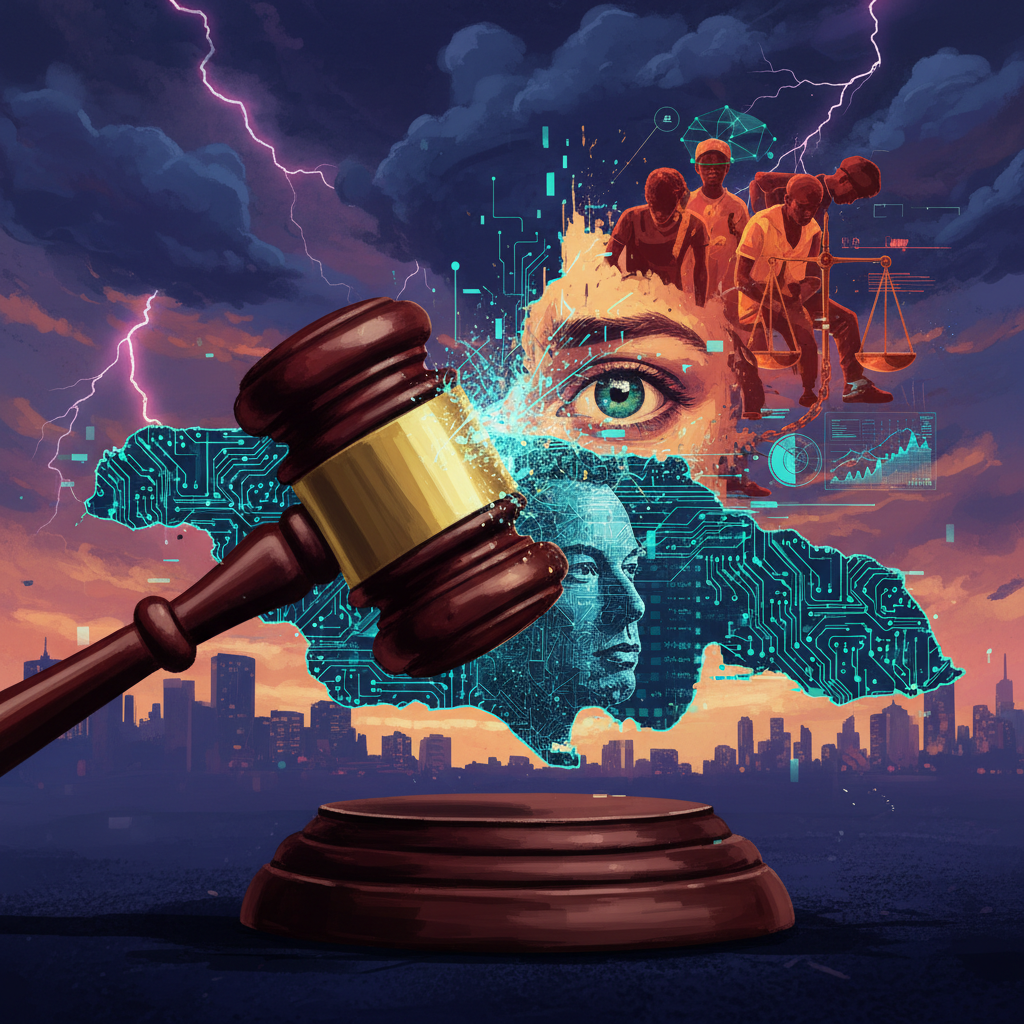

Alright, settle down, because Keishà Brownè has something to say, and trust me, it’s not about another TikTok dance challenge. We’re talking about something far more serious, something that could reshape the very fabric of justice, even here in Jamaica: artificial intelligence in criminal justice. Now, I know what some of you are thinking, 'AI? In Jamaica? We still dealing with potholes, Keishà.' And you wouldn't be entirely wrong, but the world moves fast, and these digital tentacles are reaching everywhere, including our courts and police stations.
The buzz from places like Silicon Valley, with big names like Elon Musk occasionally chiming in on societal impacts, suggests AI is the magic bullet for everything, including crime. They talk about predictive policing, where algorithms supposedly pinpoint crime hotspots before they even flare up. Then there are sentencing algorithms, meant to bring 'fairness' and 'consistency' to court decisions. Sounds grand, doesn't it? Like something out of a James Bond movie, but instead of a laser watch, it's a supercomputer telling you who the next villain is. But for us, the people on the ground, the ones who actually live in these communities, the question isn't just 'can it work?' It's 'will it work for us?' And more importantly, 'will it make things worse?'
Let's get into the nitty-gritty. The risk scenario here is not some far-off dystopian future; it's already knocking on the door. Imagine a system that, based on historical data, decides certain communities are inherently more prone to crime. What happens then? More police presence, more arrests, more convictions in those areas, creating a self-fulfilling prophecy. This isn't about catching criminals; it's about criminalizing communities. And in a country like Jamaica, with its complex socio-economic landscape and historical injustices, that’s a recipe for disaster.
Technically speaking, these systems, whether it's a predictive policing tool from Palantir or a sentencing algorithm developed by a lesser-known firm, operate on vast datasets. They gobble up crime statistics, demographic information, arrest records, and sometimes even social media data. They then use machine learning models, often complex neural networks, to identify patterns and make predictions. The idea is that these patterns, invisible to the human eye, can reveal where and when crimes are likely to occur, or what sentence is 'appropriate' for a given offense. The problem, my friends, is that these datasets are not neutral. They reflect past human biases, past policing practices, and past societal inequalities. If police historically over-patrolled certain neighborhoods, guess what the AI will learn? That those neighborhoods are high-crime areas, not that they were simply over-policed. It's like feeding a child a steady diet of junk food and then wondering why they're not healthy. The input determines the output.
We've seen this play out in other parts of the world. In the US, systems have been criticized for disproportionately targeting minority communities. A study cited by Wired detailed how predictive policing algorithms often direct law enforcement to areas with higher minority populations, leading to more arrests for minor offenses and reinforcing the cycle. Similarly, sentencing algorithms have shown biases against certain racial groups, recommending harsher penalties for them compared to others with similar criminal histories. This isn't the AI being 'racist' in a human sense; it's the AI being a very efficient mirror, reflecting the biases embedded in the data it was trained on.
The expert debate on this is raging, and it's not just academics arguing in ivory towers. Law enforcement officials, civil rights advocates, and tech ethicists are all weighing in. On one side, you have those who champion the efficiency argument. "AI can help us allocate resources better, reduce response times, and make our streets safer," argues Commissioner Alistair 'Busta' Campbell of the Jamaica Constabulary Force's (JCF) Technology Unit. "We're not talking about Minority Report here, we're talking about data-driven decisions to prevent crime. If Google Maps can predict traffic, why can't we predict crime?" He believes that with careful implementation and oversight, these tools could be invaluable. He's not entirely wrong about the potential, but the devil, as they say, is in the details, and sometimes the details are buried deep in lines of code.
On the other side, you have folks like Dr. Imani Blake, a leading Caribbean legal scholar and human rights advocate from the University of the West Indies, Mona campus. "The Caribbean has entered the chat, and we are not here for algorithms that perpetuate historical inequalities," she stated emphatically during a recent online panel. "Our justice system, like many others, has its flaws. Introducing AI without addressing the inherent biases in our historical data will not fix those flaws; it will automate and amplify them. We risk creating a digital 'passa passa' where certain groups are perpetually targeted, eroding trust in institutions that are already fragile." Her point is a powerful one: simply digitizing a broken system doesn't fix it; it just makes it break faster and with more authority.
The real-world implications for Jamaica are profound. Our justice system already grapples with issues of trust, resource allocation, and public perception. Introducing AI tools, particularly those that are opaque 'black boxes' where even the developers struggle to explain their decisions, could exacerbate these challenges. Imagine a young man from Tivoli Gardens or August Town being repeatedly flagged by a predictive policing algorithm, not because of what he has done, but because of where he lives and the historical crime rates associated with that area. Or a judge relying on an AI's recommendation for a harsher sentence, unaware that the algorithm might be subtly biased against the defendant's socio-economic background. This isn't just about statistics; it's about human lives, about freedom, and about the very definition of justice.
What should be done? First, we need transparency. Any AI system deployed in criminal justice must be auditable and explainable. We need to understand how it makes its decisions, not just accept them blindly. Second, robust ethical guidelines and regulatory frameworks are essential. This isn't just a tech problem; it's a governance problem. The government, through agencies like the Ministry of Justice and the JCF, needs to establish clear rules and oversight mechanisms. We can't just let tech companies dictate the terms. Third, and perhaps most crucially, we need to address the data problem. If our historical crime data is biased, then we need to actively work to de-bias it, or at the very least, understand its limitations and not feed it blindly into an algorithm. This might mean investing in community policing initiatives that build trust and gather more accurate, less biased information. It also means investing in education and socio-economic development, tackling the root causes of crime rather than just predicting its symptoms.
Jamaica's tech scene is like reggae, it'll surprise you with its ingenuity and resilience, but when it comes to something as fundamental as justice, we cannot afford to be surprised by unintended consequences. The promise of AI is seductive, offering efficiency and objectivity. But without careful, culturally sensitive implementation and a deep understanding of its limitations, we risk building a more efficient, more objective, and ultimately, more unjust system. We need to demand that these tools serve justice, not just accelerate a flawed process. Otherwise, we might just find ourselves in a digital 'Babylon' of our own making, and trust me, nobody wants that. For DataGlobal Hub, I'm Keishà Brownè, keeping an eye on the algorithms, one island at a time.