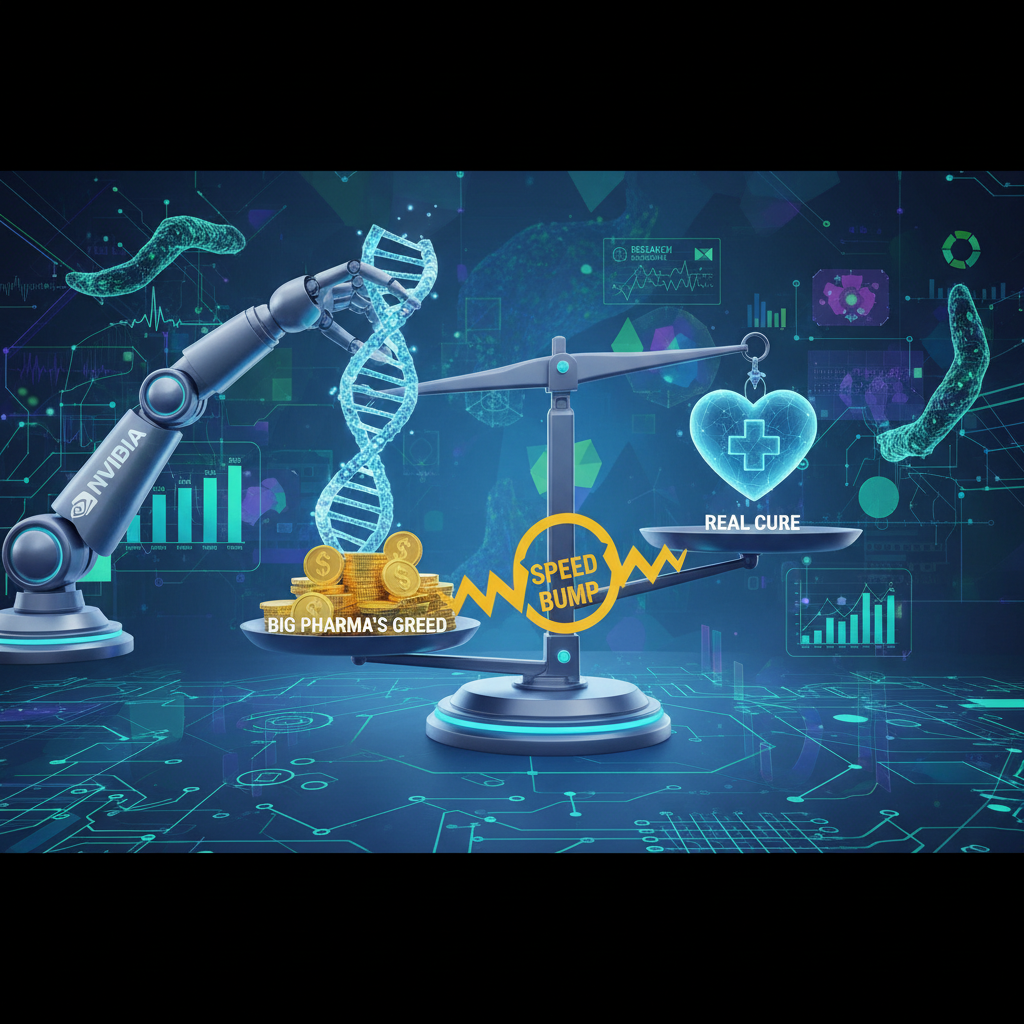

Alright, let's cut through the Silicon Valley smoke and mirrors for a minute. You can't scroll through your feed these days without tripping over another breathless headline about AI revolutionizing drug discovery. From years to months, they say. Faster cures, more accessible medicine, a golden age of pharmaceuticals. Sounds great on paper, right? But I'm Deshawné Thompsòn, and I've got a few questions about who's actually getting cured and who's just getting richer.
For decades, the pharmaceutical industry has been a slow, grinding machine. Think about it: a new drug often takes 10 to 15 years and billions of dollars to go from a lab bench to your local pharmacy. We're talking about a process riddled with failures, astronomical costs, and a whole lot of human suffering in the interim. The traditional pipeline involves target identification, lead compound discovery, preclinical testing, and then those grueling, multi-phase clinical trials. It's a marathon, not a sprint, and the finish line is often just another starting gun for pricing debates and patent wars. This isn't just some abstract problem; it directly impacts millions of Americans waiting for treatments for everything from Alzheimer's to rare cancers.
Enter AI, riding in on its white horse, promising to cut through the red tape and accelerate everything. Companies like NVIDIA, with their powerful GPU architectures, are positioning themselves as the backbone of this new era. They're not just selling chips anymore; they're selling the dream of a faster, more efficient path to life-saving drugs. Startups like Recursion Pharmaceuticals and Exscientia are using AI to sift through billions of molecular compounds, predict drug efficacy, and even design novel molecules from scratch. They claim their algorithms can identify promising candidates in a fraction of the time it takes human researchers, drastically reducing the early-stage R&D timeline.
We're seeing some compelling data points, I'll give them that. Recursion, for instance, has reportedly reduced the time to identify potential drug candidates from years to mere months in some cases. Exscientia, a UK-based company, has already pushed an AI-designed molecule into human clinical trials, a process that typically takes 4.5 years, in just 12 months. That's a significant acceleration, no doubt. The promise is that this efficiency will translate into more drugs, faster, and maybe, just maybe, cheaper. But here's what the tech bros don't want to talk about: efficiency for whom? And at what cost?
I spoke with Dr. Lena Hakim, a bioethicist at Howard University, who put it plainly.