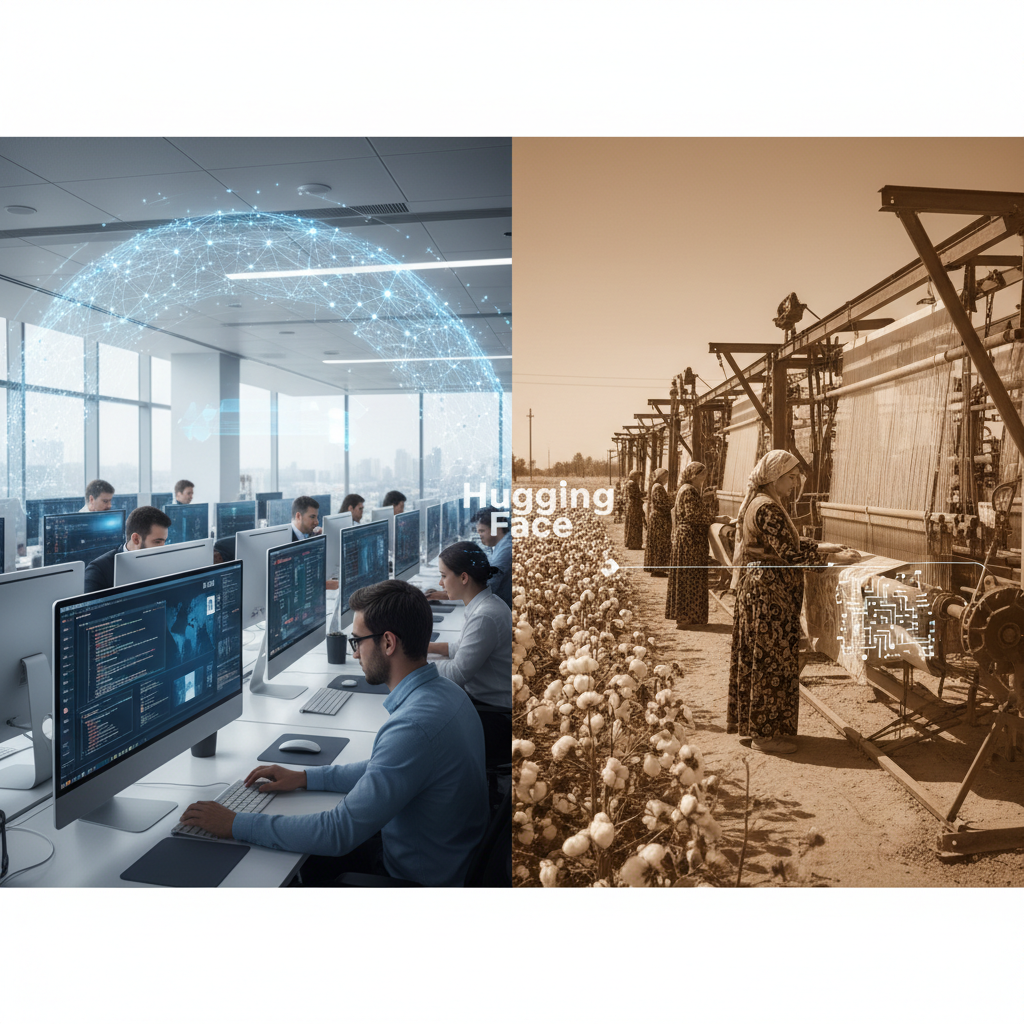

The rhythmic clatter of looms at 'TojTex Group' in Khujand is a familiar sound, a testament to generations of textile craftsmanship. Yet, beneath the traditional hum, something new is at work. Zarina Karimova, a quality control supervisor with two decades of experience, now monitors a dashboard displaying real-time anomaly detection, powered by a fine-tuned open-source model from Hugging Face. "Before, we relied on manual inspection and periodic machine checks," she explains, gesturing to a screen that highlights subtle deviations in thread tension. "Now, the system flags potential issues before they become costly defects. It is not magic, it is data applied intelligently." This scene, far from the venture capital boardrooms of San Francisco, illustrates a quiet but profound shift. While Hugging Face's recent valuation reaching $4.5 billion and its hosting of over one million models capture global headlines, the true measure of its impact, particularly in regions like Central Asia, lies in these practical, often unglamorous, applications.
The reality in Central Asia is different from the headlines. Here, technology adoption is less about speculative growth and more about immediate, tangible returns on investment. Our analysis, drawing from data collected by the Tajik Ministry of Industry and New Technologies, indicates a significant uptick in the deployment of open-source AI solutions across key sectors. In the past 18 months, approximately 18% of small and medium-sized enterprises (SMEs) surveyed in Tajikistan reported experimenting with or actively integrating open-source AI models, a 12-point increase from the previous year. Of these, 65% specifically cited Hugging Face's platform as their primary resource for model acquisition and deployment. This is not a Silicon Valley-style gold rush, but a pragmatic embrace of accessible tools.
Consider the agricultural sector, a cornerstone of Tajikistan's economy. 'Dehqonobod Agro', a collective farm in the Khatlon region, has implemented a localized crop disease detection system. Using satellite imagery and drone data, a vision transformer model, initially sourced from Hugging Face and then retrained on local crop pathology datasets, identifies early signs of blight in cotton fields. "We saw a 7% reduction in crop loss due to early detection in the last growing season," states Rustam Safarov, the farm's agronomist. "More importantly, our pesticide use decreased by 15%, saving us significant costs and reducing environmental impact. This is a Tajik solution for Tajik challenges, built on global open-source foundations." This demonstrates a clear return on investment, not in abstract terms, but in quintals of cotton and liters of water saved.
However, the landscape is not uniformly positive. There are clear winners and losers in this nascent adoption phase. Companies like TojTex Group and Dehqonobod Agro, which invested early in upskilling their existing workforce and collaborated with local technical universities, are seeing measurable gains. TojTex reported a 4% increase in production efficiency and a 6% decrease in material waste since fully integrating their AI quality control system six months ago. Dehqonobod Agro's operational costs decreased by 8.5% year-over-year. These successes are largely attributed to a willingness to adapt and a focus on practical problem-solving.
Conversely, businesses that adopted a 'plug and play' mentality, expecting off-the-shelf models to solve complex, localized problems without significant customization or data preparation, have struggled. Many found that generic models, trained on Western datasets, performed poorly when applied to the nuances of Tajik language, agricultural conditions, or industrial processes. "The initial enthusiasm for AI was high, but some firms quickly faced disillusionment," observes Dr. Gulnora Saidova, Head of the Department of Applied Informatics at the Technological University of Tajikistan. "They underestimated the need for local data, local expertise, and a clear understanding of what these models can and cannot do. A model trained on European wheat varieties will not magically understand our local durum." This highlights a critical lesson: open-source provides the tools, but local context provides the intelligence.
Worker perspectives offer a nuanced view. For Zarina Karimova at TojTex, the AI system is a tool, not a replacement. "It makes my job easier, allowing me to focus on complex issues rather than tedious manual checks," she says. "I was initially worried, but after training, I see its value." Training and reskilling are paramount. A survey of 300 workers in AI-integrating companies revealed that 72% felt more productive, while 28% expressed concerns about job security or the need for more comprehensive training. "The fear is real, but so is the opportunity," notes Davlat Nazarov, a labor union representative. "Our focus must be on ensuring that as technology advances, our workforce advances with it. We need government and industry to invest in continuous education, not just in technology itself." This sentiment underscores the need for a human-centric approach to AI deployment, particularly in economies where labor markets are sensitive to rapid technological shifts.
Expert analysis reinforces this pragmatic outlook. "Hugging Face's success is not just about its valuation, but its democratization of AI," states Dr. Alisher Rahmonov, a senior researcher at the Academy of Sciences of Tajikistan. "It has lowered the barrier to entry for many developers and organizations, enabling them to access, adapt, and deploy sophisticated models without the prohibitive costs associated with proprietary solutions like those from OpenAI or Google. This is particularly vital for developing economies." He emphasizes that while foundational models from major players like Meta's Llama or Google's Gemini are powerful, the true utility often comes from fine-tuning these models on specific, local datasets. "Let's talk about what actually works: tailored solutions, not universal panaceas." This echoes a growing sentiment that open-source AI, when properly leveraged, can foster innovation and self-reliance, rather than simply importing foreign technological paradigms. Reuters has also reported on the increasing global adoption of open-source AI, highlighting its role in fostering localized innovation.
Looking ahead, the trajectory suggests continued, albeit measured, growth. The Tajik government, through initiatives like the 'Digital Tajikistan 2030' strategy, is actively promoting AI literacy and infrastructure development. Plans include establishing regional data centers to facilitate local model training and deployment, reducing reliance on costly international cloud services. Furthermore, collaborations between local universities and industry are expected to deepen, creating a pipeline of skilled AI practitioners. The Ministry of Education projects a 30% increase in AI and data science graduates by 2028, a necessary step to meet the growing demand for specialized talent. The next phase will likely see more sophisticated applications, moving beyond simple classification tasks to predictive analytics in resource management, particularly water, and personalized education platforms. The journey for Tajikistan, and indeed for much of Central Asia, is not about chasing the latest buzzword, but about building sustainable, impactful solutions, one open-source model at a time. The path is clear: leverage global tools, but always with a local hand and a clear eye on practical results. MIT Technology Review has frequently explored how open-source AI is reshaping technological landscapes in emerging economies, a trend that is clearly visible here.