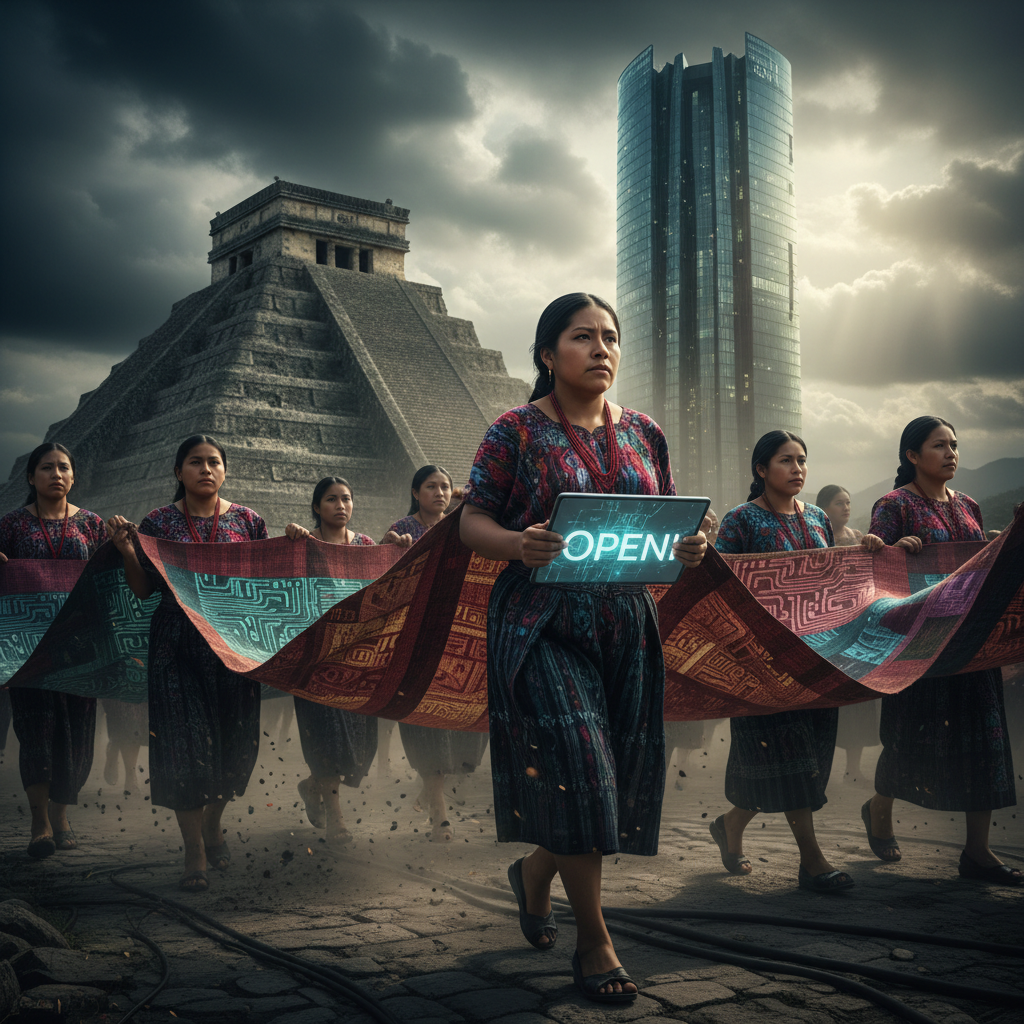

The morning sun, usually a gentle painter of the volcanic peaks surrounding Antigua, feels different today. There is a palpable tension, a hum of urgency that has nothing to do with the bustling markets or the scent of freshly brewed coffee. News has just broken that a collective of Indigenous Mayan textile artists, known as 'Tejedoras del Amanecer' or Weavers of the Dawn, has filed a groundbreaking lawsuit against OpenAI, the creator of ChatGPT and Dall-e. This isn't just another legal skirmish in the global AI copyright war, this is a deeply personal battle for cultural survival, unfolding right here in our beloved Guatemala.
For generations, the intricate patterns woven into huipiles, fajas, and rebozos have told stories of our people, our cosmology, our history. Each thread, each color, each motif carries meaning passed down through oral tradition and practiced skill. Now, these sacred designs, these living libraries of Mayan heritage, are at the heart of a legal challenge that could redefine the relationship between ancient wisdom and cutting-edge artificial intelligence.
The lawsuit, filed in a US federal court, alleges that OpenAI's large language models and image generation systems were trained on vast datasets that included digitized images of traditional Mayan textiles, many of which are protected under Guatemalan cultural heritage laws and international intellectual property agreements. The Tejedoras del Amanecer claim that these designs were ingested and processed without their consent, attribution, or compensation, and are now being replicated and reinterpreted by AI models, effectively commodifying their cultural patrimony for profit.
“It’s like someone came into our homes, took our grandmother’s most precious huipil, copied it, and started selling it in the market without even knowing her name,” said Ixchel Pop, a lead weaver and spokesperson for the collective, her voice trembling with a mixture of anger and determination. “Our patterns are not just pretty pictures, they are our identity. They are prayers. They are our connection to the land and to our ancestors. To see them used by a machine, without respect, it’s a profound violation.”
The breaking news has sent ripples far beyond the tranquil villages of the Western Highlands. Experts and officials across the globe are watching closely. This case could set a precedent for how traditional knowledge and Indigenous cultural expressions are protected in the age of generative AI, particularly in countries with rich, yet often vulnerable, cultural legacies.
Key Details: The Heart of the Claim
The Tejedoras' legal team, working with international human rights lawyers, presented evidence suggesting that OpenAI's training data included numerous images sourced from online ethnographic archives, museum collections, and even commercial photography websites featuring Guatemalan textiles. They argue that the AI models, particularly Dall-e and its subsequent iterations, are capable of generating images that bear striking resemblances to specific, unique Mayan patterns, often without context or cultural understanding. They are seeking significant damages and, crucially, a mandate for OpenAI to implement robust mechanisms for identifying and respecting Indigenous intellectual property in its future training datasets and model outputs.
This is not a small claim. The value of Indigenous intellectual property, often overlooked in global markets, is immense. A 2023 report by the World Intellectual Property Organization, Wipo, estimated the global market for products derived from traditional knowledge and cultural expressions to be in the billions of dollars annually, much of which flows without direct benefit to the originating communities. This lawsuit aims to reclaim a piece of that value.
Official Reactions: A Nation Rises
The Guatemalan government has swiftly reacted to the news. The Minister of Culture and Sports, Dr. Ana María Flores, issued a statement expressing full support for the Tejedoras del Amanecer. “This is a matter of national sovereignty and cultural dignity,” Dr. Flores declared during an impromptu press conference in Guatemala City. “Our cultural heritage is not a free resource for Silicon Valley. We stand with our Indigenous artists and will explore all diplomatic and legal avenues to ensure justice is served and our ancestral knowledge is protected.”
Her sentiments were echoed by the President of the Guatemalan Congress, who emphasized the need for stronger national and international frameworks to safeguard Indigenous intellectual property in the digital realm. The Ministry of Economy is reportedly convening a special task force to assess the economic implications of AI's use of traditional designs and to develop policy recommendations.
Expert Analysis: A Crossroads for AI Ethics
Across the academic and tech worlds, the lawsuit is being dissected with intense interest. Dr. Elena Vargas, a leading scholar in digital anthropology and intellectual property law at the Universidad de San Carlos de Guatemala, believes this case could be a turning point. “For too long, the default has been to treat online data as a public commons, ripe for scraping and use,” Dr. Vargas explained to DataGlobal Hub. “This lawsuit forces a reckoning. It asks: Who owns the patterns, the stories, the knowledge that feeds these powerful AI systems? And what are our ethical obligations to the original creators, especially when those creators come from historically marginalized communities?”
She points out that while copyright law typically protects individual authors and specific expressions, traditional knowledge often exists in a communal, intergenerational context, making its protection under current frameworks challenging. “Her grandmother’s wisdom meets machine learning, and the law is struggling to catch up,” Dr. Vargas noted, highlighting the systemic gaps.
Meanwhile, representatives from OpenAI have yet to issue a detailed public statement beyond acknowledging receipt of the lawsuit and expressing their commitment to ethical AI development. Sources close to the company, however, indicate that this legal challenge is being taken very seriously, especially given the growing scrutiny on AI's training data practices. The tech industry, as a whole, has been grappling with a wave of similar copyright infringement lawsuits from artists, authors, and musicians, but this particular case adds a crucial dimension of Indigenous rights and cultural heritage.
What Happens Next: A Long Road Ahead
The legal process will undoubtedly be complex and protracted. It will involve intricate arguments about data provenance, algorithmic attribution, and the very definition of creativity and ownership in the age of AI. The Tejedoras del Amanecer are not just fighting for monetary compensation, they are fighting for recognition, for respect, and for the right to control their own cultural narrative. They seek to establish a precedent that ensures future AI development is not built on the unacknowledged labor and heritage of Indigenous peoples.
This case will likely compel AI developers to re-evaluate their data collection practices, potentially leading to the development of more transparent and ethically sourced datasets. It could also spur the creation of new legal and technological mechanisms for licensing and attributing traditional knowledge, ensuring that the benefits of AI are shared more equitably.
Why Readers Should Care: The Human Face of AI's Impact
This is more than a legal battle between a small group of weavers and a tech giant. This is a story about resilience, about the human spirit standing up against the impersonal forces of technology. It is a stark reminder that as AI rapidly advances, we must not forget the human cost, the cultural erosion, and the ethical dilemmas that often accompany progress. The patterns woven by the Tejedoras del Amanecer are not just fabric; they are a testament to a way of life, a connection to the earth, and a profound wellspring of human creativity. Their fight is a fight for all of us to ensure that the digital future respects the richness of our past and the diversity of our present.
As the sun sets over the ancient city of Antigua, casting long shadows across cobblestone streets, the resolve of the Tejedoras del Amanecer shines bright. Their lawsuit is a beacon, illuminating the urgent need for a more just and equitable AI ecosystem, one that honors the creators, whether they work with code or with cotton threads. The world is watching, and the outcome of this case will undoubtedly shape the future of AI and cultural heritage for generations to come. For more on the broader AI copyright discussions, you can read analyses on Reuters Technology or Wired's AI section. The implications for global tech policy are immense, as detailed by outlets like MIT Technology Review. This story will continue to develop, and DataGlobal Hub will be following every thread.