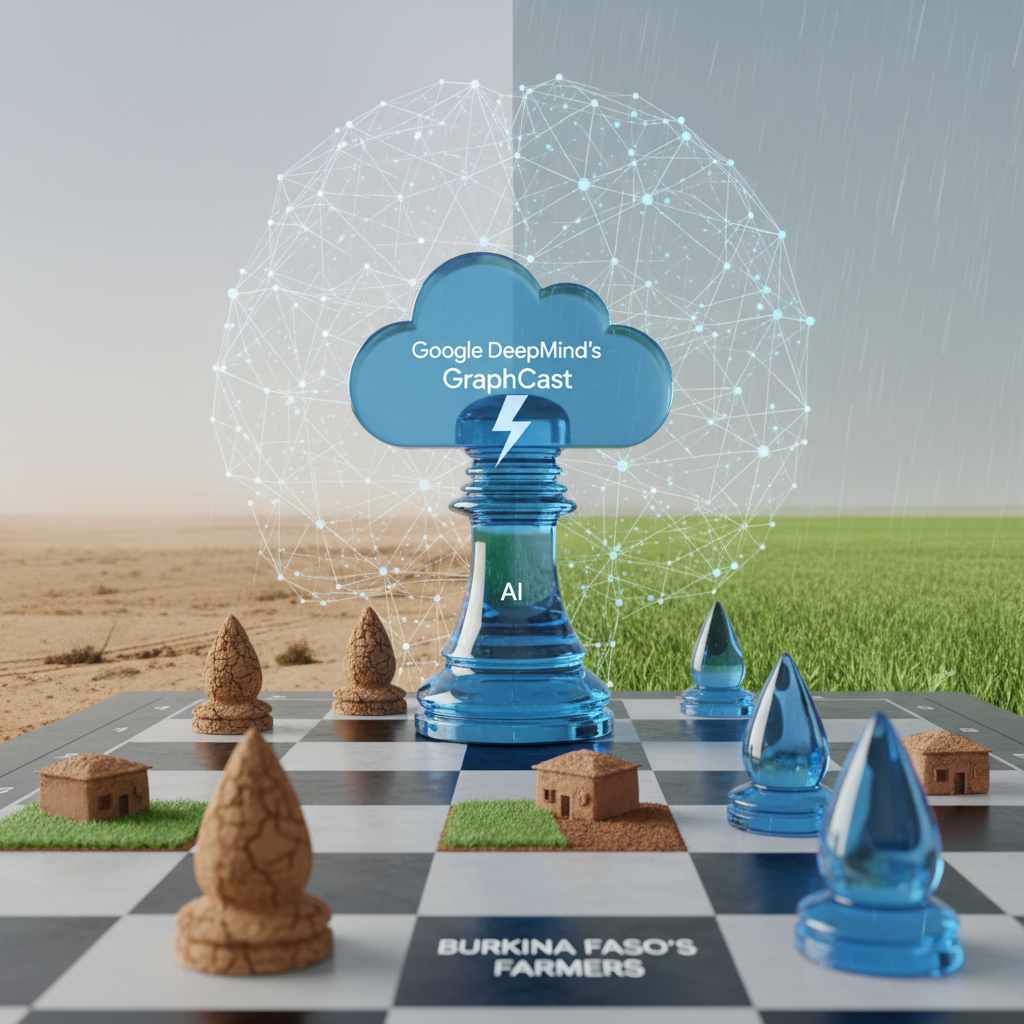
The dusty season in Ouagadougou can feel endless, a relentless reminder of how much we depend on the skies. Here, in Burkina Faso, the rhythm of life, the very survival of our communities, is dictated by the rains. When they come, how much, and when they stop, these are not abstract questions, they are matters of life and death, of food on the table or empty granaries. So, when I hear about AI models like Google DeepMind's GraphCast promising weather forecasts that outperform traditional models by orders of magnitude, my ears perk up. But my skepticism, honed by years of watching grand pronouncements from afar, remains. Is this a real solution, or just another Silicon Valley fantasy?
The strategic move by Google DeepMind, with its GraphCast model, represents a significant leap in meteorological prediction. Announced with much fanfare, GraphCast leverages machine learning to predict weather patterns up to 10 days in advance with accuracy reportedly surpassing the European Centre for Medium-Range Weather Forecasts, or Ecmwf, a global benchmark. This isn't just a marginal improvement, we are talking about a potential paradigm shift. For a region like the Sahel, where climate change has made traditional weather patterns erratic and extreme, such precision could be revolutionary.
Context and motivation are clear. Traditional numerical weather prediction models, while sophisticated, are computationally intensive and rely on complex physics equations. They require supercomputers and vast amounts of observational data, which can be scarce in many parts of Africa. AI models, particularly those based on neural networks, learn directly from historical weather data. They can identify subtle patterns and relationships that might elude traditional methods, and once trained, they can generate forecasts much faster. Google's motivation is multi-faceted: scientific leadership, showcasing AI's real-world impact, and potentially, creating new markets for their cloud computing infrastructure. For us, the motivation is simpler: survival.
Competitive analysis reveals a landscape where several players are vying for dominance in AI weather. Beyond Google DeepMind, companies like NVIDIA are investing heavily in AI for climate science, offering platforms and tools for researchers. The Ecmwf itself is exploring AI integration into its operations. China's Huawei has also made strides with its Pangu-Weather model, claiming similar levels of accuracy. The competition is fierce, but the common thread is the recognition that AI can unlock new levels of precision. However, the critical question for us is not just who has the best model, but whose model is accessible, adaptable, and actionable for the specific challenges faced by Burkinabè farmers. The reality on the ground is that a forecast, no matter how accurate, is useless if it cannot be understood or acted upon.
The strengths of GraphCast are undeniable. Its reported accuracy in predicting extreme weather events, tropical cyclones, and atmospheric rivers is impressive. For a country that regularly faces droughts and floods, knowing with greater certainty when a heavy rainfall event might occur, or when a dry spell will prolong, could allow for better planning of planting and harvesting cycles, and crucially, for early warning systems. Imagine our Ministry of Agriculture, or even local agricultural cooperatives, receiving highly localized, reliable forecasts days in advance. This could transform food security.
However, weaknesses persist. The first is data dependency. While AI models learn from data, the quality and density of historical weather data in many African regions are often poor. If the model is trained on data from temperate zones, how well will it truly perform in the unique climatic conditions of the Sahel? This is not a trivial concern. Secondly, the 'black box' nature of some AI models can make them difficult to interpret and trust, especially for end-users who need to understand why a prediction is being made. Trust is paramount when lives and livelihoods are at stake. Thirdly, the infrastructure required to disseminate these sophisticated forecasts to rural populations is often lacking. A farmer in a remote village near Bobo-Dioulasso does not have access to a supercomputer or a high-speed internet connection to download complex meteorological maps. This is where the gap between innovation and impact often widens.
I spoke with Dr. Ousmane Zongo, a meteorologist at the National Agency of Meteorology in Burkina Faso, about these developments. He acknowledged the potential, saying, “These AI models are powerful tools, no doubt. But the challenge for us is not just adopting the technology, it is integrating it into our existing systems, training our personnel, and most importantly, translating these high-resolution outputs into actionable advice for our communities. A 10-day forecast is excellent, but if it cannot be communicated effectively to the farmer deciding when to sow his millet, then its value is diminished.” His words resonate deeply. It is not enough to have the best prediction; we need the best delivery mechanism.
Furthermore, the cost implications cannot be ignored. While Google might offer some services freely or at reduced rates for research, the long-term sustainability of relying on external, proprietary AI models for such a critical national service needs careful consideration. Burkina Faso, like many developing nations, needs solutions that foster local capacity and sovereignty, not just dependency. We need to be partners in this technological evolution, not just recipients.
Verdict and predictions: Google DeepMind's GraphCast, and similar AI weather models, represent a monumental step forward in scientific forecasting. Their potential to save lives and improve agricultural yields in climate-vulnerable regions is immense. However, for this potential to be realized in Burkina Faso, a multi-pronged strategy is essential. First, there must be investment in local data collection infrastructure, improving the density and quality of meteorological observations across the country. Second, there needs to be a concerted effort to build local capacity in AI and data science, allowing Burkinabè experts to understand, adapt, and even develop their own models. Third, and perhaps most critically, is the development of robust, accessible, and culturally appropriate dissemination channels. This means leveraging radio, local languages, and community leaders to ensure forecasts reach the last mile.
Forget the hype, this is what matters: the actual impact on people's lives. Without these foundational elements, even the most advanced AI weather forecast remains a distant promise, a digital mirage in a land desperate for rain. The strategy cannot end with a superior algorithm; it must extend to the fields where our farmers toil, and to the homes where families wait for the harvest. The future of weather forecasting in Burkina Faso will not be solely determined by the power of AI, but by our collective ability to bridge the gap between cutting-edge technology and the everyday realities of our people. The path forward requires collaboration, investment, and a deep understanding of local needs, not just algorithmic prowess. MIT Technology Review often covers the broader implications of such technologies, but the granular, on-the-ground challenges are rarely the headline. We need to make them the focus. We need to ensure that the promise of AI weather forecasting translates into tangible benefits, not just impressive statistics in a research paper. Reuters has reported on the global race for AI supremacy, but for us, it is a race for resilience.