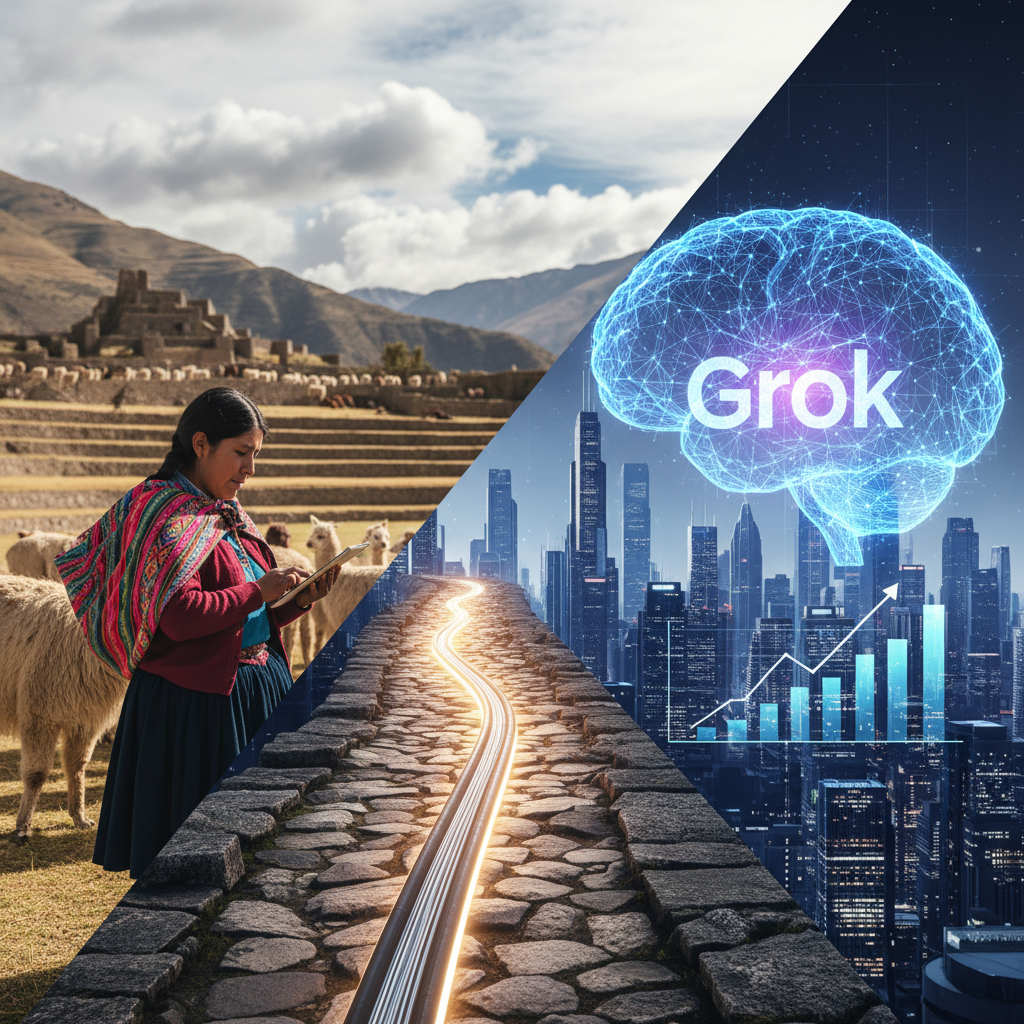
The crisp Andean air carries whispers of change, not just from the rustling cornfields or the bustling markets of Cusco, but from the digital realm. Elon Musk, a name that evokes both awe and skepticism across the globe, has unleashed xAI and its conversational chatbot, Grok, onto a world already captivated by OpenAI's ChatGPT. But for us in Peru, particularly those of us who see technology through the lens of our rich history and vibrant communities, the question is not just about who builds the fastest or smartest AI. It is about how these intelligences are built, and what values they carry.
I recently found myself in the Sacred Valley, a place where the mountains themselves seem to hum with ancestral knowledge. I was speaking with Mateo Quispe, a Quechua elder and agricultural innovator, who uses a simple smartphone to track weather patterns for his quinoa crops. He showed me something that changed my understanding of what AI truly means for people like him. He had been experimenting with a local AI-powered agricultural app, one designed with Peruvian farmers in mind, and he spoke of its 'respect' for the land and its rhythms. "It understands our needs," he told me, his eyes crinkling at the corners, "not just what the market demands."
This encounter made me think deeply about Grok's stated philosophy. Musk and his team at xAI claim Grok is designed to be more 'rebellious,' more 'truth-seeking,' and less constrained by the guardrails that often shape other large language models. They promise an AI that can tackle controversial topics, offer diverse perspectives, and even inject a dose of humor. It is an intriguing proposition, especially when compared to the more cautious, often curated responses we see from models like Google's Gemini or OpenAI's GPT-4. But what does 'truth-seeking' mean when truth itself is so often a tapestry woven from countless cultural threads?
Here in Peru, our relationship with information, with knowledge, is deeply rooted in oral traditions and community consensus. The idea of an AI that is 'unfiltered' can be both exciting and daunting. On one hand, it could offer unprecedented access to global information, perhaps even helping to bridge the digital divide that still separates so many of our rural communities from the interconnected world. Imagine a Grok that could instantly translate ancient Quechua texts into Spanish, or help a small artisan in Puno understand global market trends in real time. The possibilities are vast.
However, there is also a profound concern. An AI that is truly 'rebellious' might also be an AI that is less sensitive to cultural nuances, to the delicate balance of respect and tradition that underpins so much of Peruvian society. "We need AI that understands context, not just content," explained Dr. Sofia Vargas, a computational linguist at the Pontificia Universidad Católica del Perú. "A truly 'unfiltered' AI could inadvertently spread misinformation or disrespect cultural sensitivities if it is not trained with a deep understanding of diverse worldviews. It is not just about raw data, it is about wisdom."
Indeed, the training data for these massive models is a constant point of discussion. While OpenAI and Google have been somewhat opaque about their exact datasets, xAI has indicated Grok leverages real-time data from the X platform, formerly Twitter. This gives Grok a unique, immediate pulse on global conversations, but also exposes it to the unfiltered chaos, biases, and sometimes harmful content that proliferates on social media. This is a story about ancient wisdom meeting modern AI, and the collision points are fascinating.
For Peruvian financial institutions, the arrival of more diverse AI models like Grok presents a complex challenge and opportunity. Our fintech sector is booming, with startups leveraging AI for everything from micro-lending in remote villages to fraud detection in Lima's bustling financial district. "The promise of real-time intelligence from Grok could revolutionize our risk assessment models," stated Ricardo Peña, CEO of 'Andean FinTech Solutions,' a Peruvian startup specializing in financial inclusion. "Imagine an AI that can analyze emerging economic trends from social media conversations in specific regions of Peru, giving us an edge in predicting market shifts. It is a powerful tool, but one that requires careful ethical oversight."
Peña's firm, like many others, has invested heavily in developing AI solutions that are culturally attuned. They understand that a financial product designed for a farmer in Ayacucho needs a different approach than one for a city dweller in Miraflores. The 'one-size-fits-all' approach of some global AI models simply does not work here. This is where Grok's 'different philosophy' could either shine or stumble. If it truly embraces diverse perspectives in its architecture, it could be a game-changer. If its 'rebelliousness' translates into a disregard for local context, it could prove problematic.
The global AI landscape is a battleground of philosophies. OpenAI, backed by Microsoft, often emphasizes safety and alignment, though not without its own controversies. Anthropic, with its Claude models, champions constitutional AI, aiming for systems that adhere to a set of guiding principles. Then there is xAI, with Elon Musk at the helm, pushing for an AI that is less inhibited, more direct, and perhaps, more human in its flaws and brilliance. According to TechCrunch, the competition among these giants is accelerating innovation at an unprecedented pace, but also raising questions about the future direction of AI development.
One of the most compelling aspects of Grok, from a Peruvian perspective, is its potential for real-time information processing. In a country often affected by natural phenomena, from El Niño to seismic activity, immediate access to information can be life-saving. Could Grok become a vital tool for disaster preparedness, sifting through vast amounts of data, including local reports and social media, to provide early warnings and actionable insights? It is a hopeful vision, one that resonates deeply with our need for resilience.
However, the ethical implications cannot be overlooked. The very 'unfiltered' nature of Grok means it could potentially amplify biases present in its real-time data sources. "We have seen how social media algorithms can polarize communities," noted Dr. Elena Rojas, a sociologist studying digital divides at the Universidad Nacional Mayor de San Marcos. "An AI that feeds directly from that stream, without robust mechanisms for critical evaluation and cultural sensitivity, risks exacerbating existing inequalities or even creating new ones. The idea of 'truth' must be carefully defined, especially when it comes from an algorithm."
The Peruvian government, through its Ministry of Production, has been cautiously exploring AI's role in economic development. Initiatives to integrate AI into sectors like agriculture, tourism, and small businesses are underway. The arrival of a new, powerful player like xAI and Grok adds another layer of complexity to these discussions. Regulators will need to consider how to harness the potential benefits while mitigating the risks, particularly in areas like data privacy and algorithmic bias. The MIT Technology Review frequently highlights the global challenges in AI governance, a topic that is particularly relevant for developing nations like ours.
Ultimately, the story of Grok in Peru is not just about technology. It is about people, about communities, and about the delicate dance between progress and preservation. It is about how we, as Peruvians, choose to integrate these powerful new tools into our lives, ensuring they serve our values and empower our unique cultural identity. Will Grok's 'rebellious' spirit align with our own, or will it present a new set of challenges to navigate? Only time, and our collective wisdom, will tell.