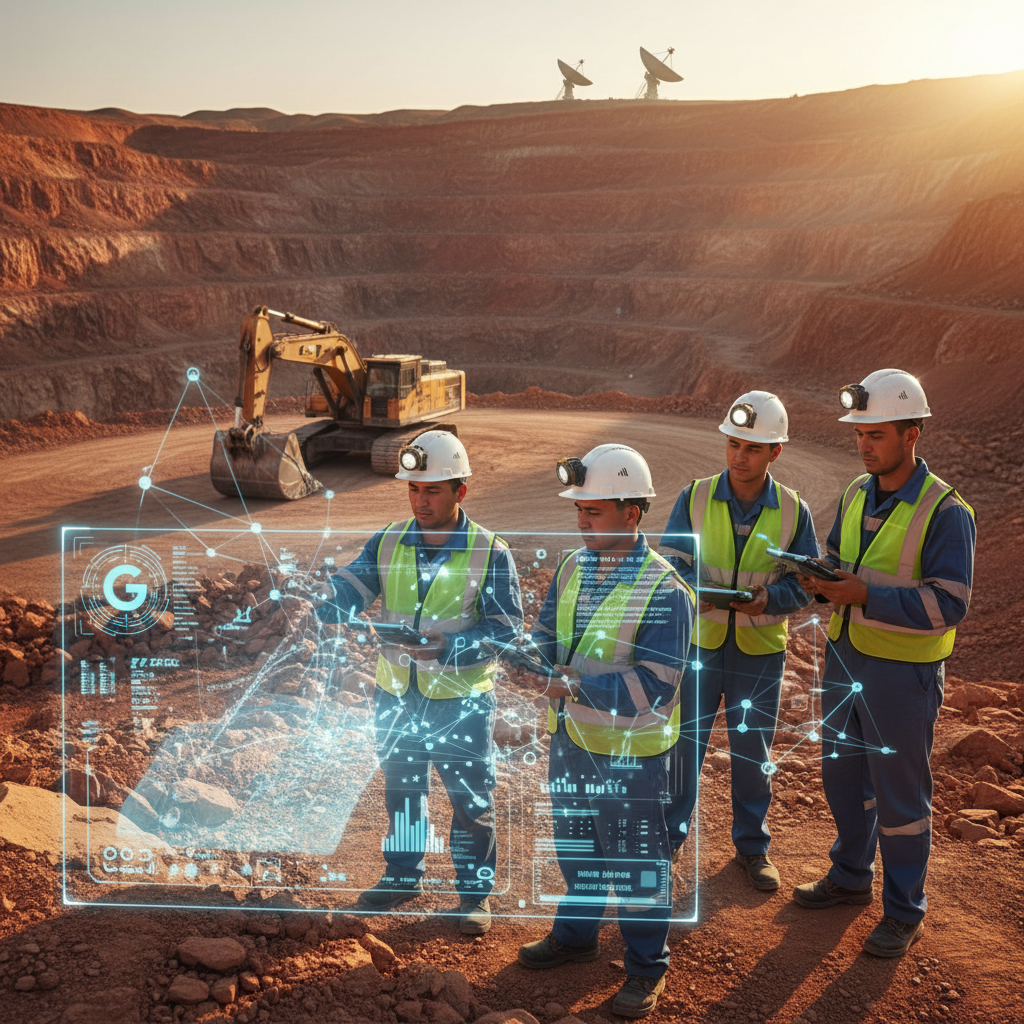

The sun beats down relentlessly on the Kyzylkum Desert, painting the vast landscape in shades of ochre and gold. For centuries, this land has held secrets, treasures buried deep within its ancient crust. Here in Uzbekistan, mining is not just an industry, it is a legacy, a rhythm that pulses through the veins of our nation. But today, the traditional sounds of picks and shovels are increasingly accompanied by the hum of servers and the whisper of algorithms. We are witnessing a profound transformation, one where artificial intelligence is becoming as vital as the geologist's hammer or the miner's lamp.
I recently traveled to a remote mining site, nestled deep within the Navoi region, a place where the earth generously yields its gold. It was there I met Dilshod Karim, a veteran geologist with eyes that have seen more rock formations than most people have seen clouds. "For years, we relied on intuition, on seismic data that was good, but often left us guessing," Dilshod told me, wiping dust from his brow. "Now, with AI, it is like the earth itself is speaking to us, telling us exactly where to look. We are finding deposits we never knew existed, with a precision that was unimaginable just a few years ago."
This is not a story of Silicon Valley giants imposing their will, but rather a collaboration, a meeting of minds between global tech and local expertise. Google's AI platform, specifically their advanced machine learning models, is being deployed by state-owned enterprises like Navoi Mining and Metallurgy Combinat (nmmc) to analyze vast datasets. These datasets include historical geological surveys, satellite imagery, hyperspectral data, and even micro-seismic readings. The AI sifts through terabytes of information, identifying subtle patterns and anomalies that human eyes, no matter how experienced, might miss. It is a powerful tool, one that promises to unlock Central Asia's best-kept secret, its untapped mineral wealth.
"We are seeing an increase in exploration success rates by nearly 30 percent in some areas," shared Dr. Gulnara Saidova, Head of Digital Innovation at the State Committee for Geology and Mineral Resources of Uzbekistan, during a recent conference in Tashkent. "This translates directly into billions of dollars in potential new reserves. The AI models, trained on our unique geological signatures, are becoming incredibly adept at predicting where gold, copper, and uranium deposits are most likely to be found. It is a game changer for our national economy." Dr. Saidova emphasized that this is not just about finding more, but finding smarter, reducing the environmental footprint of exploratory drilling.
The impact extends far beyond exploration. Once a deposit is identified, AI is proving invaluable in optimizing the extraction process. Predictive analytics, powered by companies like NVIDIA with their powerful GPUs, are being used to model rock fragmentation, predict equipment failures, and fine-tune blasting patterns. This leads to more efficient resource recovery and less waste. Imagine a massive open-pit mine, where every shovel movement, every truck route, is orchestrated by an intelligent system designed for maximum output and minimum energy consumption. This is the reality emerging in places like Muruntau, one of the world's largest gold mines.
But perhaps the most profound application of AI in our mines is in safety. Mining has always been a dangerous profession, a constant dance with risk. In a small office in Tashkent, I saw a demonstration that truly moved me. A young engineer, Azizbek Rustamov, showed me something remarkable. He presented a real-time monitoring system, developed with the help of local AI startups and utilizing computer vision algorithms from Google's Cloud AI services. This system uses cameras and sensors deep within underground shafts to detect anomalies, predict rockfalls, and monitor air quality. It can even track the precise location of every miner, ensuring rapid response in case of an emergency.
"Before, safety was reactive. Now, it is proactive," Azizbek explained, his voice filled with pride. "The AI can identify potential hazards hours, sometimes days, before they become critical. It analyzes seismic vibrations, ground deformation, and even the subtle sounds of shifting earth. We have seen a significant reduction in minor incidents, and the potential to prevent major accidents is enormous. For our miners, this means coming home safely to their families, and that is a value beyond any gold." According to internal reports from Nmmc, the implementation of these AI-driven safety protocols has led to a 25% decrease in workplace incidents over the past year, a statistic that speaks volumes about the human impact of this technology.
Of course, this journey is not without its challenges. Integrating complex AI systems into existing infrastructure requires significant investment and upskilling of the workforce. There is a continuous need for data scientists, AI engineers, and technicians who understand both the intricacies of machine learning and the harsh realities of a mine. Educational institutions across Uzbekistan, like the Tashkent State Technical University, are rapidly adapting their curricula to meet this growing demand, creating a new generation of digital miners.
As I left the Kyzylkum, the setting sun cast long shadows across the desert. The landscape, ancient and timeless, now hums with a new kind of energy. It is the energy of innovation, of human ingenuity amplified by artificial intelligence. Uzbekistan is not just extracting minerals from the earth; we are extracting insights, forging a future where our rich natural resources are managed with unprecedented intelligence and care. This is a testament to what happens when tradition meets technology, when the wisdom of the land is illuminated by the power of algorithms. It is a story of progress, carefully written by the people who call this land home, and understood through the lens of a new digital era. For more insights into how AI is transforming industries globally, you can explore reports on MIT Technology Review. The journey of AI in mining, particularly in regions like ours, is just beginning, promising a future that is both prosperous and safer for all involved. For a broader perspective on AI's impact on global industries, Reuters Technology offers extensive coverage. We are building a future not just for profit, but for people, ensuring that the wealth beneath our feet benefits every citizen, safeguarded by the smartest tools at our disposal. You can also find more about general AI developments on The Verge AI section.