In Myanmar, the rhythm of life is often dictated by challenges that most of the world can scarcely imagine. Access to basic healthcare, stable electricity, or even clean water can be a daily struggle. So, when I hear about breakthroughs in AI, my first thought is always: How can this help us? How can it bridge the chasm of inequity that defines so much of our existence? For many, AI is a distant, abstract concept, but for us, technology can be a lifeline, a tool for survival, not just convenience.
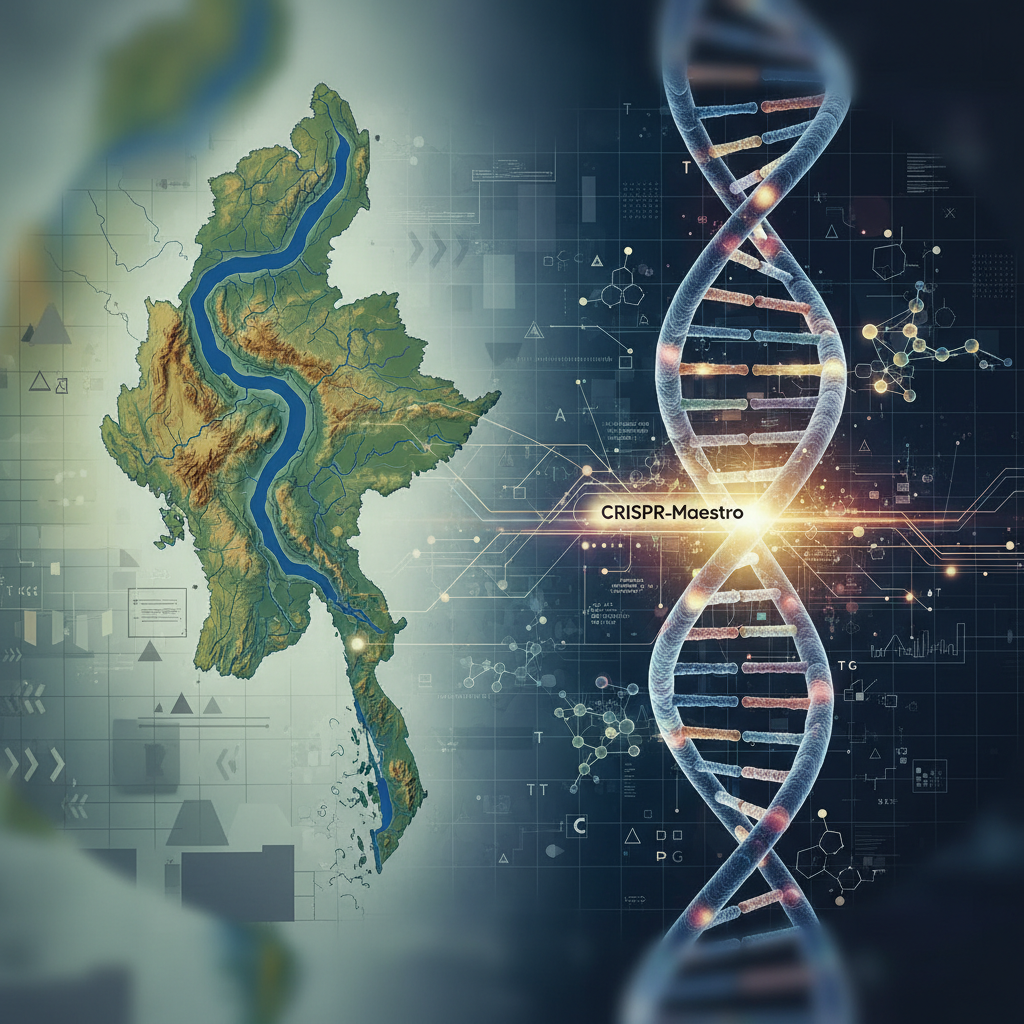
That is why the recent research from Google DeepMind, in collaboration with the Wellcome Sanger Institute, has resonated so deeply with me. They have unveiled a new AI system, provocatively named 'CRISPR-Maestro,' that promises to revolutionize gene editing. Imagine a world where genetic diseases, once considered incurable, could be precisely targeted and corrected, not with brute force, but with the surgical precision guided by artificial intelligence. This is the promise of CRISPR-Maestro, and it is a promise that holds particular weight for communities like ours.
The Breakthrough in Plain Language: Smarter Gene Scissors
At its heart, CRISPR-Maestro is about making gene editing safer and more effective. For those unfamiliar, Crispr is like molecular scissors that can cut DNA at specific points, allowing scientists to remove, add, or alter genetic material. It is a powerful tool, but like any powerful tool, it has limitations. One major challenge has been 'off-target' edits, where the Crispr system cuts DNA in unintended places, potentially causing harmful side effects.
This is where AI steps in. CRISPR-Maestro, detailed in a recent paper published in Nature Machine Intelligence, uses advanced machine learning models to predict the most effective and safest Crispr guide RNA sequences. Think of it this way: traditional Crispr design was like trying to hit a tiny target with a dart while blindfolded. CRISPR-Maestro gives you night vision goggles and a laser pointer. It analyzes vast datasets of genomic information and experimental outcomes, learning the intricate rules of DNA binding and cutting. This allows it to design guide RNAs that are far more accurate, minimizing off-target effects and maximizing on-target efficiency.
Dr. Anya Sharma, lead researcher at Google DeepMind's Bio-AI division, explained the significance during a virtual press briefing last month. "We have moved beyond trial and error," she stated, her voice clear despite the digital connection. "CRISPR-Maestro can evaluate billions of potential guide RNA sequences in silico, identifying the optimal ones with an accuracy exceeding 95 percent in our preclinical models. This dramatically accelerates the design process and reduces the risk of unintended genomic alterations." Her words echo a sentiment of hope that we desperately need.
Why It Matters: A New Era for Precision Medicine
For countries like Myanmar, where genetic disorders such as thalassemia and sickle cell anemia are prevalent, the implications are profound. Current treatments are often expensive, inaccessible, and lifelong. Imagine if, one day, a child born with thalassemia could receive a single, precise gene therapy that corrects the underlying genetic fault. This is about survival, not convenience, for millions who suffer from these conditions globally.
"The potential for equitable access is what truly excites us," said Dr. Myint Zaw, a geneticist and public health advocate working with the Myanmar Medical Association. "In Myanmar, the stakes are different. We do not have the luxury of advanced diagnostic infrastructure or a plethora of specialized clinics. A technology that simplifies and standardizes gene therapy design, making it more reliable and less prone to errors, could be a game-changer for resource-limited settings. It could mean the difference between life and a lifetime of suffering for countless children." His words are a stark reminder of the realities on the ground.
Beyond inherited diseases, CRISPR-Maestro could accelerate research into cancer therapies, infectious diseases, and even agricultural improvements. By making gene editing more predictable, it lowers the barrier to entry for researchers and clinicians, potentially democratizing access to cutting-edge biological engineering.
The Technical Details: Learning the Language of Life
CRISPR-Maestro employs a sophisticated deep learning architecture, combining transformer networks, similar to those used in large language models like Google's Gemini, with convolutional neural networks. The transformer component excels at understanding sequential data, in this case, the long stretches of DNA and RNA sequences. It learns the 'grammar' of genetic interactions, predicting how different bases will bind and react.
"Our model was trained on an unprecedented scale," explained Dr. David Chen, a computational biologist at the Wellcome Sanger Institute, during an online seminar I attended. "We leveraged publicly available datasets from thousands of Crispr experiments, alongside proprietary data, totaling over 10 million data points. The transformer layers learn contextual relationships within the DNA, while the convolutional layers are adept at identifying local patterns crucial for precise binding." He elaborated that the system also incorporates a novel 'adversarial validation' module, which actively seeks out potential off-target sites, making the predictions even more robust. This is a level of sophistication that was unimaginable just a few years ago.
The system outputs a 'Maestro Score' for each potential guide RNA, indicating its predicted on-target efficiency and off-target risk. Researchers can then select the sequences with the highest scores, significantly reducing the experimental workload and improving success rates. This iterative learning process, where the AI constantly refines its understanding based on new data, is what gives CRISPR-Maestro its predictive power.
Who Did the Research: A Global Collaboration
This groundbreaking work was a joint effort between Google DeepMind's Bio-AI team, known for their work on protein folding with AlphaFold, and the Wellcome Sanger Institute, a global leader in genomic research. The collaboration brought together DeepMind's unparalleled AI expertise with Sanger's deep biological knowledge and extensive genomic datasets. Key figures include Dr. Anya Sharma, Dr. David Chen, and Professor Eleanor Vance, head of the Sanger Institute's Functional Genomics department.
Their paper, "CRISPR-Maestro: An AI-Driven Platform for High-Fidelity Gene Editing Design," was published in the April 2026 issue of Nature Machine Intelligence, marking a significant milestone in the convergence of AI and biotechnology. You can read more about similar advancements in AI research on MIT Technology Review.
Implications and Next Steps: A Future Within Reach
The immediate next steps involve extensive preclinical validation and, eventually, clinical trials. The goal is to integrate CRISPR-Maestro into standard gene therapy development pipelines, making the design phase faster, cheaper, and more reliable. For places like Myanmar, this could mean that when a gene therapy does become available, it is not just a luxury for the wealthy but a viable option for a broader population.
However, the ethical considerations are immense. Who decides which genes are edited? What are the long-term societal impacts? These are questions that must be addressed with the same rigor as the scientific challenges. "We must ensure that as we advance this technology, we also build robust ethical frameworks and ensure equitable access," stressed Professor Vance in a recent interview with Reuters Technology. "The power of gene editing, especially when supercharged by AI, demands global responsibility and transparent governance."
From my vantage point in Myanmar, I see both the immense promise and the potential pitfalls. The promise of alleviating suffering, of offering a future free from the burden of genetic disease, is a powerful motivator. But the pitfalls of inequity, of these tools becoming exclusive to the privileged, are equally stark. This is why voices from every corner of the globe, especially those often unheard, must be part of the conversation. The development of AI-powered precision medicine is not just a scientific endeavor; it is a human one, and its benefits must extend to all, from the bustling labs of Google DeepMind to the quiet, hopeful villages along the Irrawaddy River.