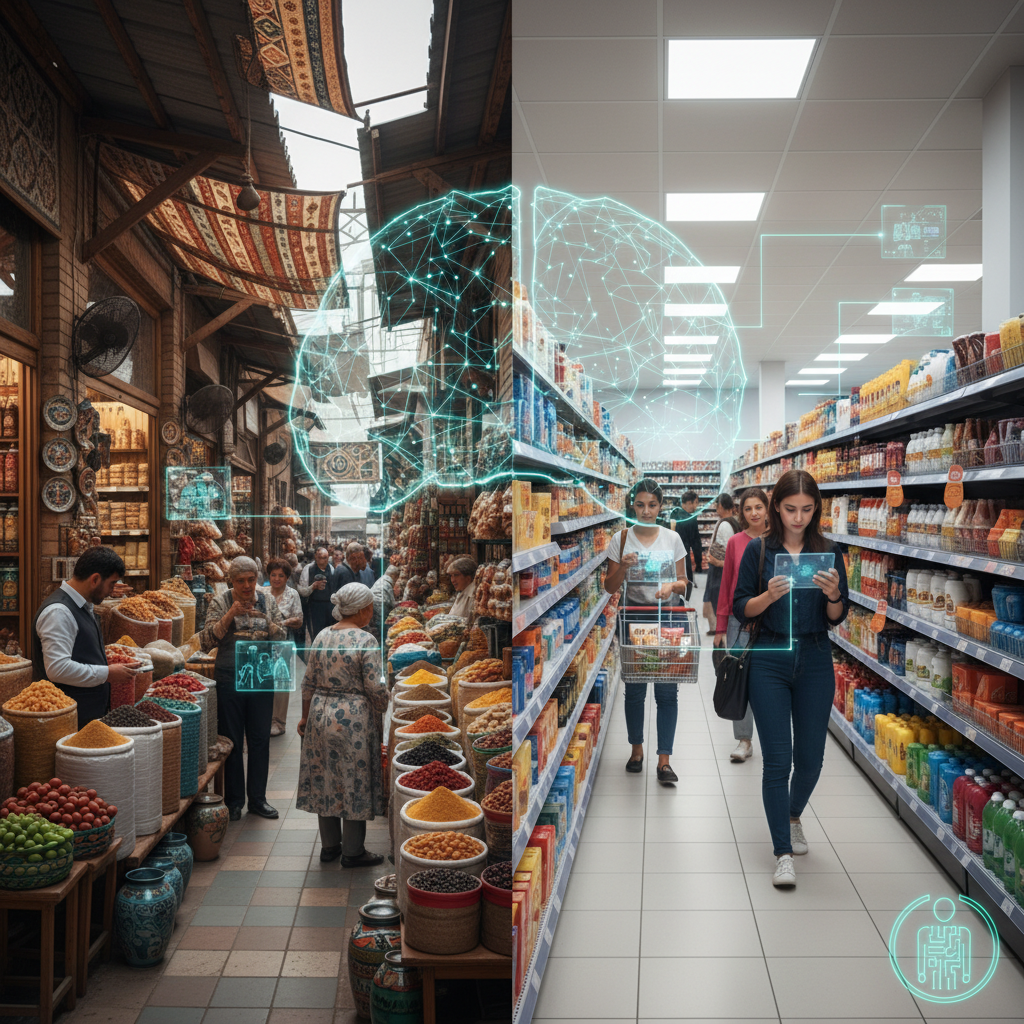

The scent of freshly baked non, the vibrant colors of ikat fabric, the lively chatter of vendors negotiating prices. These are the sounds and smells of Uzbekistan's bazaars, places where commerce is a deeply human, personal exchange. For centuries, our merchants have relied on intuition, experience, and a keen understanding of their customers to thrive. But what happens when that ancient wisdom meets the cold, calculating power of artificial intelligence? The answer, I believe, is not a replacement, but a profound evolution, one that is already reshaping retail from the bustling streets of Tashkent to the digital storefronts of the world.
The Headline Development: AI's Quiet Takeover of Your Shopping Cart
Walk into any modern supermarket or browse an online store today, and you are interacting with AI, whether you realize it or not. This isn't science fiction; it is the everyday reality of retail in April 2026. Companies like Amazon, Walmart, and even smaller, regional chains are leveraging sophisticated AI models for three critical functions: demand forecasting, inventory optimization, and personalized shopping experiences. They are predicting what you will buy, making sure it is available, and presenting it to you in a way that feels uniquely tailored to your tastes.
Demand forecasting, once a laborious manual process, is now largely automated. AI algorithms analyze vast datasets, including historical sales, seasonal trends, weather patterns, social media sentiment, and even local events, to predict with remarkable accuracy what products will be in demand. For instance, a sudden cold snap in Samarkand might trigger an AI system to increase orders for warm coats and tea, long before human buyers would react. This precision reduces waste and ensures shelves are stocked with what people actually want.
Following closely is inventory optimization. Once demand is predicted, AI determines the optimal stock levels, where to store items, and when to reorder. This minimizes both overstocking, which ties up capital and leads to spoilage, and understocking, which results in lost sales and frustrated customers. Imagine a world where your favorite brand of Uzbek halva is always available, never out of stock, because an algorithm anticipated its popularity. This efficiency saves retailers billions globally and translates into better prices and availability for consumers.
Finally, and perhaps most visibly, there is personalized shopping. From the recommendations you see on an e-commerce site to the coupons you receive in your email, AI is working to understand your preferences. It learns from your past purchases, browsing history, and even how long you linger on certain product pages. This allows retailers to create bespoke experiences, showing you products you are genuinely likely to buy. It is like having a personal shopper who knows your tastes intimately, without ever having met you.
Why Most People Are Ignoring It: The Invisible Hand of Algorithms
For many, these advancements feel less like a revolution and more like a subtle shift. The magic of AI in retail often happens behind the scenes, an invisible hand guiding the flow of goods and information. We notice when a product is out of stock, but rarely appreciate the complex systems that keep it on the shelf. We enjoy relevant recommendations, but seldom ponder the algorithms that generate them. This quiet integration means AI's impact often goes unnoticed by the average shopper, who is more concerned with finding a good deal or a specific item than with the technology enabling it.
Furthermore, the narrative around AI often focuses on the dramatic: self-driving cars, generative art, or superintelligent robots. The practical, economic applications in sectors like retail, while immensely impactful, lack the same sensational appeal. It is harder to get excited about optimized supply chains than about a chatbot writing poetry. This attention gap means the profound changes happening in our everyday commerce are often overlooked.
How It Affects YOU: More Than Just Convenience
This isn't just about big businesses; it affects you directly, Bintà's dear reader. For starters, it means a more convenient shopping experience. Products you want are more likely to be available, reducing frustrating searches. Online recommendations become genuinely helpful, saving you time and introducing you to items you might love. It is about less waste, which can translate to more competitive pricing over time, putting more money back into your pocket.
Consider the small business owner in a regional town in Uzbekistan. Perhaps a craftswoman selling intricate suzani embroideries. With AI tools, even a small shop can gain insights into what patterns are most popular, when to stock up for tourist season, or how to personalize recommendations for online customers. This levels the playing field, allowing local artisans to compete more effectively in a global marketplace. It means more choice for you, and greater opportunities for them.
The Bigger Picture: Reshaping Economies and Communities
Beyond individual convenience, AI in retail has significant societal and economic implications. For developing economies like Uzbekistan, it offers a pathway to modernize traditional commerce and integrate more seamlessly into global supply chains. Efficient logistics and data-driven decision-making can boost economic growth, create new job categories, and reduce food waste, a critical issue in many parts of the world.
However, there are also challenges. The increasing reliance on AI raises questions about data privacy and algorithmic bias. If an AI system is trained on biased historical data, it might inadvertently perpetuate inequalities, perhaps by recommending certain products only to specific demographics or by excluding smaller vendors from its optimization models. The concentration of power in a few large AI-driven retail giants could also stifle competition and limit consumer choice. We must ensure that as we embrace these powerful tools, we do so with an eye towards fairness and inclusivity.
What Experts Are Saying: A Spectrum of Perspectives
Leaders in the field acknowledge both the immense potential and the crucial considerations. "AI is not just a tool for efficiency; it is a catalyst for innovation in retail," stated Satya Nadella, CEO of Microsoft, in a recent interview. "It allows businesses to understand their customers on a deeper level and deliver experiences that were previously unimaginable." This sentiment reflects the industry's drive towards hyper-personalization.
Meanwhile, Dr. Fei-Fei Li, Co-Director of Stanford's Institute for Human-Centered AI, often emphasizes the human element. "We must remember that AI is built by humans and for humans. Its deployment in retail, while powerful, needs careful ethical consideration to ensure it serves all communities fairly and respects individual privacy." Her perspective highlights the need for responsible AI development.
From a regional viewpoint, Professor Rustam Karimov, Head of the AI Department at Tashkent University of Information Technologies, shared his optimism for Central Asia. "In a small office in Tashkent, our researchers are already exploring how AI can help local businesses optimize their stock for our unique market demands, considering everything from local holidays to regional preferences. This technology can be Central Asia's best-kept secret for economic growth and entrepreneurial success." This underscores the local relevance and potential for homegrown innovation.
Finally, Andy Jassy, CEO of Amazon, has consistently championed the role of AI in streamlining operations. "Our ability to predict demand and manage inventory with AI has been a game-changer, allowing us to offer vast selections and faster delivery times, ultimately benefiting the customer." This perspective from a retail giant illustrates the tangible business advantages.
What You Can Do About It: Engage, Question, and Adapt
As a consumer, you can become more aware of how AI influences your shopping. Pay attention to recommendations and question why certain products are shown to you. Understand your data privacy settings on e-commerce platforms. Support businesses that demonstrate ethical AI practices and transparency. Your informed choices can shape the future of retail.
For businesses, especially those in emerging markets, it is crucial to explore and adopt these technologies. Start small, perhaps with an AI-powered demand forecasting tool, and gradually integrate more sophisticated solutions. Investing in local talent and fostering an environment for AI innovation, as Professor Karimov suggests, will be key to staying competitive. The MIT Technology Review often features articles on how businesses can strategically implement AI.
For policymakers, the task is to create regulatory frameworks that encourage innovation while safeguarding consumer rights and preventing monopolies. This balance is delicate but essential for a healthy, AI-powered retail ecosystem. The Reuters technology section frequently covers policy discussions around AI.
The Bottom Line: Why This Will Matter in 5 Years
In five years, the distinction between traditional and AI-driven retail will blur even further. Shopping will be an even more seamless, personalized, and efficient experience. Imagine walking into a store where your size and preferred styles are already curated for you, or receiving a notification on your phone about a fresh shipment of your favorite spices just as you are running low. I believe she showed me something remarkable: the future of commerce is not just about transactions, but about deeply understanding and serving human needs with unprecedented precision.
This transformation will not just optimize profits for corporations; it will fundamentally alter how goods move through our world, how businesses operate, and how we, as individuals, interact with the marketplace. From the grand bazaars to the global digital marketplaces, AI is weaving itself into the very fabric of our economic lives, promising a future where commerce is both more intelligent and, paradoxically, more human-centric than ever before. The question for us, especially here in Uzbekistan, is how we will embrace this future and shape it to our own unique needs and values. The TechCrunch AI section is a good place to keep up with the rapid pace of innovation in this space.